ISO 27001: The security guarantee of the Microsoft ecosystem
Learn how Microsoft's ISO 27001 certification ensures the security of your Dynamics 365, Power Platform, and Azure projects. Complete guide.

Agentic AI accelerates your digital transformation by allowing you to automatically adapt your business processes to changes in context, to qualify and process your sales leads in real time and to free up your teams to focus on tasks with high added value. It is a qualitative leap since it corresponds to systems capable of processing data and acting independently to achieve your business goals.
In this guide, we will demystify agentic AI from A to Z. You will discover what really sets it apart from other forms of artificial intelligence, how it works technically and, above all, how to concretely integrate it into your Microsoft ecosystem to transform your operations.

One AI agent is an autonomous software system that can perceive its environment, make intelligent decisions, and act to achieve defined goals, all without requiring constant human intervention.
Unlike traditional automation that blindly follows predefined rules (“if X, then Y”), agentic AI analyzes the context, evaluates possible options, and chooses the best action. She adapts to new situations rather than getting stuck in the face of the unexpected.
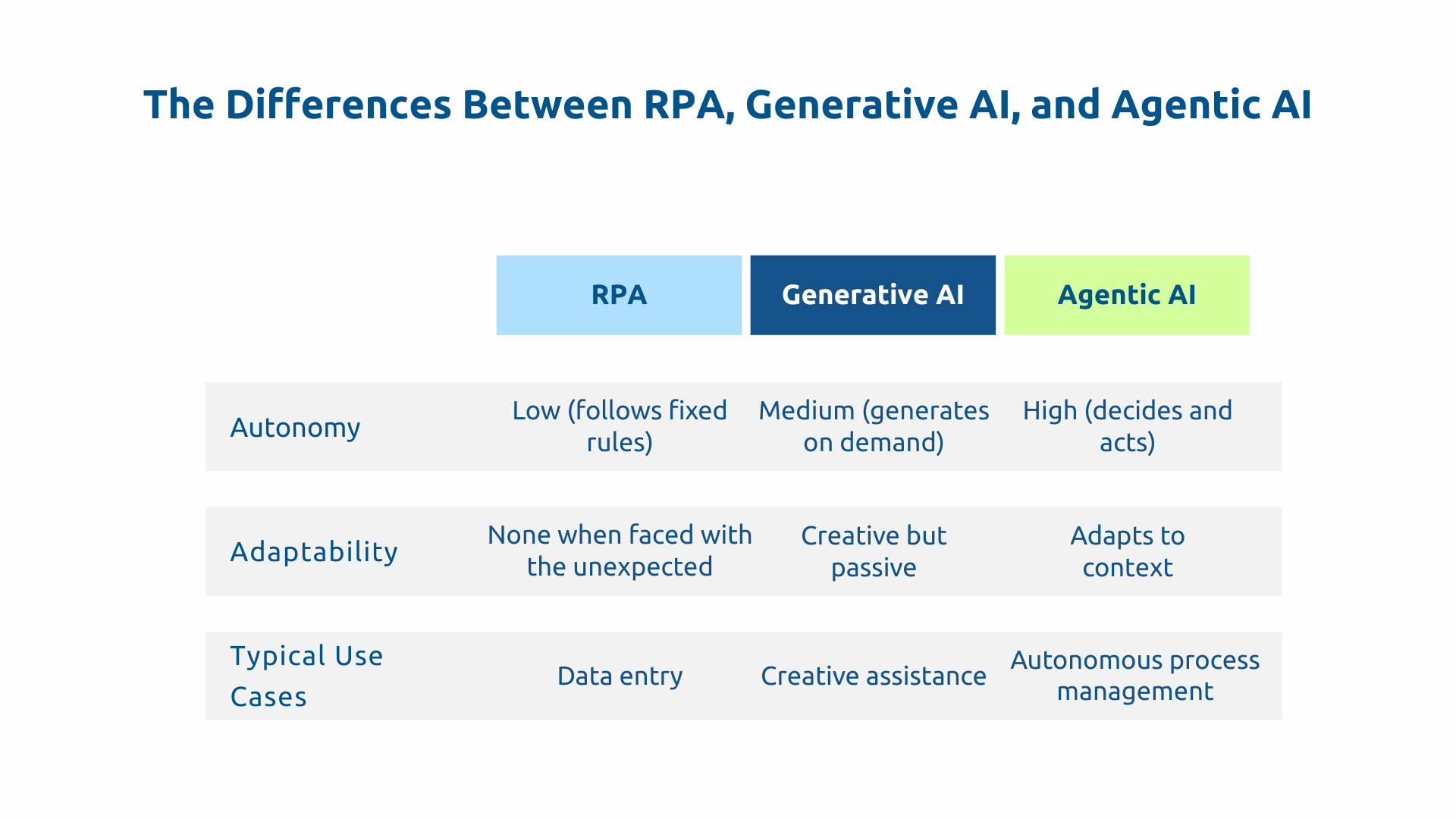
Confusion is common, as these three technologies all belong to the artificial intelligence family. But their roles are fundamentally different.
Generative AI (like ChatGPT or Copilot) excels in creating content: text, code, images. It generates, it produces, it assists humans in their creativity. But it does not act independently in your business systems.
RPA (Robotic Process Automation) automate repetitive tasks by following strict rules. They are excellent for entering data or copying information between systems. But when faced with an unexpected situation, an RPA stops or fails.
Agentic AI combines the best of both worlds and goes even further. It can generate content when necessary, automate processes like RPA, but above all it understands the context, makes complex decisions and, as we said, adapts to new situations.
This evolution is not the result of chance. We went from simple RPAs to intelligent workflows and then language models (LLM) brought the ability to reason. Today, integration with Azure AI and Copilot Studio makes it possible to create truly autonomous agents.
We are witnessing a major turning point because with this new technology, AI is going from assistance for operational autonomy.
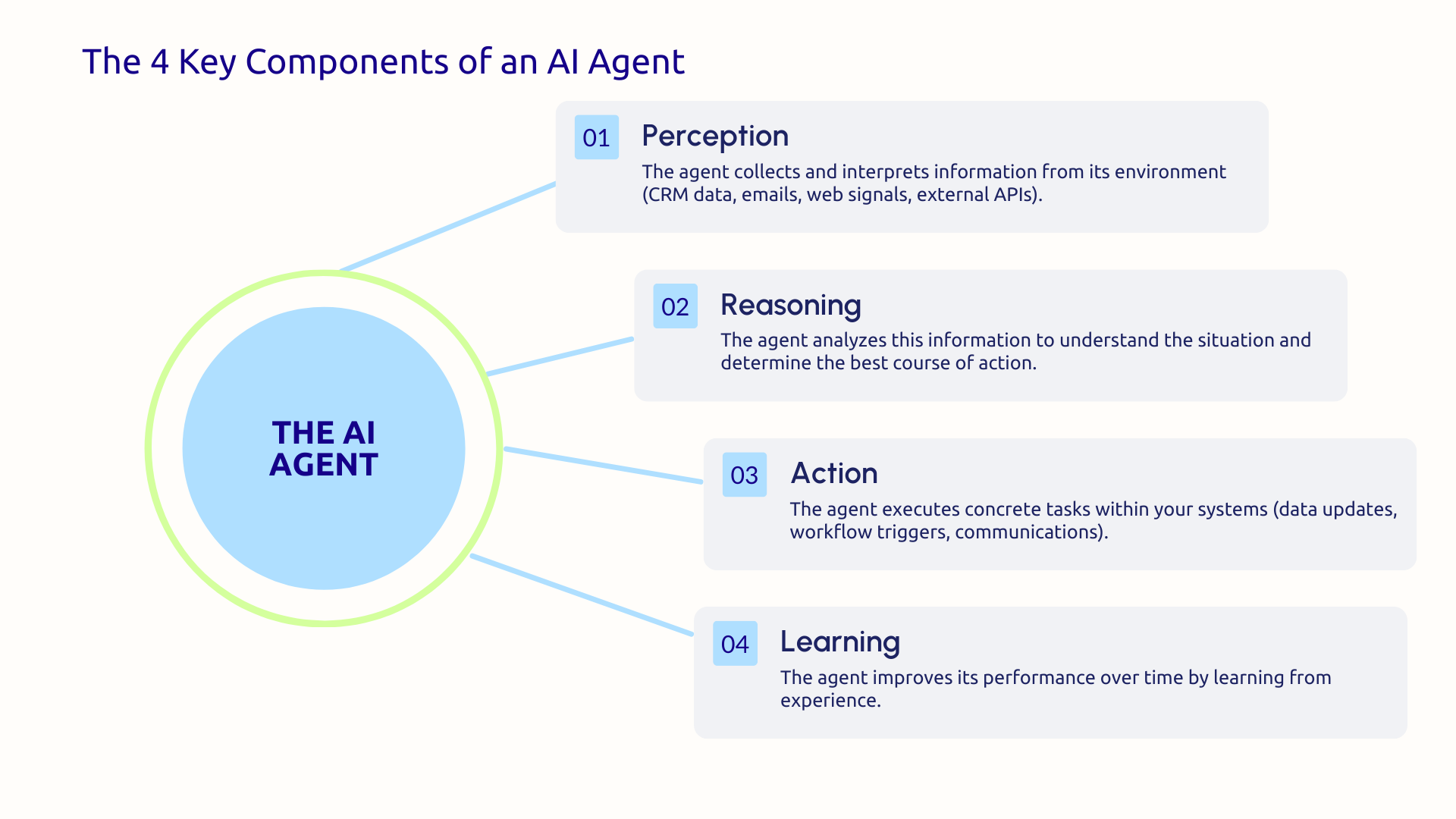
Let's start with the perception module, which is the agent's eyes and ears. It constantly collects information via APIs, connectors to your business applications, sensors or data flows. In a Dynamics 365 context, this module monitors new leads, customer interactions, changes in the sales pipeline.
To continue the analogy with a living organism, the engine for reasoning and decision making is the agent's brain. It relies on language models (LLM) and specialized algorithms to analyze the data collected, understand the context, assess possible options, and choose the best action.
Then comes the action module which relies on decisions to carry out actions. Concretely, it executes tasks in your systems: updating databases, triggering Power Automate workflows, sending communications, calling external APIs.
Finally, the memory and lifelong learning allow the agent to capitalize on his experiences. It records the actions taken, the results obtained and adjusts its future strategies accordingly.
This architecture creates a standalone loop perception/decision-action that runs constantly, allowing the agent to react in real time to changes in his environment.
Language models (LLM) like GPT-4 revolutionized agentic AI by giving agents the ability to truly “understand” and “reason.”
Thanks to natural language processing, an agent can interpret complex contexts, extract the meaning of unstructured documents, or even decipher the intent behind a customer request. He is no longer limited to keywords, he understands meaning.
LLMs work through step-by-step reasoning (chain-of-thought reasoning). Faced with a problem, the agent breaks the challenge down into sub-steps, assesses dependencies, anticipates obstacles, and builds a action plan consistent. Additionally, these models can be enriched with business knowledge specific to your organization.
That said, it is by multi-agent orchestration that LLMs reveal their full potential. Rather than a single generalist agent trying to do everything, we have an ecosystem of specialized agents collaborating intelligently. For example, a marketing agent who generates and qualifies leads, a sales agent who prioritizes opportunities, a financial agent who anticipates revenue forecasts. Everyone excels in their field and exchanges information with others to create a fluid value chain, in a way similar to a successful human team.
With a traditional RPA, you need to anticipate and program each possible scenario. Agentic AI, on the other hand, automatically manages complex workflows with contextual decision-making. She assesses the situation, consults the business rules and chooses the appropriate action even in the face of a case that has never been encountered.
The intelligent exception handling is one of its major assets. Instead of blocking the process, the agent analyzes the anomaly, assesses its criticality, and decides whether he can solve it alone or if he should escalate to a human. Even better, the agent adapts to changes in business context without requiring complete reprogramming.
In the automated management of customer orders, an agent constantly monitors incoming orders, detects anomalies, adjusts priorities according to stock and deadlines and can even automatically consult alternative suppliers to compare prices and deadlines in the event of a shortage.
What was a rigid process is becoming a adaptive and intelligent system that maintains operational fluidity even in complex situations.
In the field of CRM, the automatic lead qualification goes far beyond simple scoring:
On the side of Data intelligence, the agent explores your data independently, identifies invisible patterns, and alerts you to actionable insights. The automatic generation of adaptive reports means that each user receives the information that is relevant to their role. Scenario simulation is becoming accessible to all decision makers and the continuous monitoring of KPIs ensures that you are aware of the situations that really deserve your attention.
Thus, an agent connected to Power BI and Azure Synapse can detect a drop in performance, analyze the root causes by crossing several sources and propose corrective actions with impact simulation. Agentic AI thus transforms data into actionable insights without human intervention.
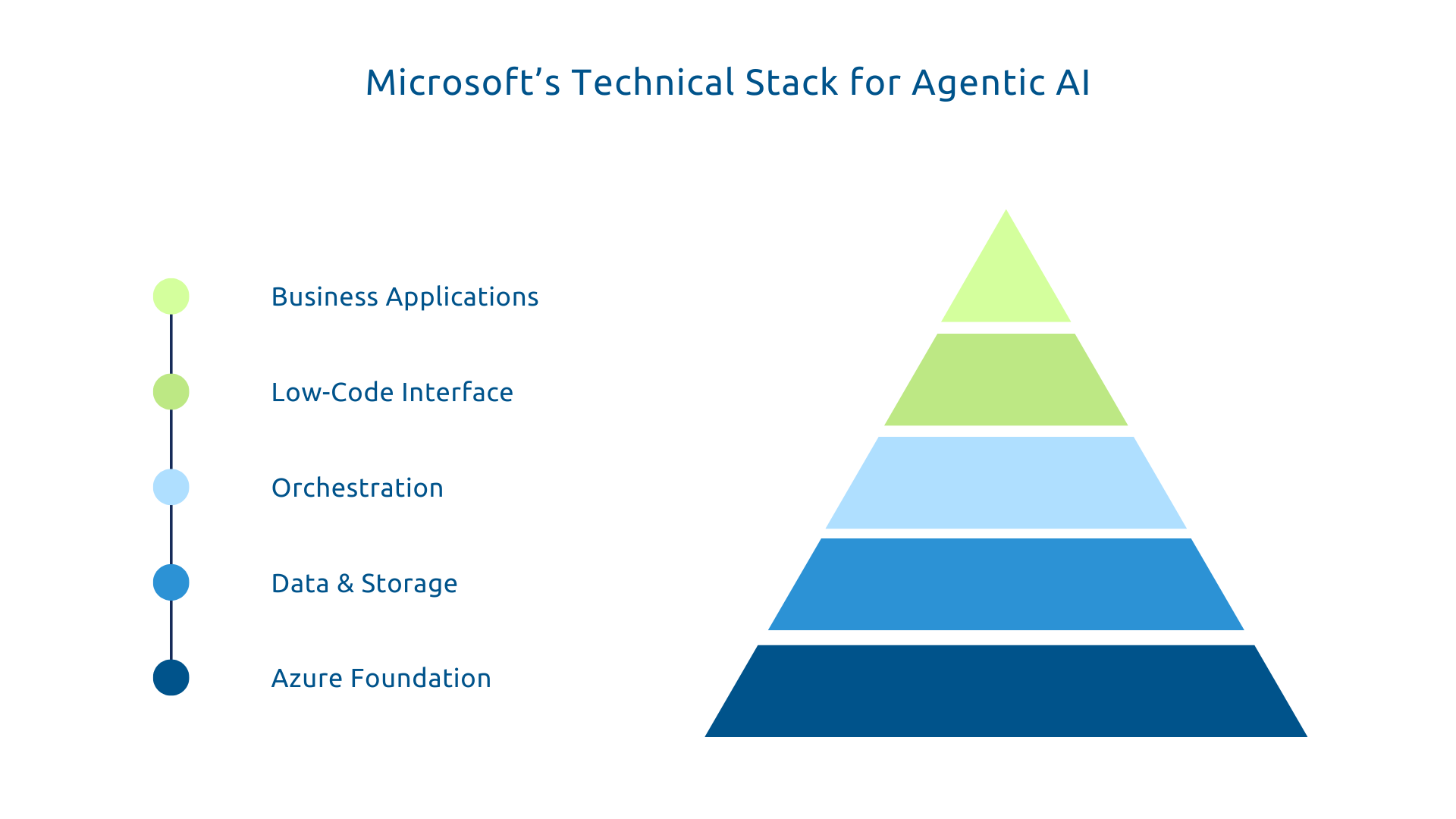
The Azure ecosystem offers all the technological building blocks needed to build enterprise-grade AI agents:
This platform is complete and secure, designed to meet the requirements of business environments: RGPD compliance, ISO 27001 and SOC 2 certifications, high availability and complete traceability.
With Microsoft, AI is no longer the preserve of data scientists. Indeed, with Power Platform and Copilot Studio, the creation of agents becomes accessible to business teams via low-code/no-code approaches.
More specifically, Copilot Studio allows you to create sophisticated chatbots with little or no code. You define what the agent should be familiar with, what actions they can perform, and what systems they interact with through an intuitive graphical interface.
At the same time, Power Automate with AI Builder enriches your automation workflows with AI capabilities:
In addition, the native integration with Dynamics 365 and Microsoft 365 (Teams, SharePoint, Outlook) eliminates technical barriers, while centralized governance and security ensure consistency and compliance.
For example, an HR support agent created in Copilot Studio can answer leave and policy questions, consult the SharePoint knowledge base, and automatically trigger approval workflows via Power Automate connected to Dataverse.
Microsoft Democratize artificial intelligence by making it accessible to business teams.
Native connectors to Dynamics 365 Sales, Customer Service, Finance, and Supply Chain Management allow your agents to access business data in real time. With this access, you get a automatic enrichment of your repository: the agent completes the incomplete forms, fixes the inconsistencies, and enriches with external data.
Beyond one-time enrichment,End-to-end orchestration allows you to manage the entire complex process that crosses several systems, from the detection of an opportunity to the generation of the contract. All while maintaining the governance and security inherited from Dynamics 365. Agents respect existing roles, permissions, and approval workflows.
In doing so, agentic AI does not replace your existing systems, it does Increase to reveal its full potential.
The impact of agentic AI on productivity is measurable and meaningful. The reduction of repetitive manual tasks frees up considerable time, the acceleration of decision cycles eliminates analysis delays, and 24/7 availability creates operational continuity that is impossible with human teams.
Thanks to all this, your teams are in a position to focus on What only humans know how to do : creativity, empathy, negotiation and strategy.
In addition, agentic AI fundamentally improves quality and consistency:
In the processing of invoices, for example, an AI agent ensures a very high level of compliance with tax rules and automatically detects anomalies.
When the volume of leads is multiplied by five, The agents absorb the increase in volume within the limits of your cloud infrastructure, without the need for recruitment. What's more, as soon as you adjust the parameters, the change is effective across all of your operations. At the same time, the accelerated deployment of new processes drastically shortens your time to market, while the reduction of marginal growth costs radically changes your ability to scale.
This operational elasticity becomes a strategic differentiator in markets where the ability to seize opportunities quickly makes the difference.
Governance and ethics require clear frameworks:
Indeed, transparency and explainability are crucial to maintaining trust.
Supervisory mechanisms ensure that a human stays in the loop for critical situations. A validation system by thresholds works well: automatic low impact decisions, high impact with human validation.
On the map security and compliance, access management must be rigorous with the principle of least privilege. The encryption of sensitive data is non-negotiable, GDPR compliance must be integrated by design and the prevention of bias requires constant vigilance.
In the Microsoft ecosystem, the architecture is based on solid foundations: managed identities, Azure Key Vault, comprehensive audit trail and Conditional Access policies via Microsoft Entra ID (formerly Azure Active Directory).
If humans don't adopt it, even the best technology will fail. In fact, you must be able to support teams by managing a spectrum of emotions ranging from distrust to enthusiasm.
In this respect, the training and skills development are critical to understanding how to collaborate with agents. Of course, with artificial AI, the redefinition of roles becomes inevitable but positive when it is well supported. Likewise, communicate transparently about the goals and benefits of this technology in order to allay fears. To be effective, a training program should include:
Success depends on human ownership and organizational alignment. Successful businesses are those that put people at the center, never those that focus entirely on technology.
Agentic AI marks a decisive turning point in the evolution of automation and business intelligence. We're talking about systems that understand, reason, and act independently to achieve your business goals.
Success is based on three pillars: the right technology (the Microsoft ecosystem), the right strategy (business/technical alignment) and The right partner combining technical expertise and business understanding.
Are you wondering about the relevance of agentic AI for your organization? Let's talk about your AI roadmap. Askware helps you identify high-impact use cases and build an implementation strategy aligned with your business challenges.
No, agentic AI is transforming roles rather than removing them. It takes on repetitive tasks to free up your employees and allow them to focus on what requires human judgment, creativity, and empathy. Your salespeople spend less time qualifying leads and more time building relationships. The value moves to the top of the string.
The key lies in rigorous governance by design. You define areas of autonomy with levels of validation: low-risk actions are automated, while strategic or high-impact decisions require human approval. Each action is traced and auditable. Agents are tested extensively before deployment, and their behavior is monitored continuously to detect drifts.
Copilot Studio targets business teams who want to quickly create chatbots with little or no code, perfect for standard use cases such as customer support. Azure AI is for developers who build custom agents with specific needs or complex integrations. The two approaches are complementary depending on the use case.
Our experts share their vision of best practices and technological trends to ensure the success of your digital transformation.