Data visualization: how to transform complexity into clarity?
Discover the principles of effective data visualization. Askware guides you with Power BI to turn your data into informed decisions.

The symptoms are familiar to most CIOs. Conflicting customer information between the CRM and the accounting department. Reports that take days to produce because the data must first be cleaned and reconciled. AI or analytics projects that fail due to a lack of reliable data. And still this anxiety: are you really in compliance with the RGPD? Do you know where all of your personal data is?
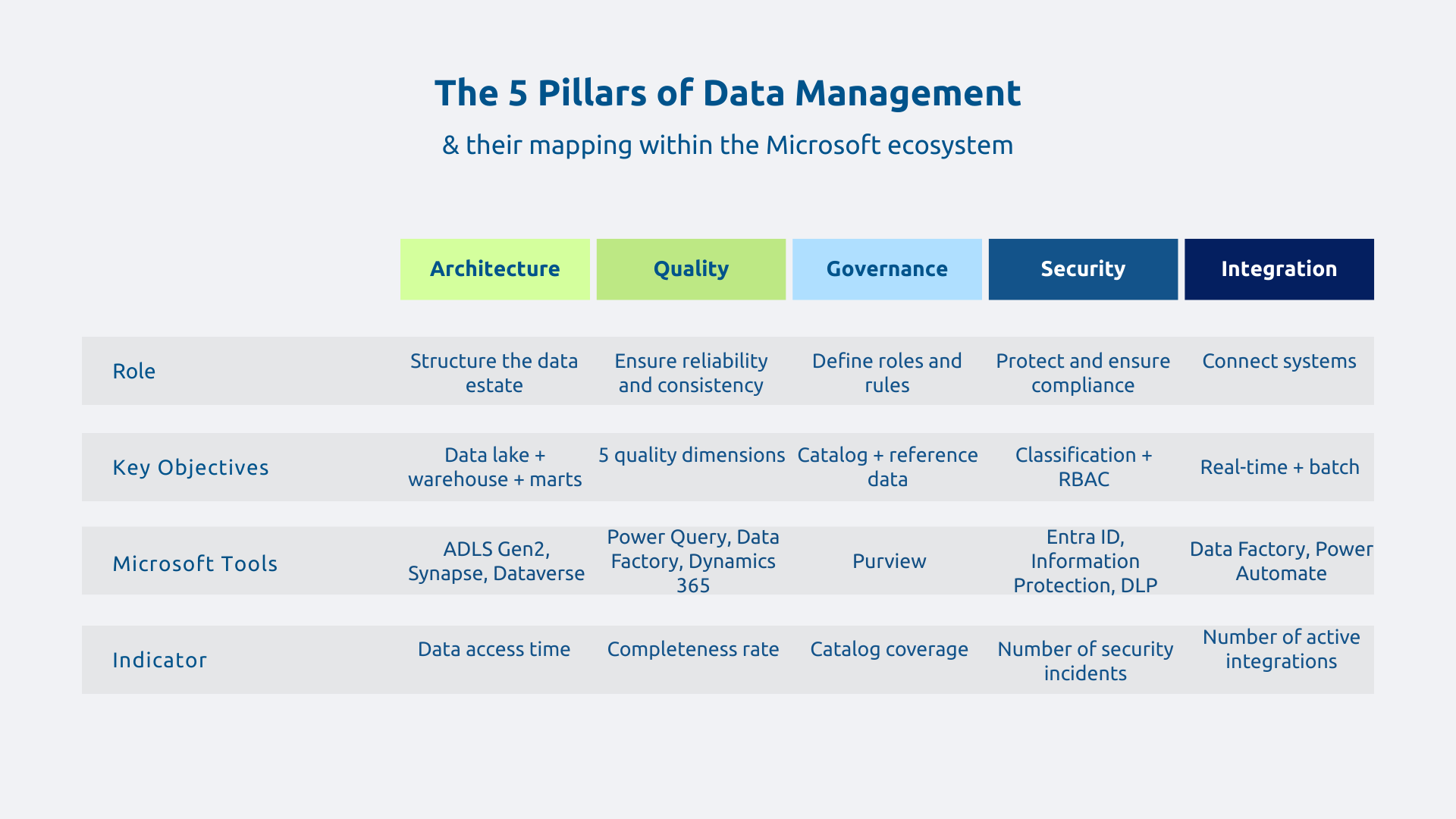
This article shows you how to turn this chaos into a controlled system. We are going to explore the fundamentals of the Data-driven model and therefore of Data management, its 5 essential pillars, and how the Microsoft ecosystem — from Purview to Azure to Dataverse — gives you the tools to build a real data management strategy.

The Data management, or data management, refers to the set of practices, processes, and technologies that make it possible to manage your data over its entire life cycle. From creation to archiving, including storage, use and possibly deletion.
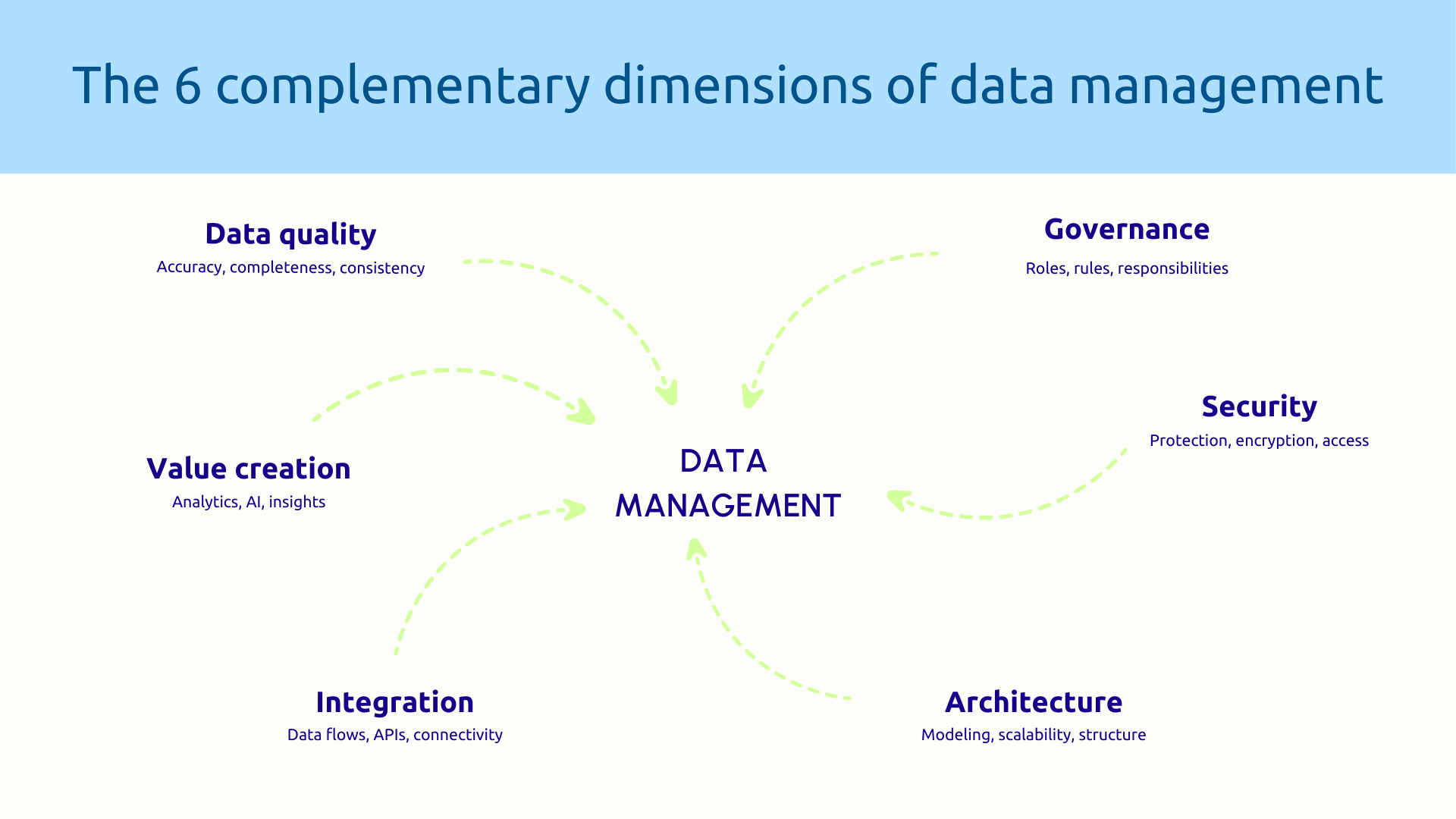
Contrary to what you might think, data management is not just about databases and storage. It is a global discipline which encompasses several complementary dimensions:
It is important to distinguish data management from related but different disciplines. Data governance is a subset of data management that focuses specifically on rules, roles, and responsibilities. The Data analytics, on the other hand, uses data to extract insights, but presupposes that data management is already in place.
On the map of regulatory compliance and data security, the stakes are considerable. The GDPR imposes strict obligations on the protection of personal data, with fines of up to 4% of global turnover.
In addition, the quality of your decisions and operational efficiency depend directly on data quality. Your strategic decisions are only worth what the information behind them is worth. Inaccurate or inconsistent data leads to erroneous decisions, with potentially serious consequences: misallocation of resources, missed opportunities, unidentified risks. A safety-by-design approach is essential from the design stage.
Finally, the valorization of data becomes impossible. Do you want to use generative AI? It needs quality, well-structured, and accessible data. Do you want to develop advanced analytics? Same problem. Without solid data foundations, these ambitious projects fail before they even start.
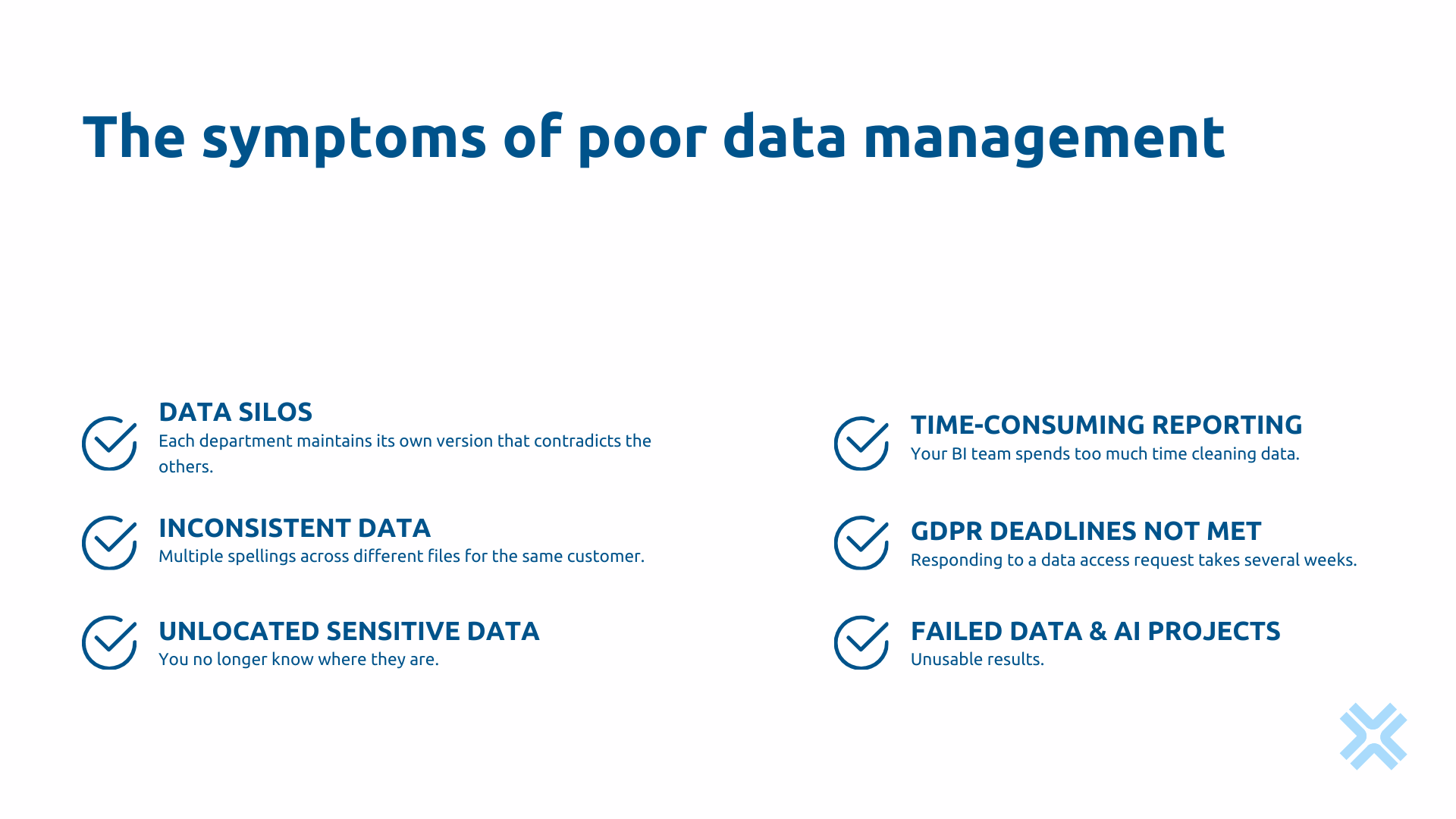
How do you know if your organization is suffering from faulty data management? Some symptoms are not deceiving:
If you recognize several of these symptoms, your data management requires a strategic overhaul.
A modern data architecture combines Data Lake (raw data), Data warehouse (structured data for analysis) and Data Marts (specific business views).
In the Microsoft ecosystem:
Modelling structure your data logically (star diagrams, slowly changing dimensions). Metadata document the meaning, origin, responsibility and business rules of each data.
Quality is measured in five dimensions, namely: accuracy, completeness, coherence, timeliness, uniqueness.
In the Microsoft ecosystem:
Data Stewards are responsible for quality in their respective fields. Without this sharing of responsibilities, quality remains an intention without realization.
Governance defines the key roles:
Note that Microsoft Purview offers an automated data catalog that discovers data, classifies it, and makes its lineage visible across the Microsoft ecosystem.
Concerning the management of repositories (master data management), it guarantees a single version for critical data: a unified customer repository in your CRM, product, validated supplier.
Finally, the governance committee meets regularly to define priorities, mediate conflicts and validate developments.
Depending on whether it is public, internal, confidential or sensitive, data requires different protections.
In the Microsoft ecosystem, with a Zero Trust strategy:
Audit Trail Tracks all critical events to investigate incidents and demonstrate compliance.
Integration turns silos into connected ecosystems through integration Real time (APIs, webhooks) or Batch (regular lots).
In the Microsoft ecosystem:
Error management is crucial: retry mechanisms, message queues, detailed logs, automatic alerts.
The audit often reveals surprises: personal data where they were not expected, unsuspected silos, volumes much higher than estimated.
To begin with, Inventory all sources where your data resides: SaaS applications, databases, databases, files, Azure services, and legacy systems. Once this inventory is established, map the flows to understand how data flows between systems, revealing bottlenecks and risky manual processes.
At the same time, Evaluate the quality by objectively measuring the current state: completeness rate, percentage of duplicates, coherence between systems. These metrics serve as a baseline for measuring progress. For EDM compliance, identify all sensitive data: personal data, confidential information, business secrets. Microsoft Purview accelerates this work considerably with its automated discovery.
On this basis, analyze the risks to determine what data would seriously disrupt business if lost or be subject to sanctions if leaked. Finally, measure your maturity via the DAMA-DMBOK framework or the Data Governance Maturity Model Microsoft, identifying your strengths and weaknesses by area.
Based on the findings of the audit, define your strategy now. This must imperatively be supported jointly by IT and businesses, otherwise it will remain a dead letter.
Start with Define your business goals : improve customer knowledge, reduce costs, speed up decision-making, comply with the GDPR, prepare for AI. These goals guide all of your priorities.
From there, develop your governance framework by defining roles (data owners, data stewards), access policies, decision-making processes, and committee frequency.
On the technical side, choose your target architecture : data lake on Azure Data Lake Storage, data warehouse in Synapse Analytics, Dataverse for low-code applications, Purview for governance. To ensure consistency, define standards: quality thresholds, naming rules, formats, and metadata documentation.
Faced with the magnitude of the projects, prioritize via a value/effort matrix. Identify quick wins (high value, low effort) to be launched immediately and structuring projects (high value, high effort) to plan carefully.
To orchestrate the ensemble, plan a multi-year roadmap over 2-3 years with measurable quarterly milestones. This realistic planning prevents team exhaustion and demonstrates results gradually.
With a clear strategy, you start implementing. Build solid and scalable foundations to avoid costly redesigns.
Start with deploy your Azure architecture : provision Azure Data Lake Storage with appropriate folder structure (raw, processed, curated areas), create Azure Synapse Analytics scaled, configure network, firewalls, and encryption according to Azure Well-Architected Framework and his Data Workload Guide.
At the same time, set up Purview to establish governance: register sources, schedule automatic scans (daily for critical sources, weekly for others), define classification rules, and train data stewards. Once the infrastructure is in place, create integration pipelines via Azure Data Factory and Dataflows, with performance testing and error management.
In terms of security, implement essential protections : Set up Microsoft Entra ID with MFA, deploy RBAC across resources, enable encryption, install Azure Information Protection, set up DLP, and enable auditing.
For quality, automate surveillance : Dynamics 365 validation rules, Power BI dashboards, automated cleaning jobs.
Finally, migrate data in successive waves, starting with the least critical ones to validate the process before attacking sensitive data.
With the technology in place, you are now activating the human dimension. Governance is only effective if it is adopted.
Start with nominate and train your data owners and stewards who will operationally pilot governance. Train them in depth about their responsibilities, tools, and processes.
At the same time, deploy the Purview catalog to democratize access to metadata, accompanied by a communication campaign and hands-on sessions. To structure accesses, formalize application processes : justified request, data owner evaluation, automatic provisioning via Entra ID with expiration and complete traceability.
Beyond processes, spread data culture through training in best practices: quality, security, RGPD and cloud. Ensure visibility through a data governance charter, a regular newsletter and data champions in each department.
Finally, launch the governance committee, which meets monthly to manage the strategy: review of indicators, trade-offs and validation of changes.
The system is operational but the work continues. Data management is a marathon, not a sprint.
Set up monitoring via Power BI dashboards consolidating all critical indicators: quality, compliance, use, incidents. This comprehensive computational observability gives decision makers the strategic overview, from CIO to data stewards.
To maintain relevance, organize quarterly reviews that check the effectiveness of processes and adjust what needs to be checked. Gradually expand the scope: after customer data, attack product, financial, HR data in successive waves.
Faced with developments, integrate new capabilities to make the system evolve: generative AI, real time, new regulations. The system thus remains alive and in line.
Finally, control your Azure expenses via FinOps data: analyze costs regularly, migrate cold data to cheaper third parties, adjust sizing according to actual use, and remove obsolete data according to retention policies.
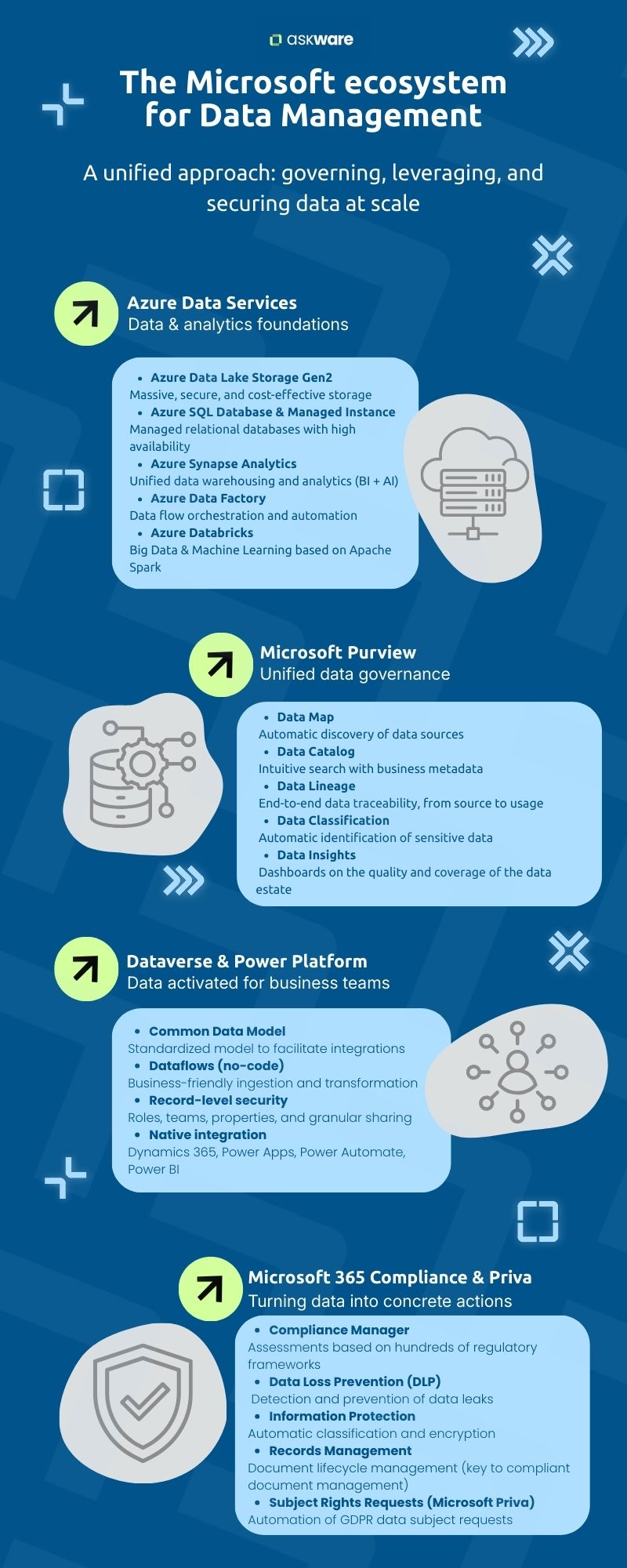
The Microsoft ecosystem offers a remarkably complete range of tools, but it is still necessary to know how to orchestrate them with a real strategy, deploy adopted governance, and maintain the effort over time.
Askware accompanies you to transform data chaos into a controlled strategic asset. Our expertise combines the advanced technical mastery of the Microsoft ecosystem and a deep understanding of business and regulatory issues. We don't just deploy tools, we design and implement strategies that create value.
Do you want to structure your data management? Request your audit to identify your vulnerabilities and establish your upgrade roadmap.
Data management is the global discipline that covers the entire data life cycle: architecture, storage, quality, integration, security, compliance and valuation. Data governance is a subset that focuses on rules, roles, and responsibilities. In short, governance defines “who decides what about data”, while data management also includes “how we store, transform, protect, and use this data.” The two are complementary and inseparable.
Data quality is being built gradually, there is no need to do everything all over again at once. Start by identifying your business-critical data and focus on it first. Implement input controls in your core applications to prevent new errors. Use Power Query and Dataflows to clean up existing data as it is integrated. Also, name data stewards who are responsible for each area.
Microsoft provides great tools to facilitate GDPR compliance: Purview to map personal data, Compliance Center to automate rights requests, Information Protection to protect sensitive data. But tools are not enough. GDPR compliance also requires organizational processes, appropriate documentation, training, and active governance. Microsoft tools automate technical aspects and drastically reduce workload, but compliance remains your responsibility and requires appropriate support.
Our experts share their vision of best practices and technological trends to ensure the success of your digital transformation.