What is a digital audit and why is it essential?
Definition: digital audit as a strategic overview
A digital audit of a company is a complete evaluation of its IS (information system) that looks at infrastructure, applications, data, business processes, and skills.
Its objective? Understand the real state of your IS, identify risks and Technical debt through the audit, assess your digital maturity, and prioritize transformation actions by aligning IT and business.
The audit is not a simple technical inventory, a bureaucratic obligation or a waste of time. It is a strategic investment that allows you to operate safely, such as medical diagnosis before surgery. Digital auditing is the foundation for a successful digital transformation by creating a common language between your technical and business teams.
The risks of transformation without prior audit
Failure scenarios are common in organizations that skip this critical step:
- The trap of hidden dependencies : a company migrates an application to the cloud and discovers interdependencies with fifteen other systems that have never been documented. In addition to blocking the project, it doubles the deadline and multiplies the budget.
- The nightmare of corrupt data : an organization invests in a new ERP. When it comes time to migrate data, it's a disaster: massive duplicates, empty fields, inconsistencies everywhere. Months of manual cleaning before you even start.
- The invisible technical debt : a modernization project starts with optimistic estimates. Undocumented legacy code, obsolete dependencies, and configurations that are impossible to migrate are gradually appearing. The “simple migration” becomes a complete overhaul.
According to the Standish Group, 47% of ERP implementations exceed their initial budget by an average of 35%. These slip-ups would have been avoided by a prior audit. An audit lasting a few weeks saves months of problems and hundreds of thousands of euros.
The concrete benefits of a well-conducted audit
The digital audit generates a measurable return on investment:
- Visibility and lucidity : you know the real state of your IS, identify risk areas and map critical dependencies.
- Informed prioritization : the audit reveals quick wins (actions with high impact and low effort) and makes it possible to prioritize projects according to their real business value. You build a digital roadmap based on facts, not on hunches.
- Controlled budgets : you get realistic estimates without unpleasant surprises. An audit represents 3 to 5% of the budget of a transformation project, but avoids 30 to 50% of slip-ups.
- IT-Business alignment : the audit creates a common language. Priorities become shared, commitment is strengthened.
- Risk reduction : you anticipate obstacles, identify alternative solutions and secure your investment.
Signals that an audit is needed
Your organization needs an audit if you check three or more boxes:
- Your IS is more than five years old without a major overhaul
- You are planning a major transformation (cloud, ERP/CRM, merger)
- You have recurring problems with performance, security or availability
- You don't know exactly what applications you're using or how they interconnect.
- Your IT costs are increasing without a clear explanation
- You have experienced the failures of recent IT projects
- Do you have regular complaints from business teams about tools?
- You have regulatory pressure (RGPD, ISO) without certainty of compliance
- You need a structured digital transformation plan
- You suspect technical debt but don't know how to quantify it
Auditing is not just for big organizations. It is a tool of strategic management accessible to all companies that want to transform their IS intelligently.
.png)
The key dimensions of a comprehensive digital audit
Infrastructure and technical architecture
The audit assesses your infrastructure : status of the servers (physical, virtual, Cloud), network performance, storage capacity, backup quality.
The application architecture is the subject of a complete mapping: how many applications? How do they communicate? What technologies ? What are the risks of obsolescence?
The key questions are being answered: how much technical debt have you accumulated? Can your architecture evolve? What dependencies could block a future project? The deliverable includes technical mapping and the identification of risk areas.
Data: quality, governance, and compliance
Your data is often the weakest link. La data quality is evaluated: completeness, accuracy, consistency, freshness.
Governance is analyzed: where is your data stored? Who is responsible for it? How are they secured and backed up?
During the audit, the regulatory compliance is scrutinized: RGPD, other sectoral regulations, traceability of access.
According to the McKinsey Global Institute, Poor data quality leads to a drop of up to 20% in productivity and a 30% increase in operational costs. The audit reveals whether your data is usable for a migration to Dynamics 365 Business Central and how much cleaning effort will be required.
Business processes and organizational maturity
This dimension determines the success of your transformation.
Audit assesses your business processes : their documentation, standardization, efficiency and the level of digitalization.
Digital maturity is the subject of a structured assessment: your company's digital culture, appetite for change, team skills, history of transformation projects.
User adoption is a key audit indicator for understanding how your current tools are being adopted? What are the resistances to change? McKinsey has shown that Businesses that implement effective change management programs achieve 143% of expected ROI. A successful IS on paper will fail if the organization is not ready. The audit makes it possible to assess this preparation.
Security and risk management
The security audit identifies your vulnerabilities : firewall, antivirus, updates, access management, backup quality.
Application security is analyzed to identify known vulnerabilities, ensure multi-factor authentication and data encryption.
Risk management is evaluated: do you have tested continuity plans (PCA) and business recovery plans (PRA)? Is there a security policy applied? With modern architectures based on Azure Active Directory, centralized identity management is becoming critical.
.png)
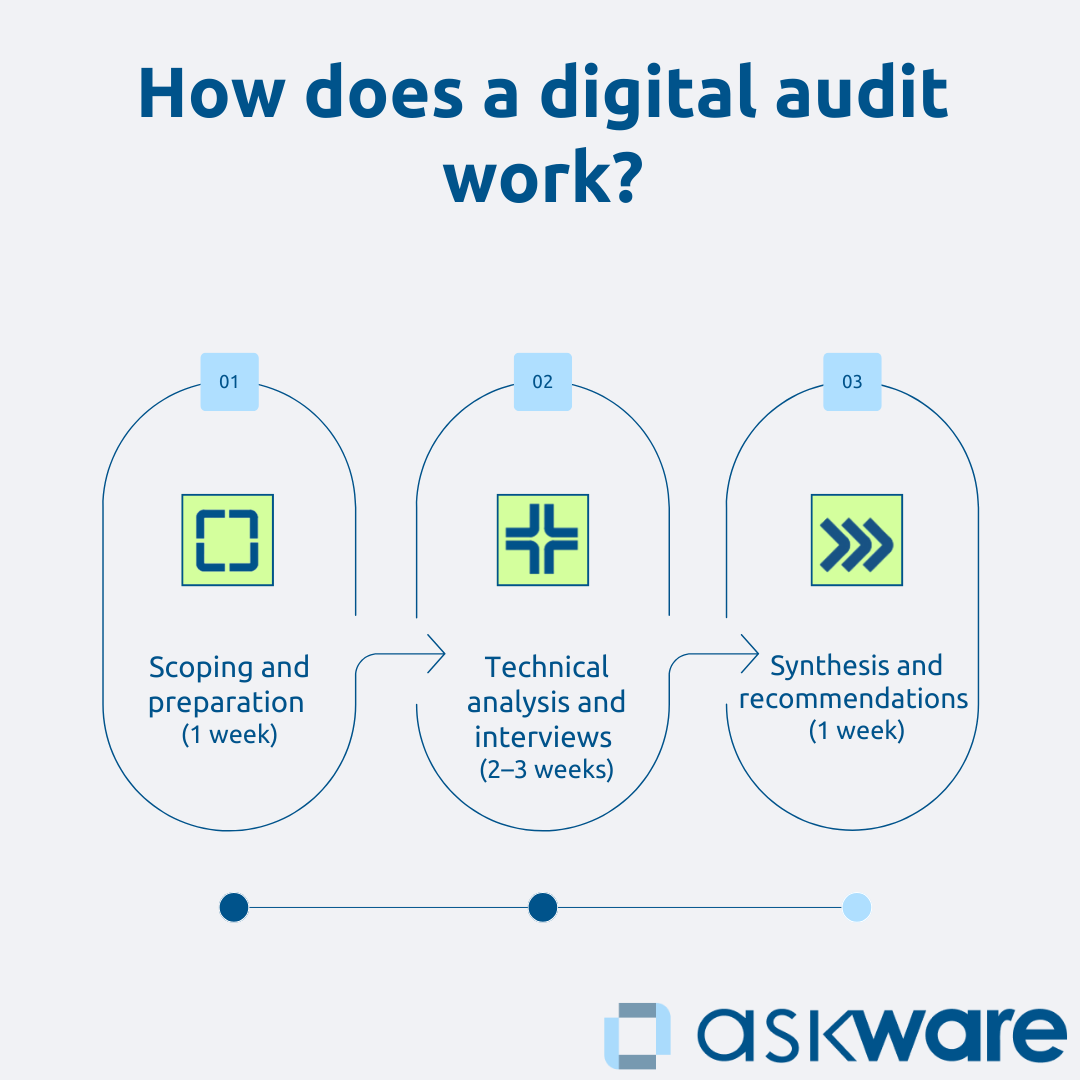
How does a digital audit take place?
Phase 1: Framing and preparation (1 week)
The first phase of the audit aims to understand your context and precisely define its perimeter. Are you going to audit the entire IS or focus on certain critical parts?
This phase identifies key stakeholders and plans all interviews and analyses.
Scoping milestones include a kick-off meeting with your management and CIO, collecting any existing documentation (network diagrams, application inventory, supplier contracts), and clearly defining audit objectives (what questions need to be answered?) and the establishment of a detailed schedule.
The framework results in a structured audit plan, an initial IS mapping and the list of stakeholders to be interviewed after about a week. A good framework ensures that the audit will answer the right strategic questions.
Phase 2: Technical analysis and interviews (2-3 weeks)
This is the core of auditing, where in-depth technical analysis and understanding of business issues are combined.
Technical analysis examine:
- The infrastructure: complete inventory, performance tests, security audit,
- Applications: detailed mapping, identification of the technologies used, evaluation of the quality of the relevant code,
- Data: evaluation of their quality and governance,
- Security tests: vulnerability scans.
In parallel, a series of interviews is conducted with your teams. The IT department and the IT team provide the technical vision. Business departments share their needs, their frustrations and their priorities. Key users describe how the tools are actually used on a daily basis. The financial department clarifies budgets and economic constraints.
These interviews pursue several strategic objectives: to understand the real business challenges beyond technical aspects, to identify the pain points of end users, to assess digital maturity and the culture of the organization and to align priorities between IT and businesses.
IT infrastructure audit tools, recognized digital maturity frameworks and structured assessment grids are used. Depending on the size of your IS, this stage lasts between 2 and 3 weeks on average.
This approach combining technique and business is the strength of the Askware methodology: we do not just audit your servers, we understand how your IS supports or hampers your digital strategy.
Phase 3: Summary and recommendations (1 week)
The final phase consolidates all the data collected to produce a clear and actionable vision. The analysis identifies your strengths, weaknesses, opportunities and threats (SWOT), assesses your level of digital maturity with a scoring and prioritizes actions according to an impact/effort matrix.
Recommendations are structured in several levels:
- Quick wins: quick actions with a high impact,
- Structuring projects: major transformations required,
- One detailed roadmap : short, medium and long term,
- Budget estimates in orders of magnitude.
The full audit report (typically 50 to 100 pages) includes an executive summary for your management, a detailed inventory of the situation, complete IS mapping, risk analysis, a maturity matrix, prioritized recommendations and the proposed roadmap. A summary feedback presentation is prepared for your executive committee.
Restitution takes the form of a presentation of conclusions and recommendations, of exchanges to collectively prioritize and validate the roadmap. The deliverable is not just a digital diagnosis, it is a real action plan that you can implement immediately.
Choosing the right partner for your digital audit
Not all audits are created equal. Five criteria are used to assess the quality of a service provider:
- A business-oriented approach, not only technical. The audit must understand your business challenges, include interviews with your business departments (not only IT) and produce recommendations aligned with your business strategy.
- A structured and proven methodology, based on recognized maturity frameworks, a documented audit process and verifiable customer references with concrete feedback.
- Technical AND functional expertise : consultants must master both technical aspects and business challenges, know the Microsoft ecosystem if it is your environment (Dynamics 365, Power Platform, Azure) and have relevant sectoral experience.
- Actionable deliverables : a clear and synthetic report, a prioritized and quantified roadmap, not only a diagnosis but a real operational action plan.
- Independence : the audit must be objective, not oriented towards the sale of a predefined solution. The recommendations should serve your interests, not those of the seller.
Digital auditing makes a risky transformation into a controlled project. In a few weeks, it reveals the real state of your information system, identifies hidden risks, assesses your organizational maturity, and builds a roadmap that aligns IT and business. Organizations that invest in an audit before transforming save 30 to 50% from slip-ups and increase their chances of success.
At Askware, we carry out business-oriented digital audits that go beyond technical diagnostics. We understand your business challenges, audit your IT ecosystem, and build actionable roadmaps. Our approach combines the strategic vision of the consulting firm and the technical expertise of the Microsoft integrator.
The question is no longer “should an audit be done?” but “when are we going to start?” Your next transformation deserves a solid start.
Ready to assess the maturity of your information system? Contact our experts to discuss your transformation challenges.