Technical audit vs business-oriented audit: two approaches, two results
The classic technical audit: infrastructure and code focus
Traditional technical audit systematically analyze your IT infrastructure (servers, network, performance), your code (quality, complexity, vulnerabilities), your architecture (patterns, coupling) and your security flaws.
It results in a detailed technical report, code metrics, a list of vulnerabilities, and quantified recommendations: you know exactly how many man-days would be needed to “pay off” your debt.
This makes it possible to have an objective technical diagnosis, to detect architectural problems, to identify “hot spots” (complex and frequently modified areas).
But its limits are real. In a technical vs business audit, the language remains airtight for non-IT people. No business translations : you know that there is debt but not its impact on your sales? On your time-to-market? The recommendations lack a clear prioritization.
For example, the technical application audit tells you “Your commercial application has 15,000 lines of duplicated code, debt estimated at 180 man-days.” But is it a priority? Is this application critical? What is the real ROI of its modernization?
Business-oriented auditing: understanding the business impact of technical debt
Business-oriented auditing starts from a simple observation: technology is only valuable if it serves the business. Our approach at Askware adds that business layer to the technical side.
The IT audit methodology starts with business immersion. Before even touching the code, we conduct interviews with your departments (sales, marketing, finance, operations), your key users, your general management. We map your business processes to understand which systems support which critical activities.
By identifying priority business goals, it is possible to reveal the business criticality of each application and quantify the real impact: time and/or money lost daily due to systems, delayed projects, revenue not captured.
The intersection of visions becomes powerful:
- Application A: strong technical debt + critical for sales = top priority.
- Application B: high debt + little used = low priority.
- Application C: moderate debt + blocks innovation = to be investigated.
Why a business-oriented approach makes all the difference
Where a technical audit could be similar to a medical diagnosis, a business-oriented audit adds a personalized treatment plan that would take into account your life and your priorities.
Business-oriented auditing adds a common language. The report becomes accessible to your general management, your business departments and your CIO. Everyone understands the issues, facilitating alignment and decisions.
Prioritization is informed. You focus your resources on what matters to the business. The ROI is clear and waste is avoided.
The commitment of the professions is strengthened. When managers understand why their CRM needs to be modernized and the concrete impact, they support investments. Change management becomes fluid.
The IT strategy is coherent. Your roadmap is in line with your business strategy. You avoid projects that are disconnected from the business.
Without a business approach, the challenges are not necessarily understood: “You have to refactor application A, cost €100K.” Budget refused. With a business approach: “Application A slows down your sales by 3 months. Refactoring it costs €100K but will speed up your launches by 40%, i.e. €500K in sales over 12 months and an ROI of 6 months.” Budget validated immediately.
.png)
How business-oriented auditing reveals invisible technical debt
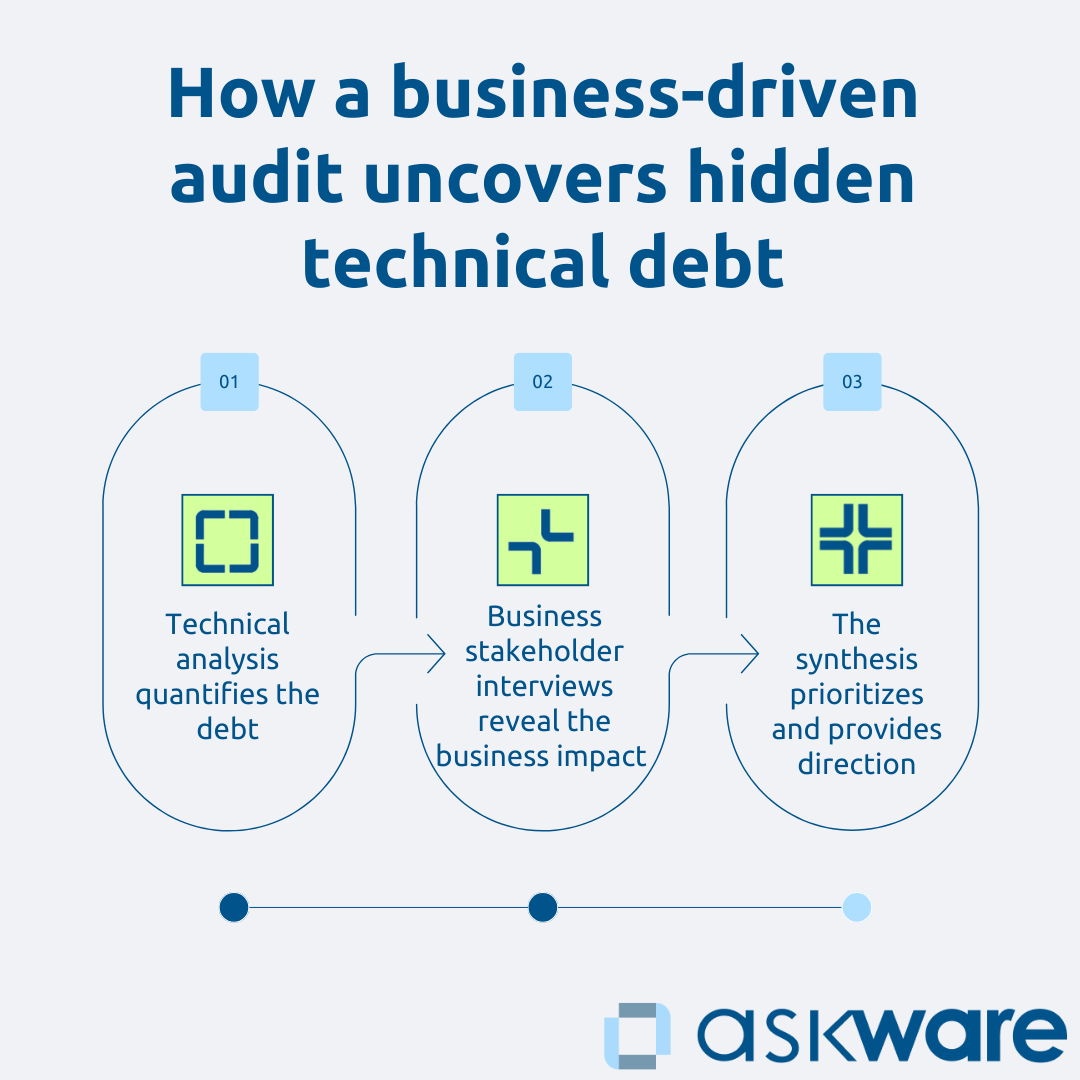
Step 1: Technical analysis that quantifies debt
The technical phase remains the foundation and several points are analyzed:
- The code : Using static analysis tools, complexity metrics are measured, duplications are identified, and test coverage is evaluated.
- The architecture : to understand the dependencies between components and coupling.
- The evaluation of obsolescence of the IT Identifies end-of-life technologies, unsupported versions, and outdated dependencies.
- Debt scoring Quantify the “reimbursement cost” in man-days per component or application.
- Risk areas : “hot spots” where complexity and frequent changes intersect, untested critical areas or even fragile dependencies.
This phase produces a precise IS mapping with objective scoring. This step is similar to a classic technical audit, it is the follow-up that makes the difference.
Step 2: Business interviews that reveal business impact
Here begins the differentiation of an IT audit. We systematically interview your business departments, key application users, project managers, general management.
We seek to understand your business goals, your daily frustrations, blocked projects, inaccessible business opportunities. This makes it possible to identify the business criticality of each application, the impact of technical debt on businesses, the opportunity cost and business priorities.
The crossing becomes powerful. For example, technical analysis reveals a high debt on the order system. Taken in isolation, this is one problem among others. Interviews reveal that this system wastes 2 hours a day for your 20 salespeople, prevents the launch of the B2B offer and generates billing errors. The impact is in the hundreds of thousands of euros per year. The priority is becoming obvious.
Step 3: The synthesis that prioritizes and guides
Synthesis transforms diagnosis into decisions. We are building a prioritization matrix with two axes: technical debt level (horizontal) and business impact (vertical).
Four strategic quadrants are emerging:
- Upper-right (high debt + high impact): top priority
- Upper-left (low debt + high impact): maintaining quality
- Lower right (high debt + low impact): deal with available resources or accept debt
- Lower left (low debt + low impact): no priority
Actions are scored according to the company's digital maturity, the overall level of technical debt and the critical areas identified.
We offer several scenarios in our IT audits:
- “Quick Wins” for quick actions,
- “Targeted modernization” on critical areas,
- “Complete transformation” following the IS audit to modern solutions such as Dynamics 365 and Power Platform.
Roadmap structure the actions: short term (0-6 months) for quick wins, medium term (6-18 months) for targeted modernization, long term (18-36 months) for structural transformation. Each phase is encrypted with ROI.
The final deliverable is a prioritized, quantified and actionable action plan.
How an IT audit prevents the accumulation of new technical debt
By aligning the IT roadmap with business priorities
IT-Business misalignment is a major source of future debt. Without understanding business challenges, IT develops without a global vision. The risk: create solutions that will never really be used (and therefore technical debt created unnecessarily).
The audit builds a shared understanding. Each IT project has a clear business rationale. You only invest in what creates real value. You are sizing the solutions correctly.
For example, the audit reveals a need for real-time reporting, not a complex data warehouse. It is then possible to build a solution Power BI simple and scalable without creating debt. Without this understanding, a project could have started on an oversized data warehouse, generating future debt.
By defining a coherent target architecture
The uncontrolled accumulation of heterogeneous solutions creates debt. The audit lays the foundations for a coherent target architecture : modularity, common standards, reuse of components, maintainable technologies.
Our Microsoft expertise makes it possible to define architectures with a Technical stack consistent: Dynamics 365 for business processes, Power Platform for automation, Azure for infrastructure, Microsoft 365 for collaboration. The integration is native, no custom developments that are sources of debt.
This architecture prevents uncontrolled accumulation. The new projects are part of a coherent ecosystem. Integrations remain simple.
By establishing standards and best practices
The absence of standards is the breeding ground for technical debt. When each developer does it their own way, debt naturally builds up.
The audit recommends development standards : code conventions, architectural patterns, systematic reviews, automated tests with coverage thresholds, standardized documentation, Architecture Decision Records.
We recommend integrating analytics tools into your CI/CD pipelines. Alerts on quality degradation. Monitoring dashboards. A quality culture where debt becomes a monitored metric.
These standards act like an immune system. They prevent the creation of new debt or detect it immediately. With the standards and the focus on quality, the IT governance is more effective.
.png)
Use case: the audit that revealed and avoided millions of technical debts
Context: an industrial ETI undergoing a modernization project
Let's take the concrete case of an industrial ETI of 500 people wishing to migrate their legacy ERP to Dynamics 365 Business Central.
The project was framed with a budget of 800K€ and a deadline of 12 months. No due diligence was initially planned.
The CIO, aware of the risks inherent in this type of project and having observed similar slip-ups in his sector, made a strategic decision: to have a business-oriented IT audit of the company carried out with Askware before launching the project. This decision radically transformed the approach and the results.
What the audit revealed: invisible technical debt
Technical analysis has revealed a reality that is much more complex than expected. The legacy ERP contained over 200 undocumented customizations, accumulated over the years without clear governance. These customizations had become “black boxes” that no one really knew.
The system was connected to 15 satellite applications through complex and fragile integrations. Critical business processes were “hard-coded” in the ERP, making any evolution extremely expensive. The quality of the data was very degraded: massive duplications, inconsistencies between systems, missing essential fields.
The overall technical debt was estimated at 400 man-days thanks to the audit, representing a potential remediation cost of 600K € if ignored.
But business interviews revealed even more critical elements for the project. The actual processes used daily by the teams did not correspond at all to the processes documented or implemented in the ERP. Many users had developed workarounds with Excel, their emails, and personal tools because the system was too rigid or too slow.
The accumulated frustrations were significant: loss of daily time, input errors, inability to respond quickly to customer requests. These frustrations presaged a difficult adoption of the new system if the same faults were reproduced.
The observation was unquestionable: a “stupid and nasty” migration from the legacy ERP to Dynamics 365 would have reproduced the technical debt in the new system. The 200+ customizations would have been migrated without questioning. Inefficient processes would have been duplicated. Business optimization opportunities would have been totally missed. The project would most likely have gone awry in terms of cost and time, like 47% of ERP projects according to industry statistics.
How the audit helped avoid future technical debt
The prioritization of technical debt was the subject of strategic decisions:
- Reengineering processes prior to migration.
- Massive cleaning of data beforehand.
- Replacing 200+ customizations with standard Dynamics 365 features or Power Platform automations.
The audit made it possible to set up a new roadmap with a first phase for reengineering and cleaning (3 months), a phase for gradual migration (9 months) and a final phase for optimization (3 months) with an adjusted budget of 1.2 M€ and a period of 15 months.
The project was delivered on time (slippage avoided), without technical debt in the new system, which made it possible to gain 30% in productivity and to reach ROI in 18 months with high user satisfaction.
The savings? 600K€ of future remediation avoided, 6 to 12 months of slippage avoided (200K€ to 400K€), several hundreds of thousands of euros in annual productivity gains.
For an investment of €50K representing 6% of the budget, the audit allowed savings of more than €1M over 3 years, showing an ROI of 1:20.
Not all information system audits are created equal. A business-oriented audit combines technical analysis with the understanding of business issues, translates debt into measurable impacts, prioritizes according to business value and builds an aligned IT-Business roadmap.
It is this alignment that makes the difference. It turns a technical report into an actionable action plan and avoids creating debt by ensuring that each IT investment serves the business.
Askware approach combines technical rigor and business understanding, thanks to our dual role in strategic consulting and Microsoft expertise. Our methodology starts with business immersion before auditing the technique, then crosses analyses to build a roadmap that creates value without creating debt.