What is a digital roadmap and why is it essential?
Definition and scope of a digital roadmap
A digital roadmap is not a simple project schedule. It is a document that is both strategic and operational that plans your transformation initiatives over 12 to 36 months, by articulating three essential dimensions:
- The strategic dimension answers the “why”: what business goals are you looking to achieve? Improve the customer experience, gain in productivity, reduce your costs?
- The tactical dimension Define “what”: what projects and initiatives will serve these goals? Cloud migration to Azure, deployment of Dynamics 365 Sales, automation with Power Automate ?
- The operational dimension organizes the “how” and the “when”: what deployment sequence, what resources mobilized, what intermediate milestones?
For example, for an industrial SME, the roadmap is not limited to cloud migration. She will detail concrete projects such as automating sales management via Dynamics 365 Sales in Q1, deploying Power BI for control in Q2 then connect field data via IoT on Azure in Q3-T4. Each initiative is linked to a measurable business objective and is part of a logic of progress.
The benefits of a well-structured roadmap
Investing time in building a roadmap generates tangible benefits. You get a alignment of IT and business teams around a common vision. No more misunderstandings and projects that go off in all directions, the roadmap provides visibility for management and stakeholders.
The roadmap allows clear prioritization of investments. Instead of spreading your resources across ten projects carried out in parallel, you focus your efforts on initiatives with the greatest impact.
She acts like a Risk shield : protects you against costly improvisation, drifting projects and the accumulation of Technical debt. By planning your initiatives in a coherent manner, you avoid architectural impasses.
Finally, a well-structured roadmap gives you the ability to pilot and adjust along the way. When the context changes, you have a frame of reference to arbitrate peacefully.
The frequent mistakes that condemn a roadmap
The majority of roadmaps fail not because of a lack of technical skill, but because of a lack of method and alignment. A too technical roadmap, disconnected from business challenges, is losing the support of operational departments.
One unrealistic schedule generates delays and frustration. Just like The lack of prioritization creates a fatal dispersion: a roadmap that does not prioritize is like a GPS that offers ten simultaneous routes, you no longer know where to go.
The lack of involvement of the professions in construction generates unsuitable projects. Finally, a fixed roadmap is rapidly becoming obsolete in the face of changes in the business context. It is therefore essential to link the roadmap to instances of IT governance.
Prerequisites before building your digital roadmap
Audit and diagnosis of the existing
You can't define a direction if you don't know where you're starting from. Digital maturity audit constitutes the indispensable foundation. This audit looks at your existing information system: what tools do you use? How are they interconnected? What processes are already digitized?
You need to identify your current technical debt and the bottlenecks that are holding back your performance. The complete mapping of tools often reveals surprises: unused licenses, duplicate tools, hidden dependencies that will complicate migrations. Assessing your available resources (budget, teams, time) brings you back to the principle of reality.
Audit must be business-oriented to be fully relevant. For example, if the marketing department wants to automate their campaigns. The audit may reveal that customer data is scattered across five non-connected tools. The unification of data on Dynamics 365 should be prioritized in the roadmap before automating with Power Automate.
Definition of strategic business objectives
The digital roadmap should serve business goals, not technological desires. Co-construction with business departments (sales, marketing, operations, finance) is crucial. Organize workshops where each department expresses its irritants and priorities on its business processes, expected gains, or regulatory or market constraints.
Translate these business goals into necessary digital capabilities. If your objective is to “reduce quotation processing time by 30%”, digital capacity becomes: automate the validation workflow with Power Automate and centralize product data in Dynamics 365 Business Central. Depending on the project envisaged, it may be interesting to Do a POC beforehand and include it in the roadmap.
Define measurable KPIs for each objective. “Improving customer satisfaction” is too vague. “Increasing the NPS from 45 to 60 in 12 months” or “reducing the average response time from 48 hours to 12 hours” are concrete targets.
Assessment of resources and constraints
A roadmap must be sized according to your real means. Evaluate your available budget over 12 to 36 months. Quantify your human resources: how many people can work full or part time on these projects?
Identify your technical constraints : legacy systems that are difficult to decommission, complex dependencies, critical interconnections. Constraints in terms of a culture of change and the ability to adopt must also be taken into account.
Evaluate the level of internal competence versus the need for external support for the transformation. When the IT team is small and is not in a position to carry out several projects simultaneously, the roadmap can be structured as follows: first phase of support for the development of teams' skills (with Askware for example), then a second phase aimed at gradual autonomy and finally a final phase in complete autonomy with punctual support. This pragmatic approach maximizes the transfer of skills while securing key steps.
.png)
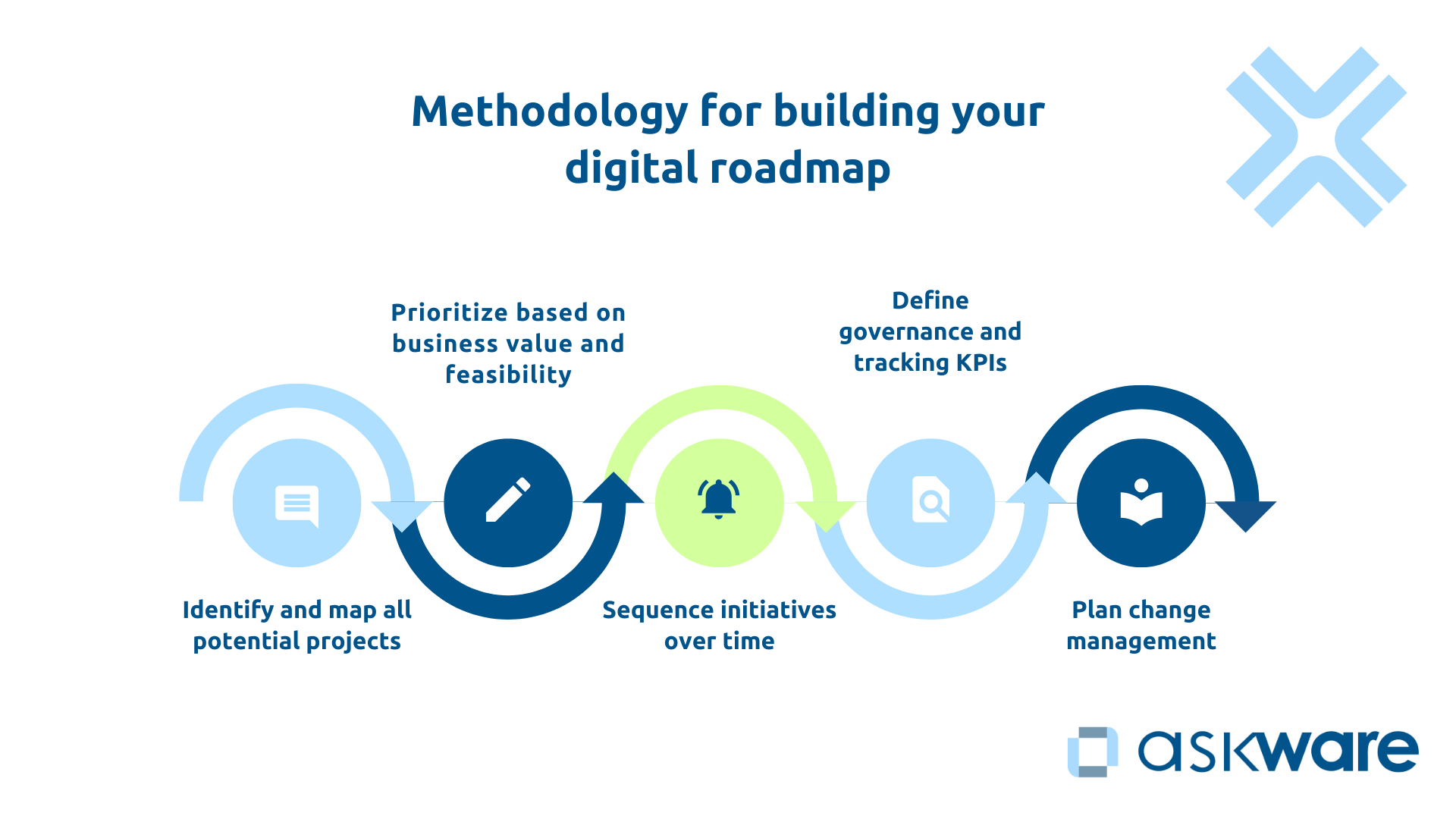
Methodology for building your digital roadmap
Step 1: Identify and map all potential projects
This first phase is a phase of divergence: List all projects possible without filtering them. Organize collaborative workshops bringing together IT and business. Identify all current irritants, business opportunities, and regulatory requirements.
Categorize projects by theme (CRM, ERP, ERP, Data, Collaboration, Infrastructure). For each project, do a macro estimate of effort and value. Write down for each project its business objective, expected benefit, estimated effort, dependencies.
During a workshop with a customer in the services sector, 23 potential projects emerged such as Azure migration, Dynamics 365 Sales deployment, the creation of a customer portal with Power Pages, the automation of HR processes, the redesign of financial reporting...
Step 2: Prioritize based on business value and feasibility
Use a prioritization matrix combining business value and technical complexity. This matrix generates four quadrants:
- Do first : high value, low complexity. These are your quick wins.
- Plan carefully : high value, high complexity. Essential structuring projects.
- Fill ins : low value, low complexity. Nice-to-have if capacity is available.
- Avoid : low value, high complexity. To be eliminated.
This matrix allows you to identify your quick wins, such as automating the sending of weekly reports with Power Automate, which, with 2 days of implementation, saves 5 hours per week, generating an immediate ROI. It also makes it possible to identify the structuring projects to put in your roadmap, such as the migration of your ERP to Dynamics 365 Business Central, which is estimated to take 6 months but will then unlock all the integration projects.
During this prioritization exercise, you should pay attention to the dependency between projects, some of which may have prerequisites. For example, it will be impossible for you to deploy Power BI if your data is not unified upstream in Dataverse. Likewise, to obtain the support of company management, you must balance the visible projects that mobilize and the technical projects that secure the IS.
Step 3: Sequencing initiatives over time
Cut out your roadmap in phases or quarters. Take into account the real capabilities of your team. Respect the logical sequencing dictated by technical dependencies: as in construction, the roof is not put before the foundations are installed.
Define clear milestones and interim deliverables. Instead of a monolithic 12-month project, break it into 2-3 month sprints with tangible deliverables. This will also give you the possibility of integrating safety margins to manage unforeseen events and peaks of activity.
Good sequencing will create value quickly while laying a solid foundation for the future. For example, an 18-month roadmap for an industrial ETI could provide for this division:
- T1: Full Audit + Infrastructure Migration to Azure
- Q2: Deploying Dynamics 365 Sales (quick win commercial)
- Q3-T4: Power BI integration + Power Automate automations
- T5-T6: Power Pages+ Customer Portal Dynamics 365 Customer Service
Step 4: Define governance and monitoring KPIs
A roadmap should be Piloted, not just displayed. Appoint an executive sponsor and a transformation project manager. Set up a monthly committee to monitor progress and a strategic quarterly review.
Define monitoring KPIs such as the rate of achievement of milestones (85% minimum), the budget consumed vs planned (± 10%), the NPS of trained users (>7/10) or the time saved on automated processes.
Communicate regularly with all stakeholders. Transparency builds buy-in.
Step 5: Plan change support
Technology alone is never enough. McKinsey studies show that 70% of IT project failures are linked to resistance to change.
Several axes must be worked on to supporting change :
- Build a communication plan from the start.
- Organize training courses adapted to each profile.
- Identify internal champions to facilitate adoption.
- Anticipate resistance management.
- Measure the adoption of the tool and provide room for manoeuvre for post-deployment adjustments.
In concrete terms, if you deploy Dynamics 365 Sales, you can schedule 3 training sessions per profile, hands-on workshops, documentation accessible via SharePoint, level 1 support for 3 months, then measure the usage rate at D+30, D+60, D+90.
Digital roadmap and Microsoft ecosystem: the points of attention
Building a coherent roadmap on Dynamics 365 and Power Platform
Microsoft ecosystem offers remarkable native integration. Your business data in Dynamics 365 automatically feeds into your Power BI dashboards, your Power Automate workflows trigger actions in Teams.
For your roadmap, first define your common base: Azure Active Directory, Dataverse, governance Power Platform in your strategy. Then sequence intelligently: start with Dynamics 365 Sales, then Customer Insights, then Customer Service.
Our Microsoft expertise at Askware allows us to build optimized roadmaps. A typical example:
- Phase 1: Azure Core + Dynamics 365 Sales
- Phase 2: Power BI for commercial management
- Phase 3: Power Automate for automation
- Stage 4: Dynamics 365 Customer Insights for marketing-sales alignment
Anticipate the evolution of the Microsoft ecosystem
Microsoft is constantly evolving its ecosystem. Include update windows in your schedule to follow the Microsoft transformations. Dynamics 365 receives two major waves per year (usually in April and October).
Build a scalable architecture. Give priority to modular developments, use standard connectors, document your customizations.
The arrival of Copilot illustrates this approach. If your roadmap has correctly laid the foundations, integrating Copilot in phase 3 as a quick win happens naturally, without calling into question the previous phases.
Balancing cloud and on-premise in your roadmap
A lot of businesses are in situation hybrid. Evaluate which legacy systems should be retained temporarily versus which ones should be migrated quickly.
Define a strategy for gradual migration to Azure: lift & shift to quickly gain security, then gradually redesign to managed services.
An industry with a critical on-premise ERP could structure its roadmap as follows:
- Year 1: Migrating infrastructure to Azure (IaaS)
- Year 2: Gradual redesign to Dynamics 365 Business Central (SaaS)
- Year 3: Decommissioning of the old ERP
This schedule makes it possible to avoid a single massive migration that would put the company at risk.
Manage and develop your digital roadmap
Set up effective follow-up rituals
A living roadmap requires regular checkpoints. Organize a monthly digital project steering committee for one hour where the first 15 minutes are devoted to progress with the Power BI dashboard to support, 30 minutes to blockages and 15 minutes to decisions.
Conduct a quarterly strategic review with the CODIR to validate the alignment with business priorities and adjust if necessary.
Use simplified reporting with a few key metrics. A Power BI dashboard showing the progress of projects, the budget consumed and the next deadlines is sufficient.
Know how to adjust the roadmap without questioning everything
Agility does not mean improvisation. Differentiate between tweaks tactics that consist, for example, in delaying a project by one month, strategic changes that can call into question a major project.
Establish clear criteria: regulatory change, major business opportunity, critical feedback. Define a validation process. Communicate adjustments consistently with a clear explanation.
Version your roadmap (V1, V2...) with a history of decisions. Like a sailboat that adjusts its sail according to the wind without changing course: you optimize the trajectory without losing direction.
Measuring ROI and communicating success
Celebrating victories builds buy-in. Systematically measure the Earnings obtained versus the objectives defined beforehand.
After deploying Power Automate, communicate internally by showing, for example, that 200 hours per month have been saved thanks to the automation of reports, i.e. 10 days of productivity redistributed to valuable tasks, with testimonies from the beneficiary teams.
Capitalize on feedback: what worked well? What difficulties did you encounter? Value teams and internal champions.
Measuring and communicating successes transforms the roadmap from an IT constraint into a collective performance driver.
.png)
Digital roadmap is the essential governance tool to methodically manage your transformation. It brings you Business/IT alignment, the clear prioritization of your investments, visibility for all stakeholders, and the reduction of risks.
At Askware, we support our customers in this process by combining strategic vision and technical expertise on the Microsoft ecosystem. We help you turn ambition into a realistic action plan, avoid traditional pitfalls, and create sustainable transformation dynamics.
Your business deserves a roadmap that is both ambitious and achievable, that generates value quickly while building solid foundations. Let's build this digital roadmap together that will bring your company's digital strategy to life.