What is a POC and why is it essential?
Definition: the POC as validation before investment
A POC (Proof of Concept, or “Proof of Concept”) is a small-scale experimental project whose objective is to demonstrate the feasibility of a solution before engaging in a complete project.
The POC validates six critical aspects:
- Technical feasibility: can technology do what we expect? ,
- Business relevance : does it meet business needs? ,
- The potential risks,
- Integration with the existing IS,
- Adoption by users,
- Realistic estimate of the efforts required.
A POC is characterized by a limited scope with 1 or 2 use cases, a short duration from a few weeks to 2-3 months, a controlled budget (between 5 and 10% of the total budget) and an approach focused on validation. Think of the POC as a test drive before buying a car: a small investment to avoid a big regret.
POC vs MVP vs Prototype vs Driver: don't confuse
Driver vs POC vs MVP vs Prototype, what's the difference? These terms are often confused but they serve different purposes:
The POC validates technical feasibility on a restricted scope by answering the question “Is it technically possible?”. It is used by the project team only, it must be functional but not necessarily aesthetic. It leads to a go/no-go decision for the overall project.
The Prototype validates the user experience and the interface by answering the question “Is the interface intuitive?” Visually successful but not necessarily functional in depth, it validates the design thanks to the interactive model with a few test users before development.
The MVP validates product relevance and market need by answering the question “Do users want this product?” Production-ready but minimalist, it is deployed to real users in real conditions to collect feedback and iterate.
The Pilot validates the implementation in real conditions by answering the question “Does it work in real life, on a reduced scale?”. Deployed on a limited perimeter (one service, one site), it is in production quality before widespread deployment.
Generally, we start with a POC to validate the feasibility and we continue with the Prototype (UX), the MVP (relevance) then the Pilot (limited deployment) to validate adoption and use before full deployment.
Concretely, for a new CRM, the POC will make it possible to test whether Dynamics 365 Sales manages your specific processes, the computer prototype validates the screens, the MVP deploys a minimum CRM for 10 salespeople, the pilot covers the France team, before deployment to all sales representatives at the international level.
.png)
Why the POC avoids failed investments
Four scenarios illustrate the value of the POC before larger investments:
The solution does not meet the need : an organization invests €400,000 in an ERP. After 6 months, discovery that ERP does not manage a critical business process. A 3-week POC at €20,000 would have identified this blocking problem.
Integration is impossible : a company invests in a marketing tool. During the project: impossible to integrate it into the CRM. Result: data in silos, double entry. A POC would have tested the integration immediately.
The performances disappoint : a cloud migration ends with unacceptable latency for international users. The project is stuck, the discontent is widespread. A POC would have tested the performances in real conditions.
Users are not adopting the deployed tool : a collaboration tool that is too complex will not be used, the old tool will be preferred and adoption will be less than 20%. The investment is then lost. A POC with test users would have identified the obstacles to adoption.
A POC costs between 10,000 and 50,000€ over 2 to 8 weeks while a failed project represents 200,000 to 1 million euros and 6 to 18 months lost. Investing 5% to secure 95% becomes good financial sense.
According to a report by the Standish Group, 71% of projects fail or do not succeed as planned at the beginning (in terms of budget, quality or deadline). The POC makes it possible to better frame the project.
When to do a POC (and when it's not necessary)
Situations where the POC is essential
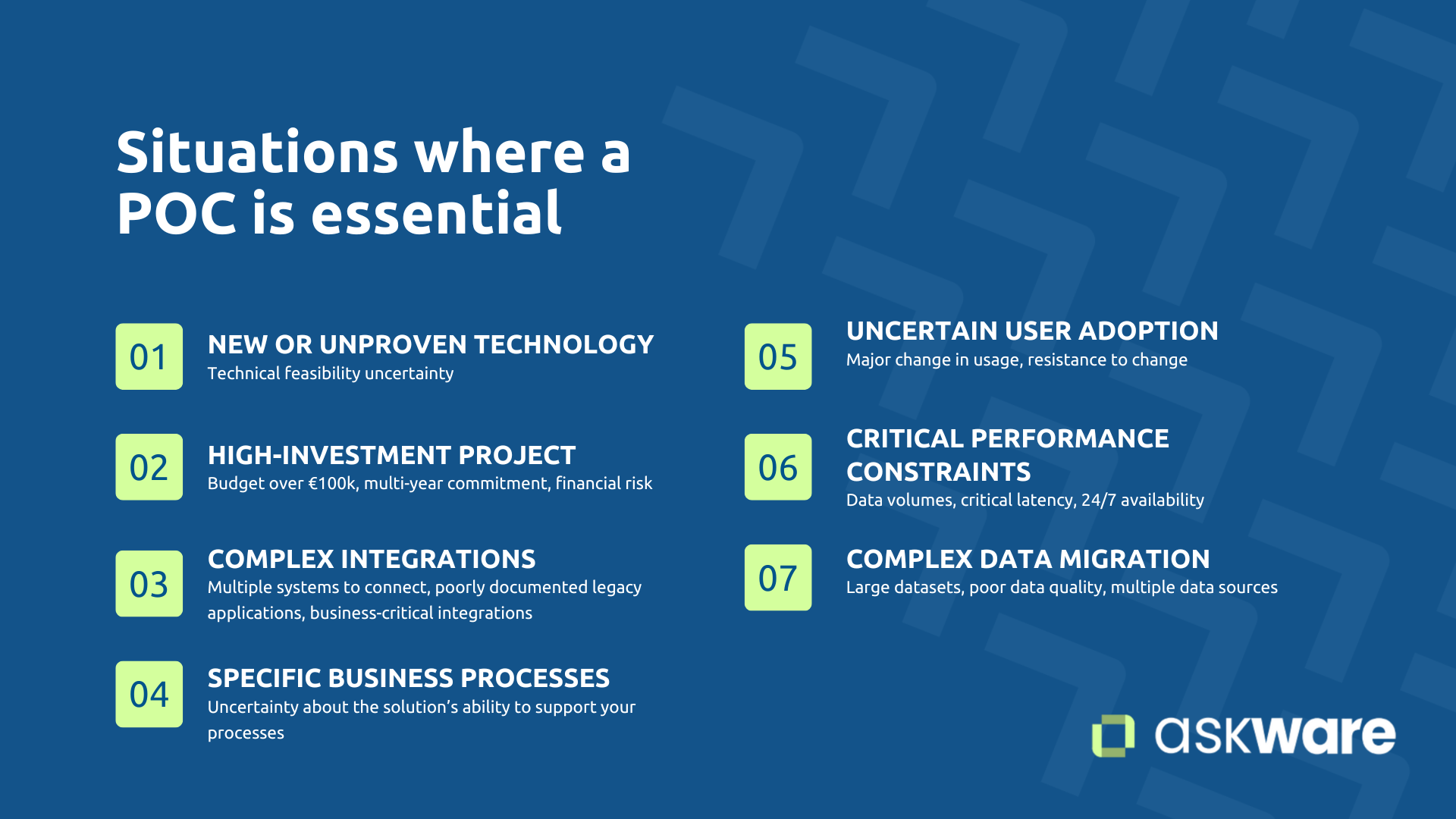
The POC becomes essential in seven cases:
- New or unproven technology : first use of a tech (AI, IoT or other) uncontrolled, uncertainty about technical feasibility is present.
- High investment project : for a budget of more than €100,000, a multi-year commitment or a project where financial risks are high.
- Complex integrations : there are multiple systems to connect, legacy applications that are poorly documented or integrations critical to the business.
- Specific business processes : processes that are very specific to your organization that adds uncertainty about the ability of the solution to support your processes.
- Uncertain user adoption : major change in uses in a company where there is a history of resistance to change and critical users.
- Critical performance constraints : large data volume, critical latency, 24/7 availability
- Complex data migration : big or poor data, multiple data sources
For example, you want to migrate from a legacy ERP with 20 years of data to Dynamics 365 Business Central. A POC is required to test data migration, integrations, and specific processes.
Situations where the POC may be optional
The POC can be optional in five cases:
- Standard and proven solution : standard SaaS deployment without customization (ex: Microsoft 365)
- Low investment : with a budget of less than €20,000 and short-term commitments that make reversibility easy.
- Very simple project : limited scope on standard processes and without complex integrations
- Extreme business emergency : immediate need or regulatory pressure (with vigilance, the emergency should not make you turn a blind eye to the risks)
- Recent similar experience : similar solution successfully deployed in a comparable context
Even in these cases, a mild POC of 1 to 2 weeks is still relevant. The cost of a POC is generally less than the risk of not doing one well so that in case of doubt, a quick POC is always worth it.
How to conduct an effective POC: step-by-step methodology
Step 1: Define goals and criteria for success (framework)
How do I do a POC? The first step is to set clear goals before you start otherwise the POC will be useless. Start by listing the hypotheses to be tested:
- Technical questions: for example, “Can the system handle 10,000 transactions/day?” ,
- Functional questions: like “Can process X be automated?” ,
- Integration questions such as “Is real-time synchronization with SAP possible?” ,
- User questions: such as “Is offline mobile use possible?”
Then define GO criteria to identify the conditions necessary for the continuation of the project and NO-GO criteria to identify the prohibitive criteria. They should be measurable and should never be subjective.
For example, you can define as criteria:
- “Response time under 2 seconds for 95% of requests”
- “Real-time SAP integration with less than 0.1% errors”
- “80% of users create an opportunity in less than 5 minutes”
- “Migrating 100 test accounts without errors”
Limit the scope to 1-3 maximum use cases with a representative sample of data.
The framework of the POC must be the subject of a relatively short framework document (5-10 pages) containing the list of hypotheses to be validated, the success criteria defined and the detailed schedule.
It is better to test few things in depth than a lot on the surface.
Step 2: Prepare the environment and data (setup)
Create a dedicated environment (outside of production) that is isolated but representative. Use real data (anonymized so sensitive), never fictional data that could mask the real problems.
The volume should be representative: if your production contains 10 million lines, do not test with 10 records. Include edge cases and error cases.
Connect real systems or realistic mocks and test data flows as they will exist in production.
Build a team: POC project manager, technical experts, business representatives, test users.
The set-up generally takes 1 to 2 weeks to set up.
Step 3: Conduct the tests and collect the results (execution)
Test each use case (nominal scenarios AND error scenarios) by systematically measuring the results. Evaluate performance, integrations, and security. Organize sessions with real users: observe them, don't just use a questionnaire to identify all the points of friction.
Document everything in a POC journal: what works, what doesn't work, screenshots, objective measurements, user feedback. But stay factual, don't write down what you want to see in the tests.
The POC is an iterative process: test, correct based on feedback, and retest. This approach is progressively refining the validation.
Depending on the complexity of the POC, this stage lasts between 2 to 6 weeks.
Step 4: Analyze the results and decide (conclusion)
Compare results to defined success criteria to identify what worked, what didn't, and what risks were detected. Three possible outcomes:
- GO : the success criteria are validated, the feasibility confirmed, the manageable risks. You can launch the complete project with realistic estimates on budget and schedule.
- GO conditional : the majority of the criteria are validated, some adjustments are necessary. You can launch the project with changes (scope, architecture, approach). The POC will have made it possible to avoid major problems.
- NO-GO : the success criteria have not been validated and unacceptable problems have emerged. You have the choice between abandoning this project or choosing another solution. The POC will have avoided wasting a budget and time on a project that is doomed to failure.
The POC must be documented with a POC report including an executive summary (for management), the results in terms of the success criteria and the prohibitive criteria, the risks identified, clear recommendations, and if GO, an adjusted project plan with estimates.
An IT POC that concludes NO-GO is NOT a failure, it is a success! It avoided an unsuitable major investment.
.png)
Power Platform: the ideal tool for fast and efficient POCs
Why Power Platform excels for POCs
Power Platform has five benefits for POCs:
- The speed : the low-code approach of Power Apps allows you to create in days rather than months with quick iterations and a reduced need for developers.
- Native integration : pre-built connectors exist for a thousand systems, integration Dynamics 365, Microsoft 365 and Azure is native which allows you to test your integrations immediately.
- The cost under control : accessible licensing, no heavy developments. A POC is possible for less than €10,000.
- Representative : what is built can evolve into production. The POC is not necessarily disposable, it can become a Pilot and then go into production.
- Accessible to trades : business departments participate by being citizen developers. This shared responsibility is conducive to the future adoption of the project.
It is thus possible to go from idea to POC in weeks, rather than months thanks to the Power Platform. Process automation on Power Automate can be done in 1 or 2 weeks, a business application on Power Apps in 2 to 4 weeks, a dashboard Power BI in 1 or 2 weeks or even a chatbot can be tested in 1 to 3 weeks thanks to Copilot Studio.
Use case: POC Power Apps in 3 weeks
An industrial ETI needed a mobile application for its field technicians in order to facilitate the reporting of interventions. 2 solutions were considered at the level of the authorities of IT governance : custom development (6 months, €150,000) or Power Apps.
To make the decision, a POC was done on Power Apps for 3 weeks. With a framework on the objectives, validation criteria and use cases for the first week. The following week, the POC was developed encompassing the mobile application and automations. In the third week, the POC was tested by 5 technicians.
Results : the functionalities were validated, the users satisfied and adopted the application immediately, the integration with the ERP (SAP in this case) was functional and the performances were acceptable even in areas with weak connections.
An additional need has been identified: an offline mode that is manageable with an adjusted architecture.
Based on the results, the POC resulted in a GO. The complete project took place over 2 months at a cost of €30,000 (vs 6 months and €150,000 for the other solution). This allowed a saving of €120,000 and a time-to-market divided by 3.
The POC of an IT project is not a superfluous expense: it is the strategic investment that secures the main investment. By investing 5 to 10% of the project budget, you validate technical feasibility, business relevance, integration and user adoption before any significant commitment.
The POC turns uncertainty into an informed decision. A NO-GO POC is not a failure, it is a success that saves you hundreds of thousands of wasted euros.
To succeed: define clear success criteria, use real data, involve end users, limit the scope, analyze factually. Power Platform is particularly suitable thanks to its low-code approach, which allows rapid prototyping.
At Askware, we support our customers to frame, carry out and evaluate their projects on the Microsoft ecosystem. Our expertise combines digital strategy consulting and technical expertise in Dynamics 365, Power Platform and Azure.