Dynamics 365 Business Central in a nutshell: the cloud ERP designed for SMEs and ETIs
What is Dynamics 365 Business Central?
Dynamics 365 Business Central is the ERP for the Microsoft Dynamics 365 ecosystem. It is not a simple business management and accounting software, but a true integrated management system that manages all of your processes: finances, purchases, sales, sales, sales, stocks, production, project management and services on the same ERP.
Its particularity? It is a Cloud-native ERP, designed from the start to work in the cloud. This modern architecture gives you access everywhere, continuous updates without interruption, and security managed by Microsoft Azure.
Business Central integrates naturally with the Microsoft ecosystem: Outlook, Excel, Teams, and other Dynamics 365 modules (Sales, Marketing, Customer Service, Field Service). All of your data is centralized in Dataverse, permanently eliminating information silos.
Heir to Navision and Dynamics NAV, Business Central combines functional maturity and cloud agility. In a context where 60% of businesses operate in hybrid mode and where fragmented data can lead to a 20% drop in productivity (McKinsey Global Institute), having a single source of truth is becoming a strategic imperative.
For whom? Businesses that get the most value from Business Central
Business Central is an ERP designed for SMEs (10-250 employees) and ETI (250-5000 employees), whether they operate in distribution, trading, manufacturing, manufacturing, professional services, retail or construction. This module makes it possible to professionalize business management and unify processes.
Key users cover all departments in the organization:
- Directorate-General for strategic management thanks to a consolidated vision of the activity,
- DAF and accounting teams for cloud financial management, accounting and cash flow monitoring,
- Purchasing and supply chain managers for stocks and supplies,
- Production managers for manufacturing planning, scheduling and monitoring production,
- Project managers for the monitoring of time and profitability on projects,
- DSI for IT governance.
Business Central will be useful, for example, for an industrial SME of 150 people: from the ERP, it manages its manufacturing production, stocks, purchases, accounting and projects from the tool with real-time visibility for management, where previously it waited for the end of the month for figures that were already obsolete.
Business Central vs big ERPs: what's the difference?
Large ERPs (SAP, Oracle NetSuite) are excellent for managing 50 subsidiaries in 40 countries with complex regulations. But this power comes with deployments that can be counted in years, licenses that weigh in the millions and training courses lasting several months.
Business Central takes a different approach to adapt to the reality and needs of SMEs with:
- Deployment in a few months rather than years
- An accessible SaaS model without heavy infrastructure investments
- An accessible, modern and intuitive interface that reduces training needs
- Natural scalability to add modules and functionalities as time goes by
- Native synergy with Microsoft 365, Teams, and the Power Platform
It offers all the functional power needed by SMEs and ETIs without the superfluous complexity or excessive costs to offer the best performance/agility/cost ratio for SMEs and ETIs.
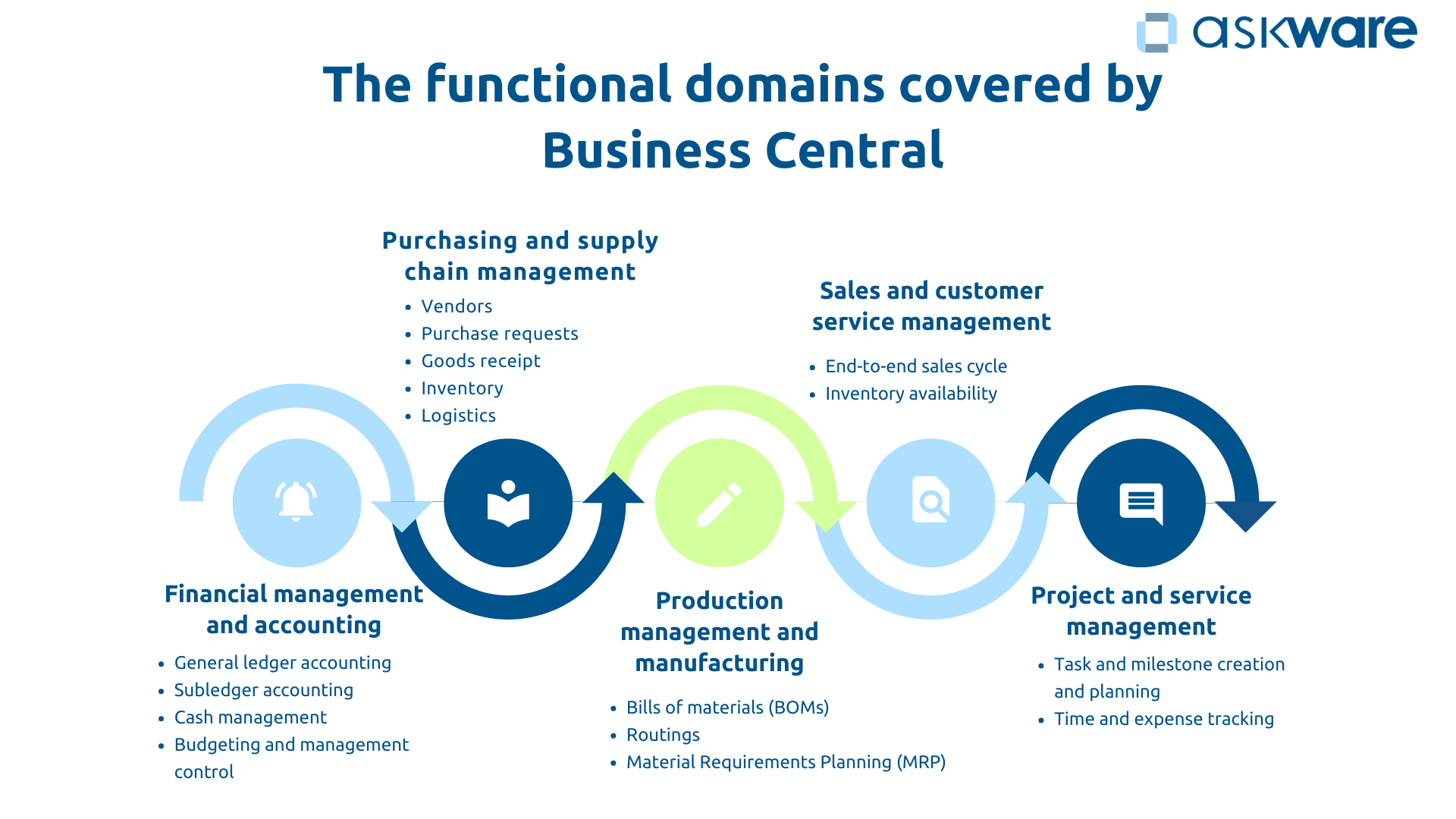
The functional areas covered by Business Central
Financial management and accounting
Business Central manages all of your finances:
- General accounting with the general ledger, entries, closings and a customizable chart of accounts,
- Auxiliary accounting customers and suppliers,
- Cash Management with automated bank reconciliations and forecasts,
- Budgets and management control with real-time discrepancy monitoring.
The system naturally manages the Multi-currency and multi-company with automatic consolidation. Tax compliance is guaranteed with VAT declarations, legal archiving and complete audit trails. Configurable analytical axes allow you to cross-reference your analyses by project, cost center, product or geography.
Your CFO consults instantly cash flow situation, pending invoices and budget/actual variances by department. Business Central gives financial departments real time and reliable visibility of the financial health of the company.
Purchasing and supply chain management
Business Central optimizes your supply chain because it allows you to manage:
- Vendors with a supplier database, evaluations and contracts,
- Purchase requests and purchase orders with validation and follow-up workflows,
- Receipt of goods with automatic reconciliation of order/delivery/invoice,
- Stocks with the management of entries and exits, inventories and valuation according to the method of your choice (FIFO, LIFO, average cost),
- Logistics with the management of shipments, carriers and shipment tracking.
For businesses multi-sites, the ERP allows the management of several warehouses and inter-site transfers for global visibility.
Procurement is automated with needs calculation, order points and intelligent replenishment suggestions. Business Central automatically alerts that an item is going to reach its order point and suggests an optimized purchase order.
Good stock management can reduce dormant stock while reducing breakups.
Production management and manufacturing
Industrial companies have a complete module to manage production with multi-level bill of materials management (BOM) for composite items, manufacturing ranges detailing production steps and load stations as well as manufacturing orders with real-time planning and monitoring.
Requirements planning (MRP) automatically calculates component requirements and capacities, alerting in case of risk of breakage.
Charging station management makes it possible to monitor capacities for both machines and human resources. Production monitoring compares real consumption with theoretical consumption and accurately values costs. Business Central includes a quality vision with the management of controls and non-conformities.
Thus, an industrial SME can plan its production orders on Monday. Business Central will calculate raw material requirements, check available inventory, and generate purchase requests for missing components. Production will start with the certainty that we have everything we need.
Sales and customer service management
Business Central covers the full sales cycle in addition to Dynamics 365 Sales for CRM. You manage your quotes and customer orders with sophisticated price lists, discounts and automated promotions.
The function Available To Promise (ATP) instantly checks stock availability before confirming an order. Preparation and shipping are coordinated from the system. Invoicing is automatically generated with configurable reminders. The module also includes return management and credit notes.
Integrating with Dynamics 365 Sales creates a perfect continuum: opportunities won in Sales automatically become orders in Business Central. Business Central ensures that your commercial promises are kept : correct inventory management on the ERP, deadlines respected, fair prices.
Project and service management
For service companies, ESNs or consulting firms, Business Central integrates a comprehensive project management : creation and planning with tasks and milestones, monitoring of time and expenses, budget management with alerts in case of overruns.
For projects requiring field interventions, integration with Field Service makes it easy to orchestrate them.
Project billing adapts to your model: on progress, under management, on a fixed price or a combination. Profitability analysis by project becomes reliable: you identify your profitable projects and your loss-making projects and understand why thanks to margin analysis. You can adjust resource allocation more easily.
Thus, an ESN or consulting firm can track the time of its consultants by project and client. On Friday, the times are validated. On Mondays, invoices are generated automatically.
The concrete business benefits of Dynamics 365 Business Central
Gain visibility and manage with reliable data
Business Central centralizes all of your data in a single source. Your dashboards show in real time your financial KPIs, the status of your stocks, the progress of your production, the profitability of your projects. Reporting is automated without re-entries or errors.
Collaboration is facilitated, the production team can see customer orders, accounting can see stocks...
Integrating with Power BI turns your data into advanced analytics for your senior management.
Every morning, your managing director consults his dashboard: monthly sales, gross margin, cash flow, orders in progress, production delays. He drives with facts, not with hunches. Businesses that implement Business Central achieve 265% ROI in 3 years.
Reduce IT costs and free up resources
The cloud model eliminates on-premises servers and their maintenance and replacements. Microsoft manages the infrastructure and the automatic updates. You don't need to hire someone who will take care of this topic internally.
Costs are becoming predictable : one subscription per user. The system is scalable, you add users or modules in a few clicks.
On an operational level, the agility of the tool makes it possible to gain in productivity. According to the Forrester study on the Business Central module, productivity gains are in the order of 12.5% for operational teams and 15.6% for finance teams.
Gain agility and support growth
Business Central rolls out in a few months, not two years. Customization does not require heavy development for functional settings, extensions, or the use of the Power Platform to create complementary applications.
If you have specific business tools, open APIs make it easy to connect them to Business Central.
Does your growth come without friction: new production site, international expansion, acquisition of a company? Business Central grows with you, you can add modules gradually.
Thus an ETI deploys a new production site in three months, where the old ERP would have required 12 to 18 months.
Integrate naturally with the Microsoft ecosystem
Business Central integrates perfectly with all Microsoft tools: export to Excel, emails via Outlook, collaboration in Teams. The flows are automated between the CRM and your ERP: an opportunity won in Sales becomes an order in Business Central, the stock is reserved, production is triggered if necessary, the invoicing is carried out automatically.
In terms of security, users benefit from single sign-on (SSO) for all Microsoft tools.
The Power Platform makes it possible to create complementary business applications, to automate workflows, to build personalized dashboards, all connected natively to Business Central.
.png)
How do you successfully deploy Dynamics 365 Business Central?
Audit your existing management system and define your needs
Success starts with a strategic audit of your current system : what tools, what processes, what data, what pains?
You will map your business processes in all areas in order to define the functional scope: which modules to activate as a priority, which roadmap over 12-18 months.
The identification of business specificities determines the necessary customizations. The data strategy is becoming clearer: what data to migrate, how to clean it, what history to keep.
At Askware, we conduct this audit by combining business vision and technical feasibility to define a pragmatic scope that takes into account your business specificities and generates value quickly.
The classic mistake to avoid? Wanting to replicate all the processes of the old system identically. It's an opportunity to simplify and modernize.
Set up and customize according to your business processes
Business Central is configured to reflect your processes: chart of accounts, analytical axes, validation workflows, price lists. Customizations add additional fields, custom reports, and specific functional extensions.
The balance is crucial: choose the standard, develop only what is really specific and of high value at the risk of introducing too much complexity and ending up with a useless tool. The Power Platform enriches Business Central without heavy development thanks to Power Apps and Power Automate.
Askware configures Business Central to reflect your businesses while avoiding over-personalization that would create technical debt.
Migrate data and ensure continuity
Cloud ERP data migration is critical and deserves meticulous preparation. Take the opportunity to Sanitize your data by removing duplicates, obsolete items in the knowledge base, inactive customers.
You need to define the migration strategy: a big bang or a gradual migration? Tests and validations should make it possible to verify that the migrations are done correctly without altering the data.
47% of ERP implementations exceed their initial budget, with an average overrun of 35%. These slip-ups rarely come from the cost of licenses, but from poor preparation.
At Askware, we manage migration from end to end with a proven methodology that minimizes risks and ensures business continuity.
Train teams and drive adoption
An ERP is only valuable if it is used by all teams on a daily basis. The training is organized by role: accountants, buyers, inventory managers, production managers. Everyone is learning what they need.
User training must take place before the tool is launched to ensure continuity of service. Your teams need to be ready, confident, and trained on their own processes. Start-up support ensures reinforced support during the first weeks.
Make documentation and materials available: user guides, short videos, rich FAQ. Identify internal champions in each department: these ambassadors help colleagues and solve problems.
Follow the measurement of the adoption of the tool: rate of use per module, quality of the data entered, user feedback. Change management and support for adoption are conditions for success.
Askware trains your teams until complete adoption, with support that continues several weeks after the go-live to ensure the anchoring of new practices.
.png)
Dynamics 365 Business Central is a complete cloud ERP that manages all of your management processes: finance, purchasing, stocks, production, sales, projects. Designed for the cloud from the start, it brings the functional power of a true ERP without the cumbersome or expensive solutions designed for multinationals.
Whether you are looking to replace an aging ERP, unify fragmented tools, gain real-time visibility, or support your growth, Business Central provides a pragmatic and scalable response.
Technology alone never guarantees success. The success of an ERP project depends on the quality of the strategic framework : in-depth audit of the existing situation, definition of a realistic perimeter, simplification of processes. It is also based on the rigor of data migration, configuration aligned with your businesses, and support for adoption by all your teams.
Askware is with you every step of the way : audit your management system, definition of the roadmap, configuration of Business Central, configuration of Business Central, secure data migration, integration with the Dynamics 365 ecosystem, training of your teams and continuous support.