What is IT governance and why is it essential?
Definition: IT governance as a strategic management framework
IT governance is the set of organizational structures, processes, and practices that enable manage, control and optimize the use of technologies in the service of business strategy.
It pursues six major objectives:
- Aligning IT and business,
- Create measurable value,
- Manage security, compliance and continuity risks,
- Optimize resources (budgets, skills, time),
- Ensuring performance
- Ensuring the sustainability of decisions.
Contrary to popular belief, IT governance is not a bureaucratic constraint. It is a framework that provides clarity and the ability to make effective decisions. Think of it like the highway code: it allows everyone to move forward together in a smooth and safe way, not prevent movement.
IT governance vs IT management: do not confuse
IT management focuses on daily operations: how to operate systems, deploy projects, manage incidents. In the short term, operational IT teams provide maintenance and support.
IT governance defines the strategic direction: what should IT do, what investments to prioritize, how to measure value. Over the medium to long term, the management committee, the IT department and the business departments define the strategy and decide on the major choices.
In summary: governance decides the “what” and the “why”, management executes the “how”. Both are necessary and complementary.
Why IT governance is essential today
There are five major reasons for this strategic need:
- Increasing complexity of information systems : IS combines cloud, SaaS, on-premise and hybrid architectures with multiple stakeholders. Driving without a structured framework is impossible.
- Major IT investments : The IT budget represents 3 to 10% of turnover on average. Transformation projects cost hundreds of thousands of euros, requiring precise management of the ROI of IT investments.
- Speed of innovation : AI, IoT, and new technologies are constantly emerging. Quickly deciding which ones to adopt without creating technological anarchy requires a clear framework.
- Regulatory pressure : RGPD, ISO 27001, sectoral compliance... The responsibility for data imposes a structured compliance framework on businesses.
- Generalized digital transformation : IT has become a strategic driver impacting all businesses, making IT-Business alignment absolutely critical.
Without IT governance, you risk technological anarchy, a technical debt galloping, wasted investments and the frustration of business teams.
The pillars of effective IT governance
Pillar 1: IT-Business alignment (strategy)
The first pillar is based on a simple principle: IT must serve business goals. IT governance is a direct result of business strategy. If your objective is international growth, your IT objective is towards a scalable multi-region cloud infrastructure.
This requires the involvement of business lines in IT decisions via joint committees, a IT-Business common language that translates each project into a concrete impact (ROI, productivity gains, business opportunities) without technical jargon and a prioritization based on business value rather than technical ease.
Tools such as IT OKRs aligned with company OKRs or a synchronized IT roadmap facilitate this alignment. This is where a business-oriented IS audit makes perfect sense as the basis for this strategic alignment. The audit can follow the COBIT IT governance framework in order to create a process-oriented management framework.
Pillar 2: Value and Investment Management (ROI)
Every euro invested in IT must create measurable value. This pillar follows a four-step process:
- Value framing : Any project requires a business case with an estimated ROI, expected gains and full costs, validated by the IT governance committee.
- Prioritization : Investment arbitration is based on business value, feasibility, risks and resources in an IT portfolio management logic offering an overall vision of projects.
- Piloting : Progress is monitored with alerts in case of slippage on the budget, deadlines or scope. If necessary, management leads to GO/STOP decisions for ongoing projects.
- Measuring the ROI achieved : The post-mortem checks whether the promised ROI has been achieved and feeds into future projects.
The recourse to the POC is part of this logic as a tool for securing investments before massive commitments.
Pillar 3: Risk and compliance management (security)
The third pillar protects the organization by identifying and managing IT risks:
- Security (cyberattacks, data leaks),
- Compliance (RGPD, regulations),
- Continuity (failures, unavailability),
- Technical debt (obsolescence, instability)
- Dependencies (publisher or key persons).
The risk management process starts with identifying risks through a mapping and then evaluating them according to their probability and impact. They are then treated (accepted, mixed, transferred, or avoided) and monitored continuously.
Governance defines risk management policy, validates acceptable risks, and actively manages technical debt.
.png)
Structuring IT governance: bodies and processes
Governance bodies: who decides what?
Clear governance is based on four complementary levels:
Level 1: Management Committee (strategic). Composed of the General Management and its deputies, the IT Department and Business Directors, this committee meets every quarter or according to the Codir calendar. It validates the IT strategy, arbitrates major investments and manages digital transformation.
Level 2: IT Governance Committee (tactical). Composed of the IT Department, Business Directors, Architects, PMOs and the Financial Department, it prioritizes IT projects every month, validates business cases, arbitrates resource conflicts, monitors the portfolio, monitors the portfolio, manages technical debt and tech stack and decides on the follow-up to the POC.
Level 3: Architecture Committee (technical). Composed of the IT Department, Architects, technical experts and business representatives, it meets bimonthly to validate architecture choices, guarantee the coherence of the stack, validate tool additions and define technical standards.
Level 4: PMO (operational). Composed of the PMO and project managers, the team meets every week to monitor the progress of projects, identify risks and consolidate reporting for higher authorities via dashboards and alerts.
The principle of subsidiarity is essential: each level decides what falls under its jurisdiction and only reports when necessary, thus avoiding bureaucracy. Depending on the size of the business, these instances can be simplified.
.png)
The key processes of IT governance
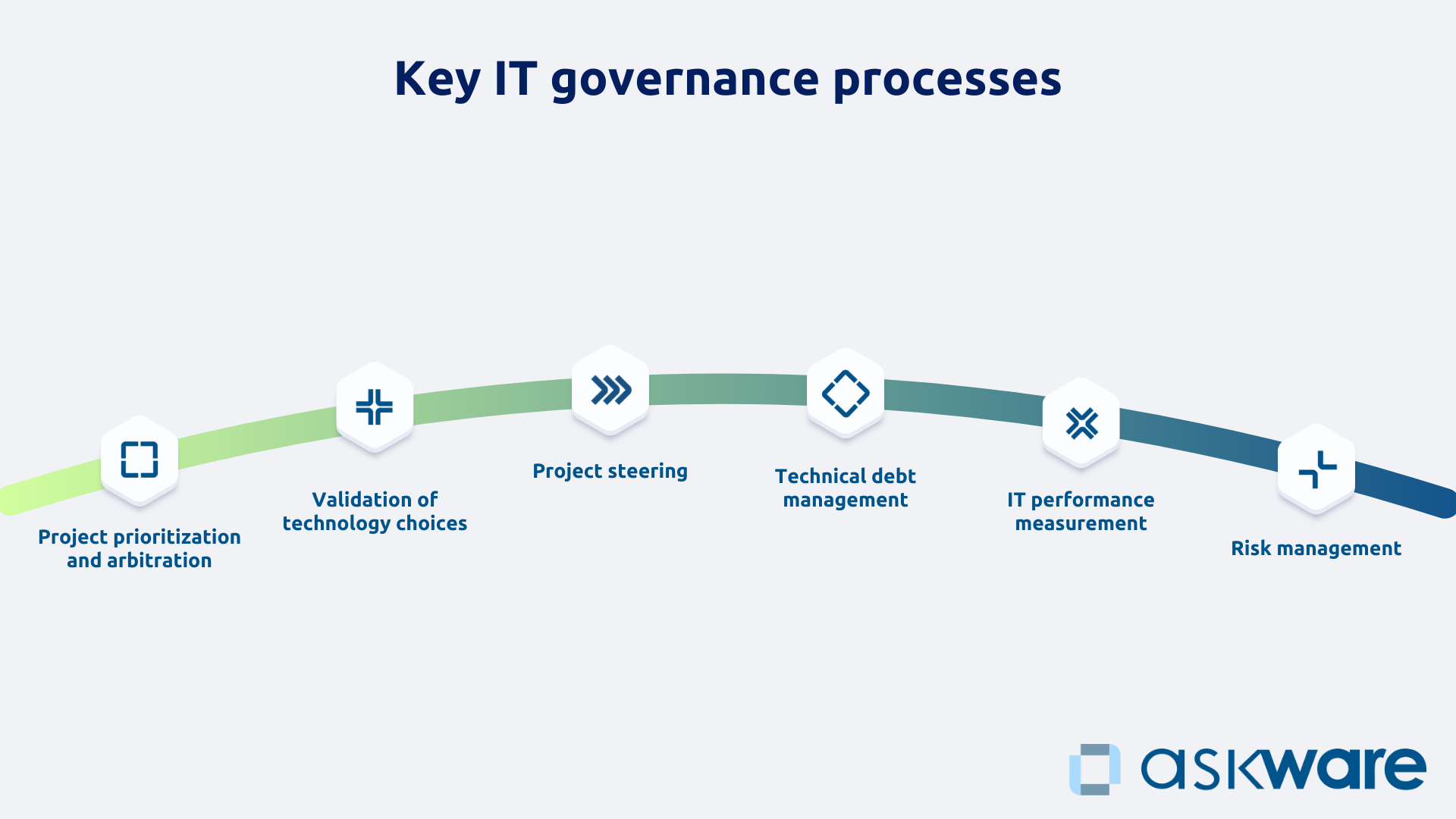
Six structuring processes ensure the effectiveness of IT governance:
- Project prioritization and arbitration : From demand tointegration into the roadmap through the validation of the business case and the evaluation of the project (value, feasibility, risks)
- Validation of technological choices : Assessment of the need for a new tool or a new technology in the face of the current stack, possible POC, validation by the architecture committee
- Project management : with validation milestones and regular control points allowing GO/STOP decisions to be taken during the project if necessary.
- Technical debt management : Regular evaluation, allocation of 20-30% of the budget to reimbursement, prioritization of remediation actions and monitoring of progress
- IT performance measurement : Definition of KPIs, dashboards and periodic reviews
- Risk Management : Continuous identification, evaluation, treatment and reporting
These processes need to be clear, documented, and pragmatic.
IT governance tools
The tools make the governance of digital transformation visible and controllable.
For the Portfolio Management, project portfolio management, Jira Portfolio, Microsoft Project or even PPM tools allow an overview of projects.
Architecture Repository (architecture repository) allows you to document the target architecture, maps the IS and define standards and patterns.
Of dashboards consolidate IT and business KPIs, the progress of projects, and the monitoring of budgets and costs.
The decision framework (decision logs/ADR) allows the traceability of decisions taken and their justifications.
Finally, some technical debt management tools like SonarQube allows you to analyze the code and track the debt..
The ecosystem Microsoft Azure offers solutions that are particularly adapted to IT governance with Azure DevOps for portfolio management, Power BI for dashboards, SharePoint for documentation, and Planner/Project for monitoring.
Implement or optimize your IT governance
Diagnosis: assess the maturity of your current governance
Four levels of maturity make it possible to locate IT governance in your organization:
Level 1: Governance does not exist. No formal authority, ad hoc decisions, no process for prioritizing or managing technical debt. Each department takes care of its tools. The first step is to create the foundations of governance with committees and prioritization processes.
Level 2: Initial governance. A committee exists but meets irregularly, processes are poorly formalized and decisions are not always followed. Here you can start by formalizing processes and establishing a regular rhythm of meetings.
Level 3: Structured governance. The authorities are in place, the processes formalized, the decisions documented, but the management of performance can be improved. The improvement will involve KPIs and dashboards and through the optimization of processes.
Level 4: Optimized governance. Maturity has been reached, the IT-Business alignment is strong, performance management is effective and a continuous improvement process is in place. The key is to maintain efforts and optimize what can be optimized when opportunities are detected.
Governance is built step by step.
The steps to set up effective IT governance
Once governance maturity has been detected, implementation follows five gradual steps:
Step 1: Get support from management (1-2 weeks) Sponsorship at the highest level legitimizes the approach.
Step 2: Define the target governance model (1 month). Define instances, key processes, and tools by adapting them to your size and culture.
Step 3: Create priority instances and processes (1-2 months). Start with the essentials: IT governance committee and prioritization process.
Step 4: Train and communicate (1 month). Train committee members and communicate the benefits across the organization.
Step 5: Start and iterate (continuous). Organize the first committees, make the first decisions and adjust based on feedback.
Three to six months are enough to set up IT governance. Start small, iterate and scale gradually, taking care not to introduce too much bureaucracy or to set up isolated IT governance.
IT governance transforms your intentions into a coherent and sustainable strategy. Without it, even the best ideas crumble. With effective governance, you create clarity, consistency, and the ability to execute.
IT governance orchestrates all the elements of your digital strategy: it decides on audits, manages technical debt, maintains the coherence of the stack, oversees the POCs and builds the roadmap. It is based on three pillars: IT-Business alignment, value management, risk management and is structured via clear bodies, formalized processes and adapted management tools.
Ready to structure your IT governance? Assess your maturity with our Askware experts.