What is a tech stack and why is it critical?
Definition: the technical stack as the foundation of the IS
The technical stack (or “tech stack”) refers to all the technologies that make up and operate your information system (programming languages, frameworks, platforms, tools, services). Much more than a simple list of tools, it is the fundamental IS architecture on which all your operational capacity is based.
A complete technical stack includes:
- Frontend: User interfaces (web and mobile applications)
- Backend: Business logic and treatments
- Databases: Your data management systems
- Infrastructure: Servers, cloud, network
- Developer tools: IDEs, CI/CD, version management
- Business applications: ERP, CRM, collaboration tools, BI
These components are organized into several levels: Infrastructure as a Service (IaaS), Platform as a Service (PaaS), Software as a Service (SaaS), and specific developments. Think of your company's technical stack as the foundations of a building: invisible but essential, and if poorly designed, everything else suffers the consequences.
Coherent stack vs heterogeneous stack: two different worlds
One heterogeneous stack is a patchwork that accumulates fifty tools or thirty different editors, with technologies that overlap and 100% custom integrations. The consequences: unmanageable complexity, high integration costs, massive technical debt, difficulty recruiting, slow pace of change and increased security risks.
Conversely, a coherent stack is based on standardized technologies, native integrations, a clear architectural vision and a structured ecosystem. Result: simplicity of management, fluid integrations, limited technical debt, shared skills, speed of evolution and controlled security.
To illustrate this difference, we can imagine a company that will implement Dynamics 365 for its CRM and ERP, Power Platform for process automation, Azure for the Cloud and Microsoft 365 for collaboration. Here everything is integrated natively. For these same needs another company can combine Salesforce, SAP, Zapier, AWS and Google Workspace. The functional needs are met but here each integration requires specific developments and continuous maintenance. Stack consistency is a factor of simplicity, performance, and agility.
How an inconsistent stack creates technical debt
Four types of debt are self-sustaining when the technical stack lacks consistency:
- Integration debt forces to develop custom connectors for each tool, creating code to maintain that may break with each update. In addition, there is the snowball effect because the more tools there are, the more integrations and the more complexity.
- Skill debt requires your IT team to master a dozen different technologies, creating dangerous knowledge silos with a dependence on experts for each technology.
- Dependency debt progressively trap certain obsolete technologies that have become impossible to replace because of the integrations that depend on them.
- Governance debt makes it impossible to manage security consistently across 50 different tools and 50 distinct perimeters.
This technical debt progressively transform your IT into a strategic brake rather than a performance driver.
.png)
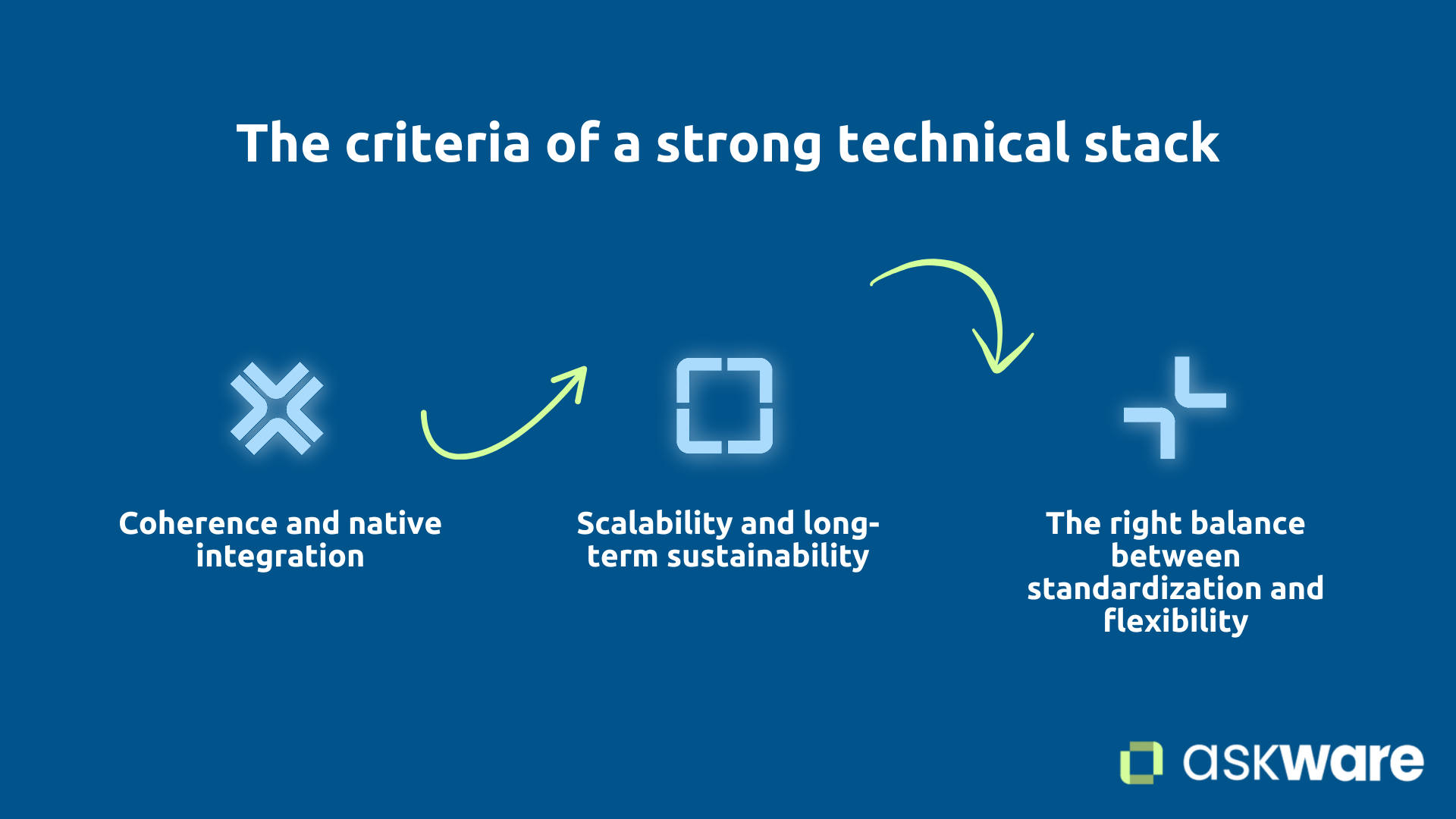
The criteria for a good technical stack
Criterion 1: Coherence and native integration
Native integration is the holy grail of technical architecture. When your tools are designed to work together, you eliminate the main source of complexity in your IT.
Native integration eliminates integration debt since there is no code to maintain. Maintenance is simplified because the editor manages the updates. Reliability is increasing, as the integration is tested by the publisher. The speed of implementation makes it possible to deploy in days rather than months.
Several questions are used to assess consistency:
- Do your tools share data easily?
- Are the authentications unified (SSO)?
- Are the interfaces consistent?
- Do the technologies belong to the same ecosystem?
Power BI illustrates this principle: it integrates natively with Dynamics 365 without a connector, shares Entra ID authentication, and offers a consistent interface. As a result, your teams create dashboards in hours instead of weeks.
Criterion 2: Scalability and Sustainability
Your stack should support your growth without requiring a complete overhaul. One stack evolutive is measured by its ability to manage more users, more data, more transactions and to welcome new functional components without questioning everything.
Sustainability assesses whether the chosen technologies will still be actively developed in 5 or 10 years and whether experts can be recruited into the company. Technologies at the end of their life, publishers about to disappear, communities that are dying out are all signs that show the risk of obsolescence. Modernizing your technical stack should be feasible without going through a total overhaul in the medium term.
Microsoft is investing heavily in AI, Azure and Power Platform with R&D budgets of several billion, guaranteeing the sustainability of the ecosystem. On the other hand, an obscure JavaScript framework maintained by a few developers presents a major risk of obsolescence.
Criterion 3: The balance between standardization and flexibility
The challenge: to find a balance between too rigid standardization that will stifle innovation and will not adapt to specific needs and excessive flexibility that will lead to chaos, with everyone choosing their tools without taking care of the coherence of the whole.
The recommended approach follows the 80/20 principle:
- Standardize the base with a main ecosystem for 80% of needs
- Maintain flexibility at the margin for the 20% of really specific needs by adding specialized tools.
Establish clear rules to determine when it is possible to break the norm. An architecture committee must validate any exception with a mandatory business justification. This discipline avoids the gradual drift towards technological chaos.
For example, a company can opt for a Microsoft platform with Dynamics 365, Power Platform, Azure, and M365 and add a specialized CAD tool integrated via APIs for its engineers.
Best-of-Breed vs integrated platform: which approach should you choose?
The “best-of-breed” approach: the best tool for every need
The best-of-breed approach chooses the best tool on the market for each function and need. For example, Salesforce for CRM, HubSpot for marketing, Tableau for BI.
This approach has several advantages. In addition to choosing the “best-in-class” functionalities for each function, this approach provides flexibility by not being dependent on a single publisher and makes it possible to benefit from the innovations of specialized publishers.
But it is not without its rewards:
- Integrations are complex and expensive because they each require specialized developments, which can create integration debt,
- Management is becoming more complex with different contracts, different licenses to manage and different training courses to carry out,
- Dispersed data makes it difficult to see the big picture and creates the risk of data silos that can hinder organizational productivity,
- The maintenance is heavier, each update can break the integrations.
This approach is suitable for large organizations with large IT teams, very specific needs, and those ready to invest heavily in integration.
The “integrated platform” approach: everything from a publisher
The integrated platform approach chooses a complete ecosystem:
- All Microsoft with Dynamics 365, Power Platform, Azure, M365,
- All of Google with Google Workspace, Google Cloud, AppSheet,
- All Salesforce with Salesforce Platform, MuleSoft, and Tableau.
With this approach, you benefit from native integration (everything works together immediately) and a coherent system where the user interface is homogeneous and the data centralized, management is simplified with a single contract, as is maintenance because the integration between products is managed by the publisher, which allows better control of costs and a sharing of skills on a single system.
However, the functionalities are sometimes less advanced than the specialists, and you are dependent on the vision of the publisher, which reduces your flexibility.
This approach is suitable for SMEs and ETIs where IT resources are limited, for organizations seeking simplicity and agility and for those who want to reduce their technical debt.
The hybrid approach: realistic pragmatism
In reality, few businesses adopt a fully best-of-breed or fully integrated approach. Most organizations adopt a hybrid approach following the 80/20 rule mentioned earlier: a integrated platform base (main ecosystem for 80% of needs) supplemented by targeted best-of-breed (specialized tools for 20% of very specific needs).
By default, use the integrated platform. The best-of-breed exception is only justified if the need is really very specific and not covered by the platform, if the ROI of the specialized tool is clear and if the integration is done via standard APIs without heavy developments.
An Architecture Review Board validates any exception with mandatory business and technical justification to maintain a solid governance and combine the benefits of both approaches.
The Microsoft ecosystem: example of a coherent technical stack
Overview of the Microsoft ecosystem
The Microsoft ecosystem concretely illustrates a coherent stack covering all business needs with:
- Microsoft 365: Collaboration and productivity (Teams, Outlook, Outlook, SharePoint, OneDrive)
- Dynamics 365: Integrated CRM and ERP business applications (Sales, Customer Insights, Customer Service, Business Central, Field Service)
- Power Platform: Low-code development and automation (Power Apps, Power Automate, Power BI, Power Pages)
- Azure: Cloud and modern scalable infrastructure
- Entra ID: Identity and access (SSO, MFA, centralized management)
The total native integration between these five bricks is the real value: same authentication (Entra ID), same data model (Dataverse), standardized APIs, coherent interface.
The concrete benefits of a consistent Microsoft stack
The Microsoft stack has several advantages:
- Native integration = zero integration debt: Power BI connects natively to Dynamics 365, M365, and Azure without any development. Power Automate automatically orchestrates flows between all products without a custom connector to develop and maintain.
- Centralized data in Dataverse: a single source of truth containing all business data, which eliminates silos and makes analyses more reliable.
- Unified security: SSO on all tools, centralized access management via Entra ID, consistent protection with Microsoft Defender.
- Mutualisable skills: training on Power Platform allows you to create solutions across the ecosystem. Microsoft skills are in high demand, the job market is wide on these skills.
- Continued innovation: Microsoft is investing heavily in Copilot and AI and makes regular updates to the entire ecosystem.
- Optimized costs: license management is simplified (Microsoft 365 E3/E5) and there are no integration costs, which allows for a quick ROI (often less than a year according to Forrester).
It is precisely on this complete orchestration of the Microsoft ecosystem that Askware builds its expertise.
.png)
When the Microsoft stack is NOT the right fit
Microsoft covers the majority of business needs but there are still cases where it is not the solution.
Microsoft is not optimal in particular for:
- Ultra-specific needs of niche industries (advanced CAD, very specific fleet management)
- Organizations already heavily invested elsewhere (AWS/Salesforce/Google) with a system that works well
- Philosophical preferences for open source
- Extremely specific needs in a field where a specialist is clearly superior
In some of these cases, the hybrid approach may remain relevant with Microsoft providing the foundation and specialized tools in addition.
Building or redesigning your stack requires a structured approach: business-oriented audit of the existing, definition of the target architecture, roadmap progressive, and governance continue. Askware supports you by evaluating your current stack, by defining with you the coherent target architecture and by managing the gradual transformation of your technological ecosystem.
Your tech stack determines whether you'll navigate complexity or simplicity, whether you'll gain agility or rigidity, whether you'll accumulate technical debt, or build on solid foundations.
Faced with the choice between “best-of-breed” and “integrated platform”, a pragmatic hybrid approach is often necessary: an integrated platform base like the Microsoft ecosystem for 80% of needs, complemented by specialized tools for 20% of truly specific needs.
The Microsoft ecosystem is a concrete example of a coherent stack that eliminates integration complexity. Consistency and native integration will transform your IS into a competitive advantage rather than a liability.
Ready to simplify your technical stack and build a coherent IS that accelerates your transformation? Let's discuss your target architecture.