What is technical debt? (Definition and origins)
Definition: the technical loan that is becoming more and more expensive
Technical debt, by definition, represents all the compromises and shortcuts accumulated in your information system (in code, architecture or infrastructure). These choices facilitate the short term by allowing us to move forward more quickly, but create an increasing burden for the future.
A parallel can be drawn with financial debt. When you take out a loan, you get money immediately but will have to pay it back with interest. Technical debt works exactly the same way: you take shortcuts to deliver quickly today, but will have to “repay” later with additional maintenance and evolution efforts.
Interest on this debt are manifesting themselves concretely: developments are slowing down, bugs are multiplying, complexity is increasing. It can grow exponentially until it paralyzes your capacity for innovation.
Technical debt is not necessarily bad code, it can come from deliberate and rational choices and it can sometimes be necessary to meet the company's business challenges.
For example, to quickly release a feature, your team copies and pastes existing code rather than creating a reusable solution. So you deliver in two weeks instead of four. But each future change will need to be replicated in five different locations instead of just one. You have taken on technical debt.
How does technical debt accumulate?
Technical debt builds up naturally if we don't consciously make efforts to prevent or reduce it. Several mechanisms fuel this accumulation:
- The pressure of time-to-market: Faced with a market opportunity, you need to release a feature quickly. The team takes shortcuts by saying “we'll clean up later” except that this “later” never happens.
- Lack of skills or time: Undersized teams that lack the time to do well from the start or teams with little experience that don't have time to form naturally produce suboptimal code.
- Unanticipated changes in needs: An architecture designed for a need A must suddenly support B, C and D. Instead of redesigning, patches follow one another and complicate the whole thing.
- Technological obsolescence: Frameworks are aging, becoming difficult to maintain, and it is becoming impossible to recruit experts on these end-of-life technologies.
- The lack of documentation: Knowledge resides in the head of one or two people, creating a considerable risk in case of absence because no one knows how it works anymore.
- The absence of automated tests: Each modification risks breaking something elsewhere without a way to detect it quickly, causing regressions with each modification and a fear of touching the code.
Deliberate Technical Debt vs Accidental Technical Debt
A fundamental distinction exists between two types of debt.
Deliberate debt is the result of a conscious choice. You know that the solution is not optimal, but you decide to implement it to save time with the intention of coming back to it.
For example, you Start an MVP with a simple architecture to test the market, knowing that it will be necessary to redesign if it works. It is acceptable if it is documented, planned to be reimbursed, and justified by a business benefit.
On the other side, the accidental debt results from accumulation in an unintentional way, due to ignorance or lack of time. The team thought they were doing well but the solution turned out to be suboptimal. This debt is more dangerous because it is not documented, not planned and can grow without control.
How to identify and measure technical debt?
Indicators that reveal technical debt
How do you know if your organization is suffering from technical debt? Quantitative and qualitative warning signs can reveal this to you:
Quantitative indicators:
- Decreased development speed: fewer features delivered per month
- More than 50% of the time spent on maintenance (vs. innovation)
- Increase in the number and time it takes to resolve bugs
- Automated test coverage of less than 50%
- Longer build and deployment times
Qualitative indicators:
- Fear of touching the code
- High IT turnover
- Systematic refusal of business requests because “it's too complicated”
- Dependence on one or two “experts” who understand the system
- Absent or outdated documentation
- End-of-life technologies
If you check five or more indicators, your organization is likely suffering from significant technical debt.
.png)
The audit as an indicator of technical debt
Only a structured audit can truly quantify the extent of technical debt. One business-oriented digital audit evaluates several dimensions:
- Code analysis: complexity, duplication, compliance with standards,
- Architecture: coupling, modularity, scalability,
- Technological obsolescence,
- Test coverage and automation,
- Existence and quality of documentation,
- Team skills and dependencies on experts
Static analysis tools like SonarQube automatically measure code quality. Complexity metrics quantify maintenance difficulty. Interviews with the teams complete this technical vision.
The audit generally results in a Debt scoring by component, a mapping of risk areas, a estimation of the remediation cost, and a prioritized repayment plan.
At Askware, we systematically incorporate technical debt assessment into our software and information system audits, identifying opportunities to modernize to Dynamics 365, Power Platform or Azure.
Quantifying the cost of technical debt
To convince your management to invest, you need to translate the debt into euros.
According to a study by Stripe Developer, developers spend on average 33% of their time managing technical debt rather than creating value. For a team of 5 developers at €60,000 per year each, this represents nearly €100,000 lost each year between the costs associated with the slowdown and the repair of bugs.
Let's take a concrete example. Your team spends 60% of their time managing debt, compared to 20% in a healthy system. The additional cost represents 40% × 5 × €60,000 = 120,000€ per year. Over five years, without doing anything, you lose €600,000 while seeing your capacity for innovation decrease (and therefore income not generated by these undeveloped functionalities).
In addition, there are the costs of recruiting to replace employees leaving the company.
Ignoring technical debt is always more expensive than dealing with it.
Strategies to reduce technical debt
Strategy 1: Progressive repayment (continuous refactoring)
The most pragmatic approach is to repay debt gradually, in parallel with development to prevent it from growing and to reduce it gradually.
The principle is simple: allocate 20% of the time from each sprint to code refactoring to leave the code cleaner than you found it.
With each new feature, your teams also refactor the code areas they touch. You prioritize the most painful areas to get quick wins, always starting with adding tests to secure changes.
The advantage is that the risk is low, it is not a “big bang” project, the improvement is continuous and does not require stopping innovation.
But it's a slow strategy that requires discipline and constant managerial support.
Strategy 2: Targeted modernization (rewrite critical modules)
Some modules are so problematic that it is better to rewrite them completely. It's the surgical approach.
Identify modules at once critical to business and highly indebted, frequently modified “hot spots” whose complexity causes recurring problems.
Rewrite them in parallel with the old one, test comprehensively and then switch gradually.
For example, your price calculation module has become a bug nest. It can be completely rewritten in a modern version with automated tests and deployed gradually.
The impact is rapid and visible and the quality is drastically improved, but this strategy requires a heavier initial investment and specialized skills.
It is better to rewrite 20% of your system in a profound way than to refactor 100% superficially.
Strategy 3: Migration to modern solutions (when debt is too heavy)
Sometimes the debt is so massive that migrating to modern solutions costs less than paying back.
Consider a migration when your technologies are obsolete, when it becomes impossible to recruit, or when there is an opportunity for transformation.
Options for reducing technical debt include moving to modern SaaS solutions (replacing a legacy ERP with Dynamics 365 Business Central), the adoption of modern architectures or the cloud migration (on-premise to Azure).
The approach requires a comprehensive audit before starting in order not to replicate problems and a gradual migration. This is an opportunity to reengineer your business processes to improve them.
However, this strategy presents risks due to its high cost, complexity and potential disruptions. But it is interesting when the ROI of a well-conducted IT modernization exceeds the cost of debt and if it makes it possible to gain in agility and innovation.
.png)
The balance between innovation and debt repayment
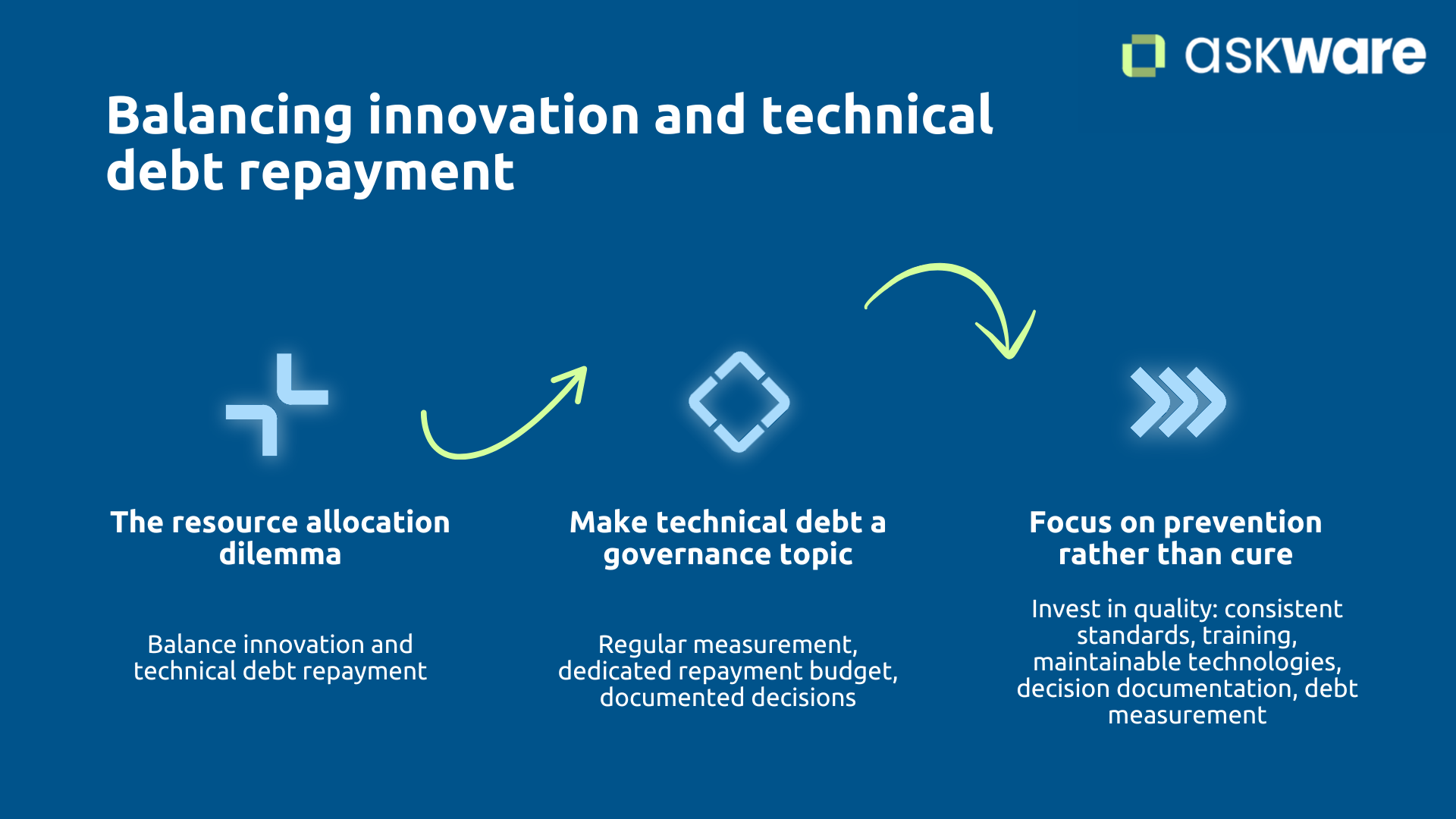
The resource allocation dilemma
Managing technical debt means constantly balancing between two contradictory imperatives.
On the one hand, innovation in new functionalities to generate revenue and maintain competitiveness by meeting customer needs. On the other hand, the repayment of debt to improve the existing, reduce future costs, increase speed.
The risks of extremes are catastrophic.
- 100% innovation and 0% reimbursement? Debt explodes until the system collapses.
- 100% refund and 0% innovation? You are stagnant and losing market share.
Recommended balance follows the 70-30 or 80-20 rule: devote 70 to 80% of your resources to innovation and 20 to 30% to reimbursement. Adjust based on your current debt level.
Making technical debt a governance issue
To manage technical debt sustainably, it must become a subject of strategic governance.
To do this, the debt must be subject to a regular measurement via a dashboard that is reviewed quarterly, a budget must be explicitly dedicated upon reimbursement and the systematic documentation decisions to voluntarily take on debt with a repayment plan
Management role is crucial: to understand that technical debt has a direct impact on competitiveness, to make informed decisions, and to support IT teams in their refactoring requests.
Role of the CIO is to make debt visible through understandable reporting by translating debt into business impact, propose pragmatic plans and validate major technical choices beforehand.
One IT governance structured naturally integrates debt management like any other strategic risk.
Preventing rather than curing: best practices for limiting future debt
Best strategy All that's left is not to accumulate debt. Among the best practices:
- Investing in quality from the start : automated tests, code reviews, documentation
- Adopting consistent standards : homogeneous architecture, shared code conventions, reuse of components
- Continuously train teams : increasing skills in modern technologies, sharing knowledge and technological intelligence
- Use maintainable technologies : stacks with long term support and a large community
- Documenting architecture decisions (ADR) : explain why this choice was made
- Measuring technical debt from the start : analysis tools integrated into the CI/CD, alerts on the increase in debt
By adopting these practices now, you are transforming technical debt from a fatality into a controlled risk.
Technical debt is neither inevitable nor a mystery. It is the accumulation of compromises that generates increasing costs and blocks innovation. It is a business obstacle that directly impacts your competitiveness.
The good news? It can be measured, quantified in euros and gradually reduced through pragmatic strategies. Organizations that actively manage their technical debt maintain their agility over the long term.
At Askware, we systematically integrate the assessment of technical debt into our digital audits. We quantify it accurately and propose appropriate strategies: gradual refactoring, targeted modernization or migration to Dynamics 365, Power Platform and Azure that structurally solve architectural problems.
Ready to make your invisible technical debt visible and regain control of your agility? Let's discuss your modernization strategy.