How serverless is revolutionizing your applications
Discover serverless: automatic scalability, optimized costs, increased performance. Askware guides you to adopt it effectively.

Your business management requires more agility, your IT team is drowning in technical debt, while you juggle between legacy systems and SaaS applications that don't communicate with each other.
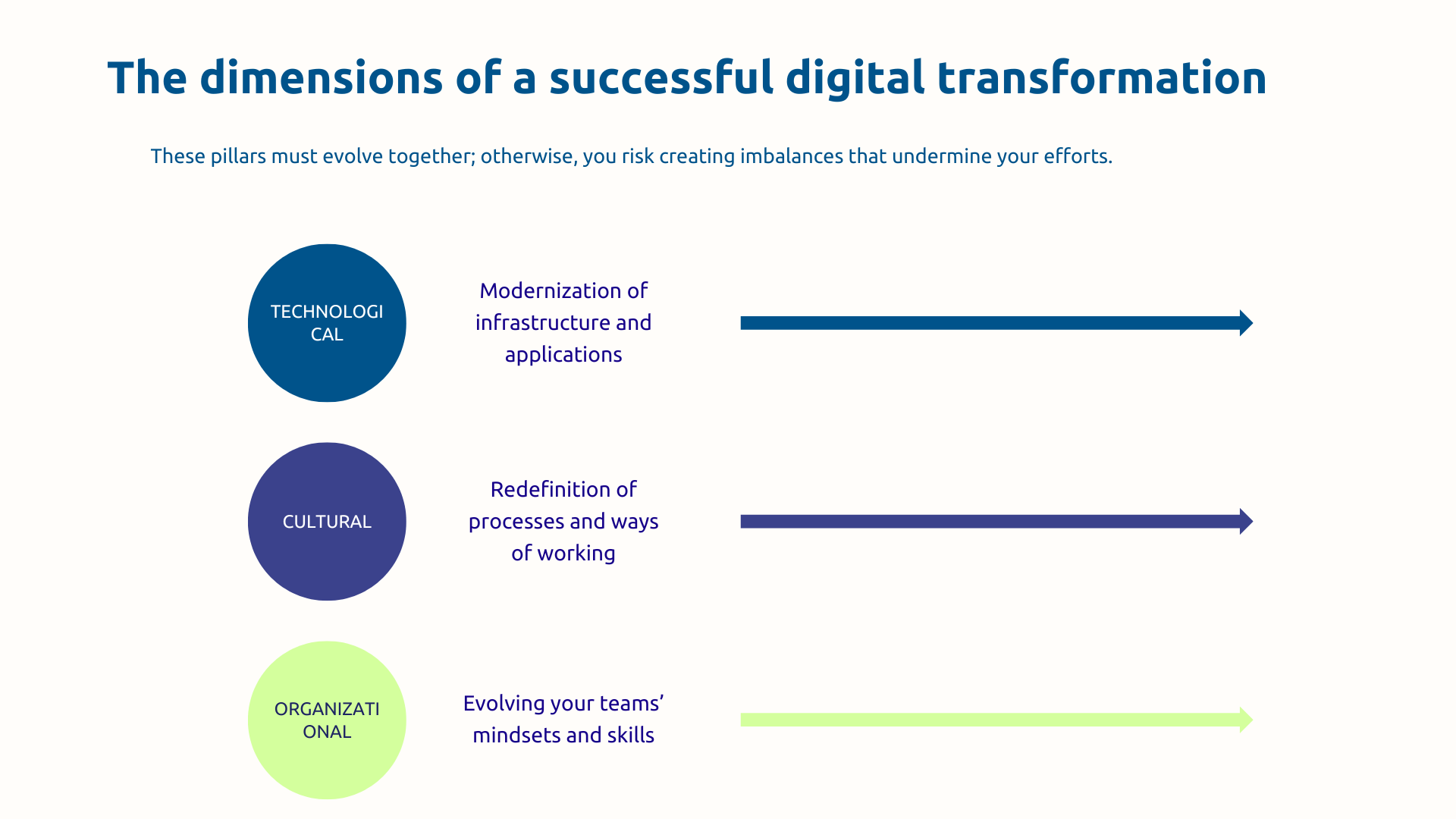
Digital transformation is the structured response to this fragmentation that paralyzes your organization. But be careful, a real transformation orchestras operational performance, enhanced security and capacity for growth like an integrated system.
In this article, we'll show you how to drive this transformation from start to finish. First, you'll learn about the three pillars of successful transformation, and then how the Microsoft ecosystem serves as a unified infrastructure to enable them. We will then detail the implementation methodology before illustrating it with real use cases where performance, security and growth are orchestrated over time.

Digital transformation refers to the approach by which you Rethink your business processes, operating models, and value proposition by exploiting digital technologies.
Today, your customers expect a smooth and personalized experience, your employees want modern tools that make them effective, and your competitors are investing heavily to become more agile. Therefore, transformation is becoming a strategic imperative.
Silo projects are the most common symptom. Marketing is deploying its marketing automation tools, sales are adopting their CRM, finance is modernizing its ERP, everyone in their own corner. In short, there is no big picture and the result is that new silos replace the old ones, and that complexity increases rather than decreases.
In addition, given the lack of measurement and control, you do not know if it works, you cannot adjust and therefore you Sail blindly without a defined KPI, without a dashboard, without governance. It is then impossible to justify the investments or to guide the arbitrations.
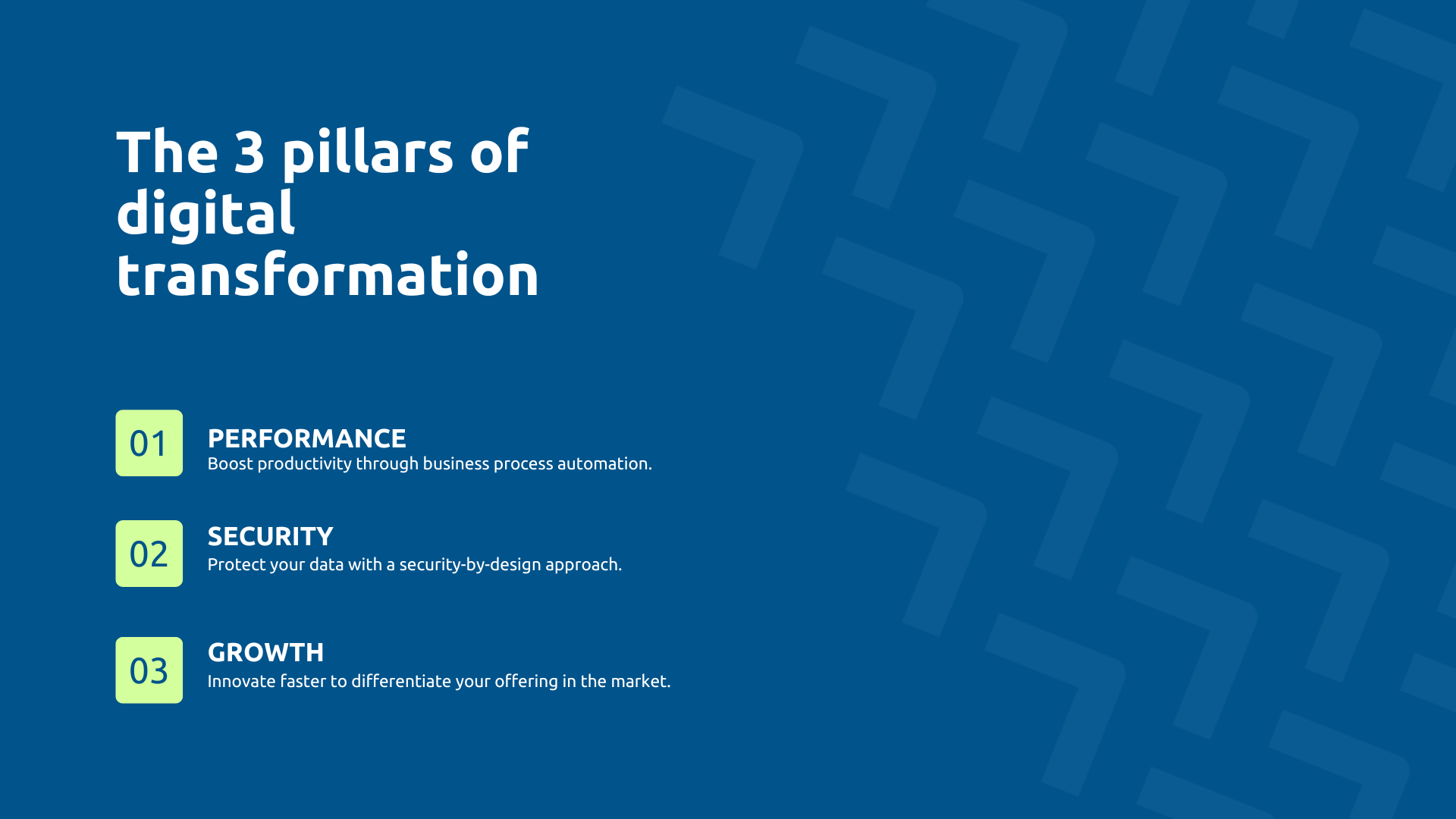
First pillar, performance aims at measurable productivity gains that free up time and resources for high value-added tasks.
Focus on first automating tasks with no added value. How much time do your salespeople spend manually entering information into the CRM? How many hours do your accountants spend reconciling data between systems? These repetitive and time-consuming activities can be automated, reducing errors and drastically speeding up cycles.
Beyond automation, it is also about streamlining the collaboration and decision making.
For example, an omnichannel approach to customer service with well-designed self-service can reduce ticket volume by up to 40% while significantly improving satisfaction.
Second pillar, security by design means integrating protection right from the design stage of your new processes and systems. Each architectural decision must integrate the security dimension: how to authenticate, how to authorize, how to encrypt, how to trace.
In fact, this means rigorous identity and access management, data protection through encryption and classification, as well as resilience and business continuity mechanisms. In short, IT governance and compliance (RGPD, ISO 27001, DORA depending on your sector) are safeguards that create trust — from your customers, your regulators, and your employees.
Note that a Zero Trust approach allows you to rethink security in the Microsoft ecosystem by applying the principle of least privilege at each level.
Product innovation and the reduction of time-to-market constitute a first lever. In other words, your ability to launch new products or services more quickly than your competitors creates a direct competitive advantage. Thus, low-code platforms allow you to test hypotheses in a few weeks instead of several months.
At the same time, the transformation opens the door to new business models. Servicization — moving from selling products to selling services — relies heavily on digital technology. In this context, an industrial equipment manufacturer can offer predictive maintenance based on IoT and thus create a recurring and predictable income, as we will see in our use cases.
This ability also makes it possible to create a differentiating customer experience or a factor of loyalty and acquisition. Large-scale personalization, fluid omnichannel, proactive forecasting of needs: these capabilities are based on the intelligent exploitation of data in a data-driven logic and the automation of interactions.
The hidden cost of application silos far exceeds the apparent savings of specialized solutions chosen for their excellence in a specific field. Your teams are wasting time switching between applications, re-entering information, and reconciling contradictory data. Your analytics projects fail due to a lack of consolidated data. Your IT maintains dozens of fragile custom integrations that break with each update.
As a result of this unification, the competitive advantage of an integrated ecosystem lies in fluidity. When your tools speak naturally to each other, your processes accelerate, your data flows without friction, your teams focus on their business instead of fighting against their tools. Rather than juggling 5 heterogeneous solutions, you centralize on Dynamics 365 (CRM), Teams (communication), Power BI (reporting) and SharePoint (documents) with native integration and unified governance.
Dynamics 365 is a modular platform divided into several modules that each tackle a specific field:
The major advantage? Data flows between modules thanks to Dataverse, Microsoft's unified data layer.
For example, an industrial distributor uses Dynamics 365 Sales to manage its sales force, Field Service to orchestrate technical interventions for customers, and Customer Service for after-sales service. When a salesperson identifies a maintenance need, they automatically create an intervention assigned to the best available technician according to their skills, location and availability.
Power Platform democratizes the creation of business solutions and is a transformation accelerator major:
In practice, this low-code approach allows you to reduce development times a few weeks instead of several months to create a functional application. You involve businesses in the creation of solutions through citizen development: your business experts who know the real needs can now contribute directly.
Be careful, however, low-code is not no-governance. You need to train your users, set up Data Loss Prevention (DLP) policies to avoid anarchy, and combine low-code and pro-code according to complexity. Simple low-code solutions, complex architectures in classical development. This approach fits perfectly into a modern and secure collaborative environment.
If you are looking first to Modernize your infrastructure, migrating applications to the cloud reduces your costs while increasing your agility. Don't you want to change everything at once? A hybrid architecture allows you to reconcile your existing situation and your future innovations without a sudden break.
But it's on Data exploitation that Azure reveals all its power. Azure Synapse allows you to analyze massive volumes of data, Data Factory orchestrates its flow between your systems, and Azure Machine Learning creates predictive models that transform this data into actionable decisions.
The integration with Dynamics 365 and Power Platform is native. Dataverse can be enriched with data from Azure. Power BI connects directly to Azure sources. Custom applications on Azure interact with Dynamics 365 through standardized APIs.
A use case illustrates this power: a manufacturer uses Azure IoT Hub to collect data from its production machines, analyzes this data with Azure Synapse and Machine Learning to predict failures depending on the equipment up to 2 to 4 weeks in advance, then integrates these insights into Dynamics 365 Field Service to automatically trigger interventions of preventive maintenance.
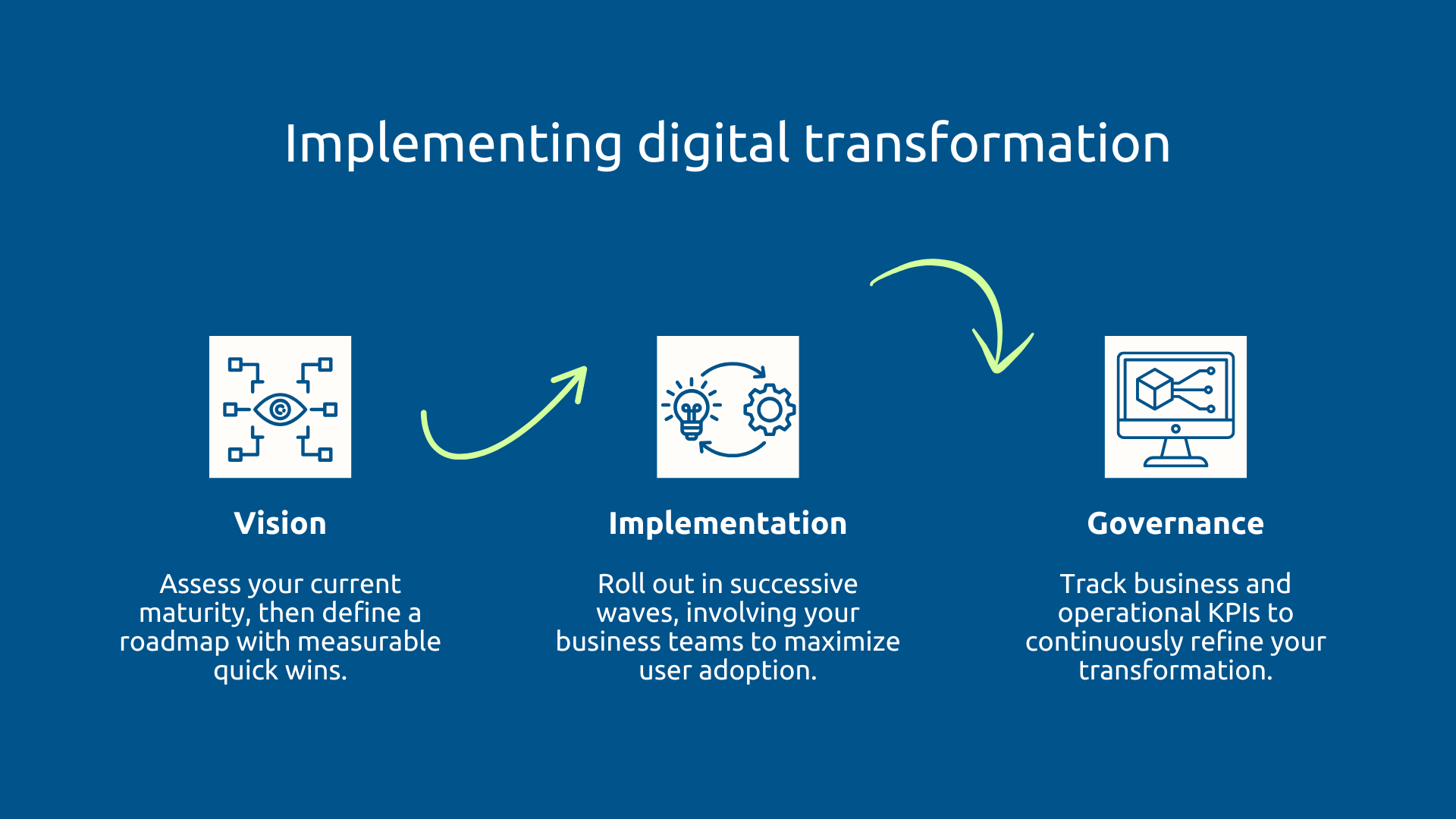
You only transform well what you understand. Multidimensional evaluation examine your maturity on several axes: business processes, technologies, data, organization. Mapping the existing situation often reveals surprises that allow projects to be prioritized according to their real impact.
Once this diagnosis is made, you build your strategic vision. What are your business goals for 3-5 years? How can digital technology accelerate these goals? What customer and employee experience do you want to create? What KPIs measure your success?
Transformation roadmap structure the path. Identify your quick wins: quick results that create momentum and fund the future. Sequence your structuring projects over several waves. Use an effort/impact matrix to prioritize intelligently.
For example, rather than a tunnel project that often lasts 18 months, start by automating lead-to-quote in Dynamics 365 Sales for a pilot region (between 2 and 4 months depending on the complexity), measure the gains (time saved, conversion rate), and then gradually extend to other regions and processes.
Technology is only one part of the transformation, the main thing is in humans and their ability to adopt change.
The MVP approach and the successive waves avoid the big bang. Start small with a limited scope, measure what works, adjust quickly, then expand. This iterative logic creates visible successes that fuel buy-in instead of promising hypothetical results in 18 months.
This iterative approach is accompanied by a involvement of professions from the design stage. Identify your business sponsors and champions — these influential early adopters who will carry the project forward. Don't build solutions FOR trades, build them WITH them. Co-design, test, adjust continuously.
At the same time, the training adapted to profiles rejects the one-size-fits-all approach. Your salespeople don't need technical training on Dataverse architecture. They want to understand how the new tool helps them sell more effectively. Local start-up support radically changes adoption rates: deeply trained super-users, a responsive hotline, and a public celebration of success.
A transformation has no “end.” It is a process that requires constant measurement and adjustment. You need to track two main categories of indicators:
These objective data make it possible to measure the Before/after and to quantify the gains. If you can't prove results that are typically seen in similar projects — such as a sales cycle going from 45 to 30 days, processing costs dropping by 35%, or customer satisfaction gaining 15 points — you can't justify the investment or guide your next decisions.
Power BI dashboards consolidate all these indicators. For example, a dashboard allowing COMEX to monitor monthly +25% sales productivity, -40% customer request processing time, a Dynamics 365 adoption rate of 82%, and user satisfaction of 4.2/5. What is not working should be fixed quickly through these regular reviews.
A company in the financial sector had to deploy Dynamics 365 while complying with the strict requirements of DORA (Digital Operational Resilience Act, European regulation for the financial sector applicable since January 2025). You can't compromise on safety.
The approach Security by Design configured the following elements from the start:
Assessment of this approach: DORA compliance audited and validated, no security incidents detected, and paradoxically, innovation maintained. Why? Because security built in from the start frees teams up instead of blocking them. They know that they operate in a secure environment and can innovate with confidence. Security then becomes a confidence accelerator : trust of customers, regulators, employees.
Second case, an industrial equipment manufacturer traditionally sold machines. Simple model: one-off sale, then spare parts and curative interventions invoiced on a per fee-for-service basis. But zero predictability in after-sales revenue, and customers frustrated by unexpected outages.
The transformation created a new economic model : predictive maintenance as a service. Azure IoT Hub collects data from machines installed at customer premises. Azure Machine Learning analyzes this data and predicts failures depending on the equipment. These predictions feed automatically Dynamics 365 Field Service who plans preventive interventions.
Measurable impact: a predictive maintenance contract of the order of a few thousand to ten thousand euros per machine and per year replaces random curative interventions. Income becomes recurrent and predictable. Customers can reduce unplanned downtime by up to 60%. The equipment manufacturer differentiates its offer, builds loyalty to its installed base, and increases its valuation. This case illustrates how digital transformation is not limited to internal efficiency but is becoming a strategic lever to create new competitive advantages.
Performance, security and growth are interdependent pillars to be orchestrated together. The Microsoft ecosystem offers an integrated platform that simplifies this orchestration, provided it is deployed with a real strategy and a pragmatic and measurable approach.
Each business is unique, and your transformation must be tailor-made. It is precisely this combination that Askware offers: the strategic vision of a consulting firm and the technical precision of a Microsoft expert integrator.
Ready to structure your digital transformation? Contact Askware for a maturity diagnosis and discover how to align your business ambition with the right Microsoft technologies.
The key is to stop thinking “IT project” and to think “orchestration program”. First, make sure you have a clear business vision from senior management. Then, move forward in quick iterations with quick wins that show value in a few months. Invest massively in change management: training, champions, local support. And above all, measure everything with clear KPIs, because you only manage what you measure well.
Because you're buying an integrated platform where everything communicates natively: Dynamics 365 with Power Platform for automation, with Azure for data, with Teams for collaboration. Your data flows without friction, your IT does not maintain dozens of fragile integrations, and you have a single partner instead of juggling five publishers. This architectural simplicity frees up resources to innovate rather than maintain.
Everything depends on the transformed perimeter and the complexity of the existing one. An SME with 80 to 120 employees that automates its business processes can start for a first targeted phase with a few tens of thousands of euros. A complete architectural overhaul is in the hundreds of thousands. But the main thing is ROI: if your transformation generates substantial annual gains and accelerates your growth, the investment is quickly justified. Start with a diagnosis to quantify your potential and build a solid business case.
Our experts share their vision of best practices and technological trends to ensure the success of your digital transformation.