Microsoft Defender vs Sentinel: how do you move from reactive security to proactive surveillance?
Learn about the differences between Defender and Sentinel, how they complement each other, and how to build a proactive security architecture.

Traditional application architectures require infrastructure sizing for peak loads, which causes waste during off-peak periods. Servers run empty, consuming budget and energy without producing value. At the same time, IT teams devote a significant part of their time to operational management at the expense of developing new business functionalities.
The Serverless promises to solve this paradox by completely delegating infrastructure management to the cloud provider. You only pay for what you actually consume and scaling becomes automatic.
In this article, you'll learn how it transforms the scalability and performance of your applications, when to adopt it, and how to integrate it into your Azure architecture.

The term “serverless” is confusing. Servers exist, but serverless computing is a model where cloud provider dynamically manages resource allocation. You write code, deploy it, and that's it. Provisioning servers, installing operating systems, patching vulnerabilities — all of this disappears from your perimeter.
You pay only for actual run time of your code, measured to the millisecond. No idle servers that cost a fortune during off-peak hours. Scaling becomes automatic and transparent: from zero to thousands of instances in a few seconds, without any intervention on your part, within the limits of your Azure subscription quotas.
The idea behind serverless is to delegate complexity as much as possible to focus on business logic.
Azure Functions is the core of the device for the execution of event code. It is triggered in response to HTTP requests, scheduled timers, messages in queues, or file changes.
To orchestrate more complex workflows, Azure Logic Apps takes over by visually connecting more than 600 business services such as Dynamics 365, SAP or SharePoint, all with a low-code approach.
Azure Event Grid acts as the nervous system of this architecture by intelligently routing events between your various components with very low latency.
Beyond these compute services, the ecosystem extends to containers and data. Azure Container Apps allows you to deploy your Docker containers in serverless mode without having to manage the complexity of Kubernetes. Azure Cosmos DB serverless completely eliminates capacity provisioning for your databases, you only pay for the operations actually performed.
Finally, Azure API Management En tier consumption manages your APIs with billing strictly proportional to the number of calls.
Serverless is part of a spectrum of cloud models, each with its own trade-offs:
The Serverless pushes abstraction to the maximum: highly elastic automatic scaling, native event model, payment strictly at runtime. But you are losing control and have to deal with certain constraints (cold start, timeout).
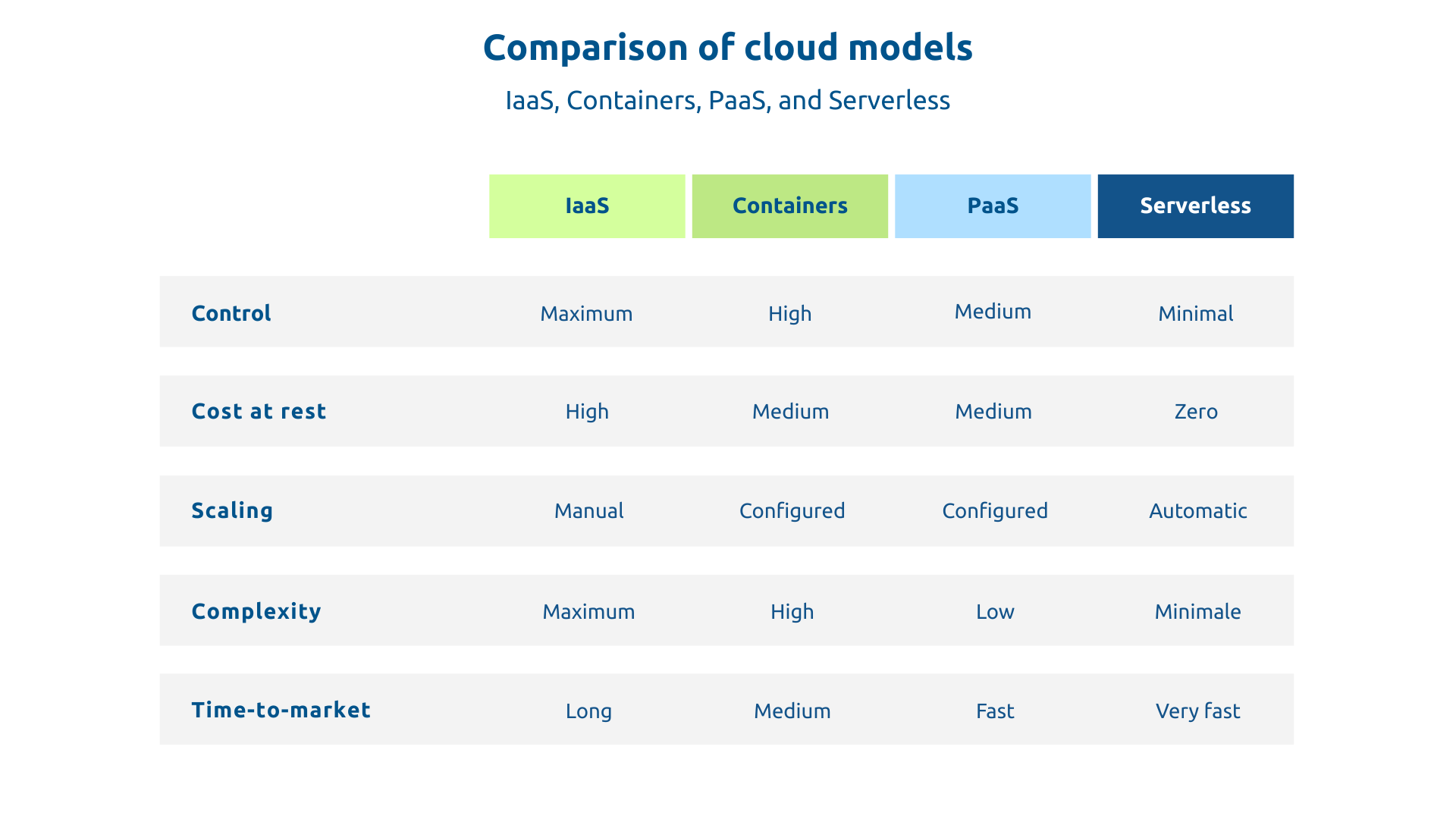
Serverless excels for event-based and intermittent workloads, but combines with other approaches in a hybrid architecture.
The real superpower of the serverless is its Scaling “from zero”. When your application receives no requests, no resources are consumed. As soon as a request arrives, an instance is activated quickly.
Conversely, scaling becomes very elastic : from 10 to 10,000 requests per second without prior configuration, within the limits of the configurable quotas of your subscription.
You no longer have to manage load balancers, autoscaling groups or capacity planning. If an instance fails, it is automatically replaced without intervention.
For example, an image processing department receives 10 images per day on average, but 10,000 images in one hour during a marketing event. With traditional architecture, you would have sized for this exceptional peak, maintaining oversized servers all year round. With Azure Functions, the system automatically scales to absorb the peak and then go back down to zero.
The serverless Align costs to actual use. Azure Functions offers 1 million free executions per month and 400,000 GB-seconds for free in the Consumption plan. Beyond that, the cost remains very competitive with invoicing at the time of execution and the resources consumed. For an application processing 100,000 monthly requests with 500 ms of execution and 512 MB of memory, the costs can remain very low, even in the free envelope.
Whether your application serves 10 or 10,000 requests, an Azure App Service in the Basic tier costs around 50-55€ per month and runs 24 hours a day, even when no one is using your service.
Serverless is transforming these fixed costs in variable costs aligned with your business. However, be careful: inefficient code that runs in 5 seconds instead of 500 ms multiplies your costs by 10. Management via Azure Cost Management is becoming essential.
No more OS to patch, no more middleware to configure, no more low-level monitoring. Deployment becomes simple: you push your code, it runs immediately.
Integration with GitHub Actions and Azure DevOps is native. Your developers become more autonomous, no longer depend on ops teams for each deployment. The iterative cycle is accelerating drastically.
For example, developing a new API, in IaaS, could take you 2 weeks for the infrastructure. With serverless: only 2 days of development for immediate deployment.
Resilience and high availability can be configured according to your needs, with redundant deployment options and built-in retry mechanisms. Observability integrates directly with Azure Monitor and Application Insights.
Serverless excels at creating Lightweight and responsive RESTful APIs. Azure Functions easily exposes HTTP endpoints that respond to requests from your applications. By combining it with Azure API Management, you get a comprehensive API gateway that manages the throttling, authentication, and monitoring of your endpoints centrally.
The architecture event-driven becomes particularly powerful in this context because it decouples your microservices from each other. Instead of calling each other directly, your services publish events to Azure Service Bus or Storage Queue. Other functions then consume these events asynchronously, at a rate that suits them.
This approach provides a resiliency remarkable: if a consumer service is temporarily unavailable, the messages remain wisely in the queue waiting for its return. No data is lost.
For example, a notification API receives a “new user created” event. This event automatically triggers three Azure Functions that run in parallel. The first sends the welcome email, the second creates the user's SharePoint folder, the third notifies the onboarding team via Teams.
Each function scales independently according to its own workload. This modular architecture facilitates the gradual evolution of your system: you can add new processes that react to the same event without ever touching the existing code.
Azure Functions is triggered automatically upon arrival of data in Event Hub, IoT Hub or Blob Storage thanks to its native triggers. You transform, enrich, and route on the fly and then persist in Data Lake or Cosmos DB.
Automatic scalability is a game changer: treat 10 or 10,000 events per second without reconfiguration.
Industrial IoT pipeline: sensors send their measurements to the IoT Hub. An Azure Function detects anomalies in real time (temperatures exceeding a threshold), generates an immediate alert, and stores all data in Data Lake for historical analysis. The whole thing scales if you multiply the sensors by 10 tomorrow.
The combination Azure Functions and Logic Apps becomes an automation engine for your complex workflows. Triggering via email, form, database modification, timer or webhook.
Integration with more than 600 systems is done via connectors: Dynamics 365, SAP, Salesforce, SharePoint, Teams. Logic Apps orchestrate multi-step processes with error management and retry.
For example, a new contract is uploaded to SharePoint. An Azure Function automatically retrieves key information (amount, customer, duration). Logic Apps then launches an adapted approval workflow: automatic validation under €10K, approval by the sales director between €10K and €100K, transition to the management committee beyond that. Once validated, the contract is saved in Dynamics 365 and the customer receives a confirmation.
Azure Functions is becoming the ideal backend for your modern web and mobile applications built with React, Angular, React Native or Flutter. This approach is part of the model Backend-as-a-Service (BaaS) that provides all the essential services your frontends need: user authentication via Microsoft Entra External ID, file storage in Blob Storage, sending push notifications, and full-text search with Azure AI Search.
Your serverless APIs thus manage theset of business operations (creating, reading, updating and deleting data (CRUD), complex searches, aggregations) without you having to maintain dedicated backend servers that run constantly. Automatic scaling perfectly absorbs unpredictable traffic spikes, such as during a successful marketing campaign or a buzz on social networks.
Integration with Azure Static Web Apps takes this logic even further by offering a serverless full-stack deployment experience. Your static frontend is hosted on a global CDN for maximum performance, while your Azure Functions APIs are automatically deployed at the same time, all with free HTTPS and preview environments for each pull request.
To really take advantage of serverless, Rethink your architecture in event-driven mode. Each business action generates an event, each component reacts to events that concern it.
Decoupling via events changes the structure of your systems. Your services are no longer called directly but publish in Event Grid, Service Bus, or Storage Queue. This asynchronous architecture improves resiliency : If a service is down, the events remain in the queue and will be processed once the service is restored. Scalability becomes independent for each component, which can scale at its own pace.
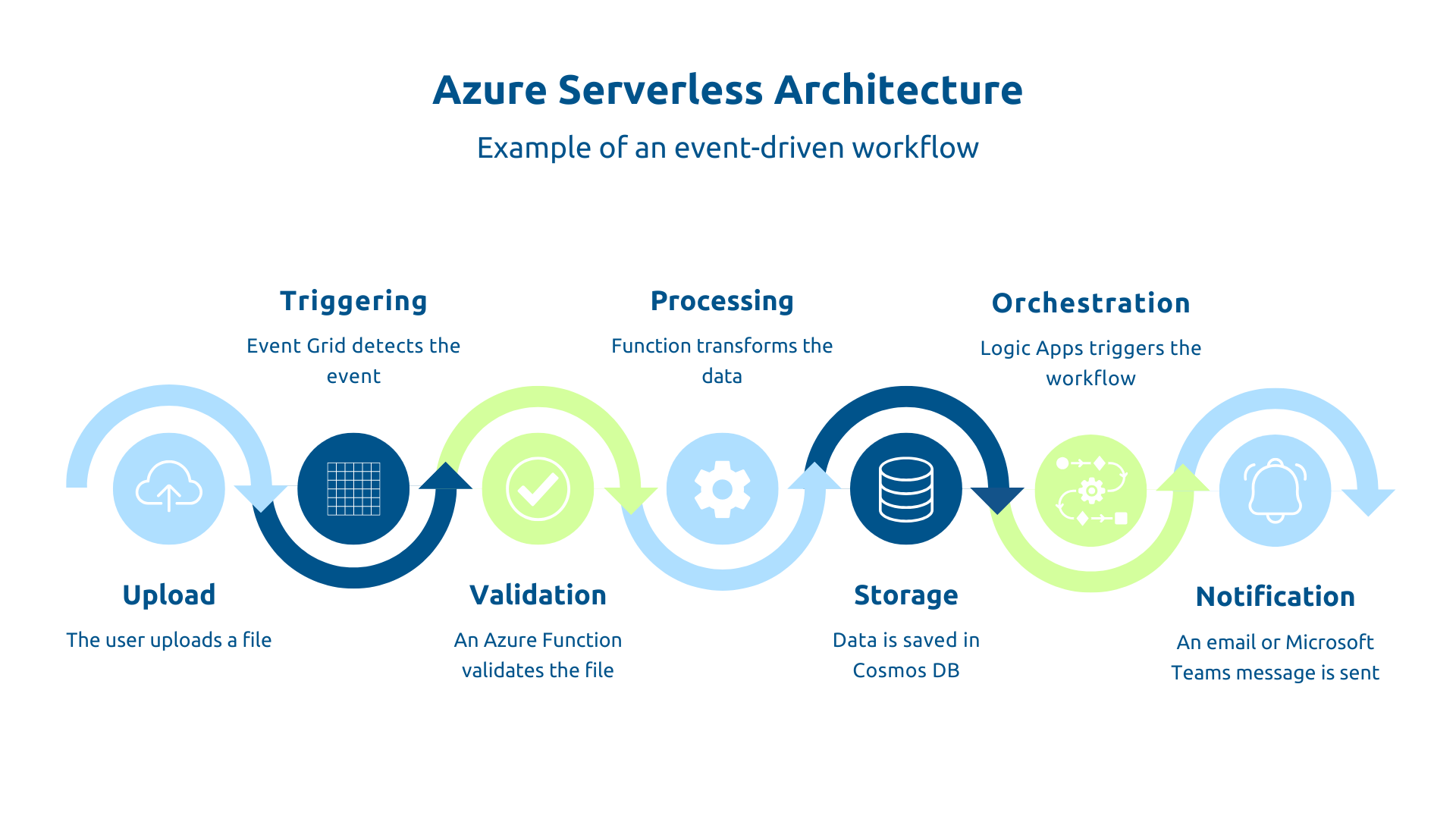
Typical architecture: a user uploads a file to Blob Storage. This generates an event routed by Event Grid to a validation Function. Once the file is validated, a new event triggers a processing Function. After processing, a final event activates a Notification Function. Each stage is isolated, independently testable, and scaled according to its own load.
Serverless is not a one-size-fits-all solution that replaces everything. The best architecture intelligently blends serverless, containers, and PaaS according to the needs of each component. This approach respects the shared responsibility model where Microsoft secures cloud infrastructure while you secure your applications and data.
For the Frontend, Azure Static Web Apps offers optimal serverless hosting. Your lightweight, event-based APIs find their place in Azure Functions. Complex, stateful business services that require fine control stay better on App Service or Azure Kubernetes Service.
For the data, combine Cosmos DB for global scalability and managed Azure SQL for relational needs. Integrations and workflows are orchestrated with Logic Apps and Event Grid.
For the authentication, use Microsoft Entra ID for your internal APIs, OAuth for your public APIs, or API keys managed through API Management for partner integrations. Authorization is finely configured with role-based access control (RBAC) according to the principle of least privilege. Never store secrets hard in your code: connection strings and API keys should reside in Azure Key Vault.
For the network isolation, configure VNet integration and Private Endpoints so that your functions communicate with your databases without exposure to the Internet. Security monitoring is activated with Microsoft Sentinel, which analyzes the logs and detects abnormal behavior.
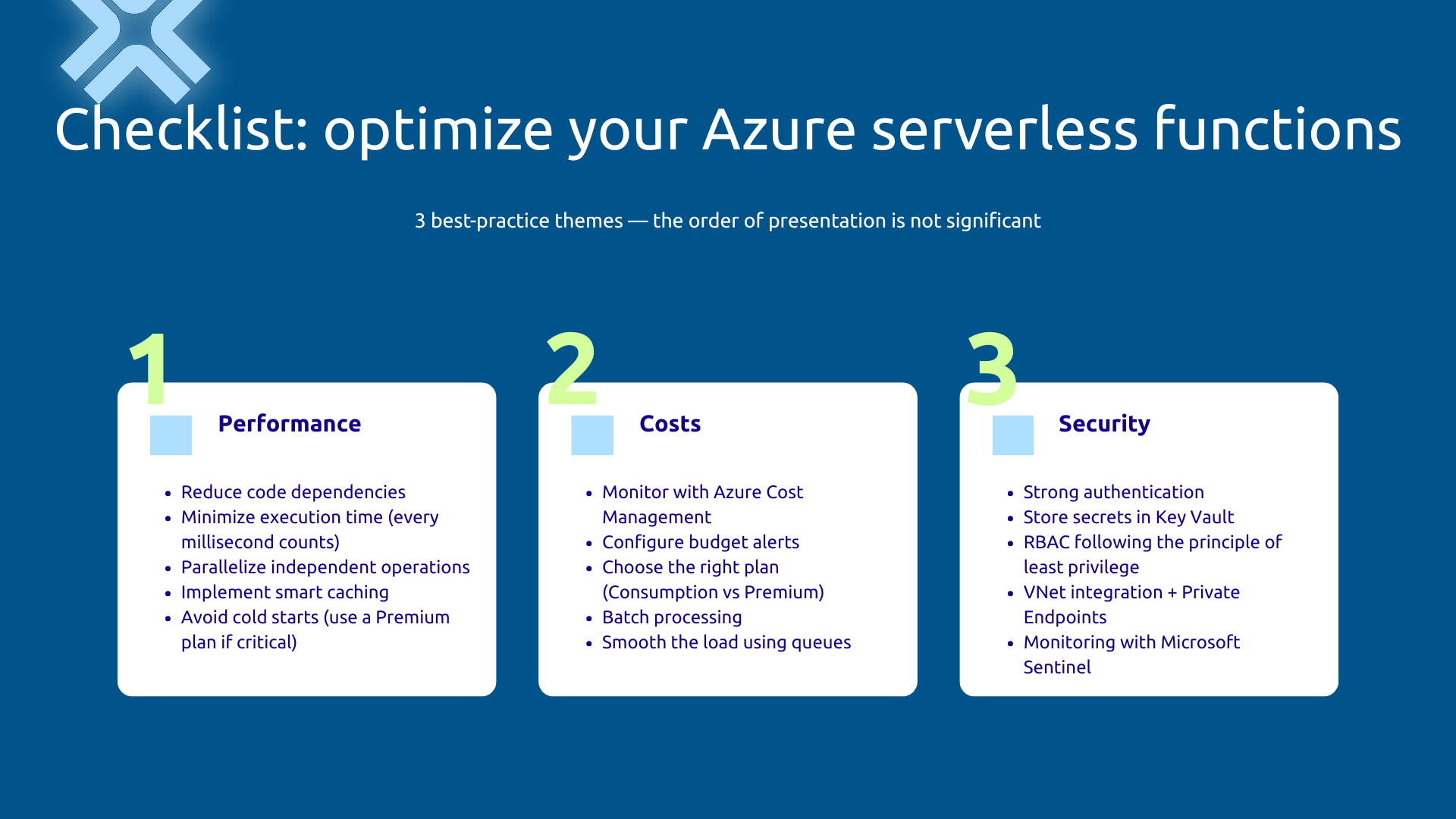
Optimizing performance and costs is critical because every millisecond is billed. Reduce code dependencies to limit load times. Minimize execution time by optimizing your algorithms and parallelizing independent operations. Monitor your costs continuously with Azure Cost Management and set up budget alerts to avoid unpleasant surprises.
Follow some best practices:
The choice of rate plan directly impacts your costs and performances. The Consumption plan offers pure pay-per-use with a default timeout of 5 minutes (maximum 10 minutes), ideal for intermittent workloads. The Premium plan maintains warm instances all the time, eliminates cold starts, integrates VNet natively, and allows unlimited runtime, but with a higher fixed monthly cost.
Serverless is not just a trend but a profound paradigm shift that rethinks the scalability, performance and economy of applications. By delegating infrastructure management to the cloud, you free up your teams to create business value and accelerate innovation.
The real question is no longer “should serverless be adopted?” but “where and how to integrate it to maximize its value?” Do you want to explore how serverless could transform your applications and reduce your infrastructure costs? Contact Askware for a discovery workshop and identify opportunities to migrate to Azure serverless with our Microsoft experts.
Serverless is a model where you no longer manage the infrastructure. You write your code, deploy it, and the cloud provider takes care of the rest: provisioning the servers, managing scalability, patching the flaws. You only pay for the actual execution time, per millisecond. No idle servers that run empty. It's like Uber: you use the service when you need it, without managing maintenance.
Containers offer more control and portability but you need to orchestrate with Kubernetes, configure scaling, and manage nodes. Serverless pushes abstraction further: no infrastructure to manage, fully automatic scaling with great elasticity, but less fine control. The two approaches often complement each other according to the needs of each component in the same architecture.
It depends on what you use it for. For intermittent or unpredictable traffic, the savings are massive. For an application with a lot of constant traffic, serverless can cost more than a dedicated server. The important thing: analyze your real load, optimize your code to reduce execution time, and monitor your costs. Serverless transforms your fixed costs into variables, but it requires careful management to avoid surprises.
Our experts share their vision of best practices and technological trends to ensure the success of your digital transformation.