Creating an effective Design System: a complete method
Discover the Design System: definition, benefits, creation methodology. Expert guide to unify your digital ecosystem.

According to several Gartner studies, CIOs believe that business demands ignore technical realities, while business departments perceive IS as a barrier to innovation. This deaf dialogue is expensive: projects that fail, budgets that explode, opportunities missed. And in the meantime, your competitors are moving forward.
This article shows you how to transform this dysfunctional relationship between CIO and business departments in a genuine strategic partnership. You will discover the profound mechanisms that create these frictions, then a concrete methodology for building effective collaboration. With examples from the field and a focus on the Microsoft ecosystem as a dialogue facilitator, you will leave with an action roadmap to finally align IT and business.

Your DSI reasons in terms of stability, security and risk management. She thinks about technical debt, scalable architecture, compliance; all over the long term, because a technical decision today engages the company for years.
As for your business directions, they think in terms of opportunities, innovation and time-to-market. They think about customer experience, market share, turnover. Their horizon? The current quarter, because commercial pressure leaves them with no choice.
Thus, in the field, the IT department will prioritize maintaining operational conditions, security updates, and reducing technical debt, while businesses will prioritize new tools, functionalities that make a difference from the competition, and visible innovation. In short, a clash over development priorities.
This problem is all the more aggravated by the technical vocabulary barrier. For example, when the IT department refuses a project by evoking “the absence of a REST API on the legacy”, the professions simply hear “no”. As a result, IT budgets are arbitrated without real visibility on the real business value of projects.
In other words, the absence of common valuation metrics means that each camp legitimately defends its priorities, which automatically collide.
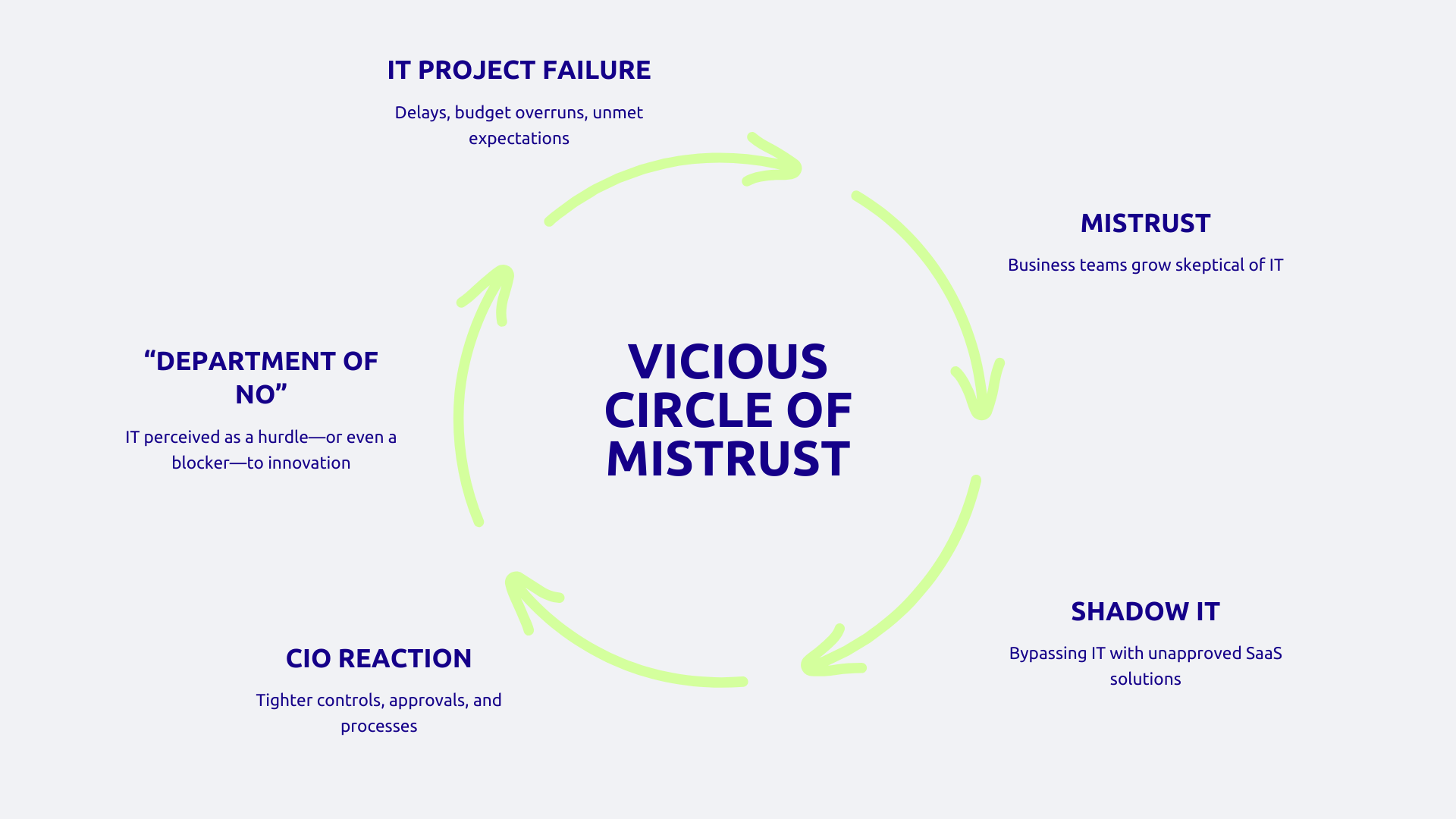
On the one hand, IT projects that did not keep their promises : chronic delays, budget overruns, functionalities delivered that do not correspond to initial expectations. These disappointments add up and create lasting skepticism.
On the other side, Shadow IT Which develops by circumvention. Frustrated by deadlines perceived as too long, business departments subscribe directly to SaaS solutions without IT validation. This circumvention creates security risks, data silos, and information system fragmentation. The IT department then tightens its governance rules, which reinforces the perception among businesses of a “no office” that blocks innovation.
It is a vicious cycle by which each deception reinforces mistrust which in turn makes the next collaboration more difficult, etc.
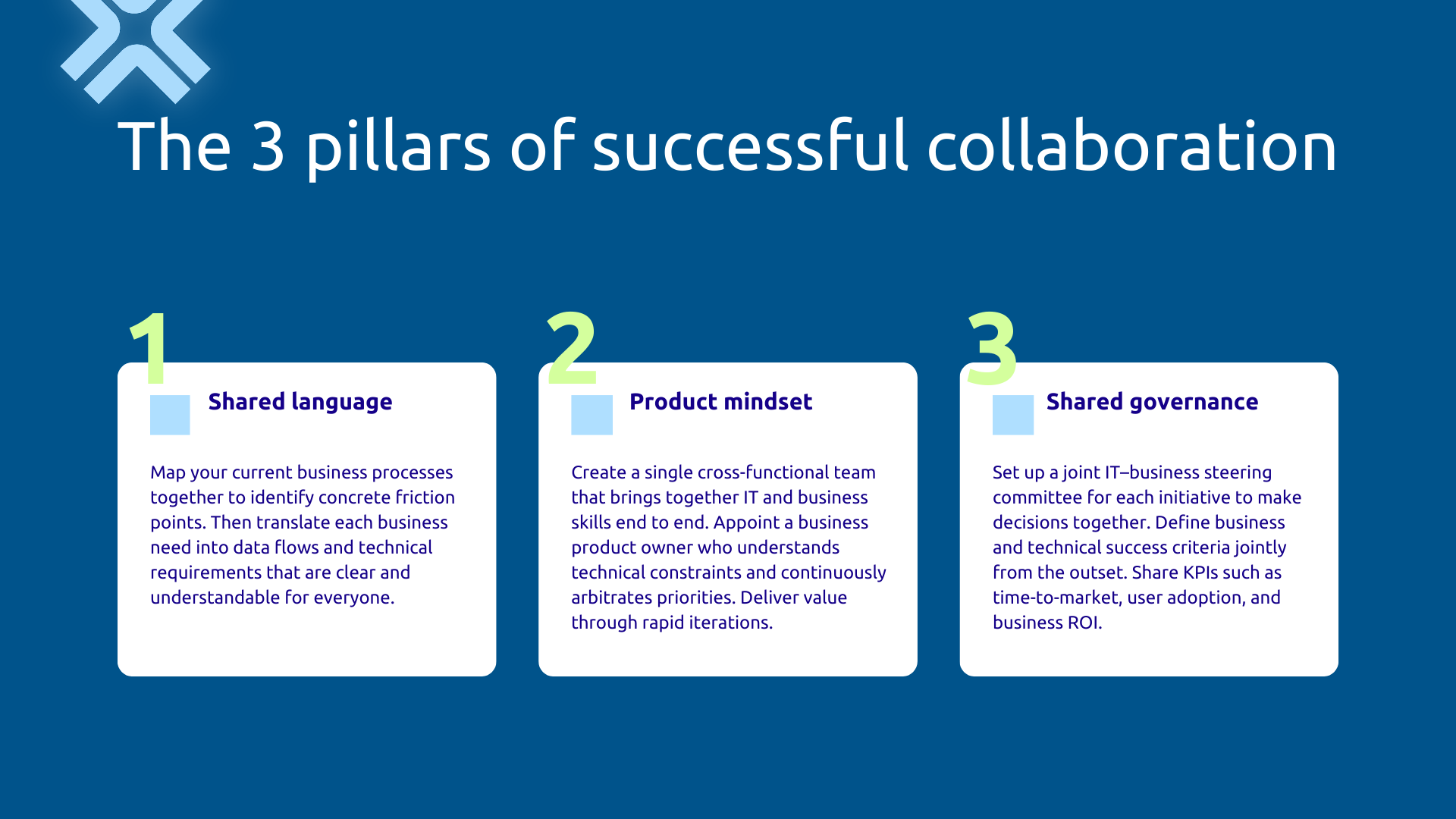
Collaboration is only improved by building a shared repository : business processes. This is the only area where CIOs and businesses can really meet.
Start with map your current and target business processes together, which is a true description of what happens on a daily basis:
This map highlights the concrete operational friction points. You no longer discuss “digitizing customer service” in an abstract way, but about, for example, resolving the fact that teams are wasting 40% of their time by re-entering between 3 different systems. The problem becomes tangible, measurable, and suddenly everyone understands what is at stake.
Then, translate each business need into data flow and technical requirements. Does sales management want to “better manage its business”? Technically, this means: consolidating data from the CRM, billing system and e-commerce platform, cleaning them up, structuring this data with validated business rules and feeding Power BI in near real time.
In fact, the establishment of a common language could follow a scenario of this type: a CRM project that starts with a business process mapping workshop. CIOs and sales managers discover together that salespeople lose two hours a day in administrative tasks with no added value. The two teams then immediately agree on the priority.
Project logic Classic creates a customer/supplier relationship between business and IT. The professions write specifications, the IT department develops for months. At delivery, the need has often changed and there is a disappointment on both sides.
Product logic changes this paradigm because it creates a multidisciplinary team with a common objective: business, IT and user experience work together from end to end. This approach is based on the appointment of business product owners who understand the technical constraints and arbitrate continuously with the IT department.
That said, we must be able to maintain commitment on both sides and that is why we will resort to quick iterations. In other words, rather than a major 12-month project, you deliver value every three weeks. Users test, give feedback, and the team adjusts immediately.
IT/Business governance must be based on a informed decision structure which gives as much weight to business challenges as to technical constraints.
Create a joint IT/business steering committee on each strategic initiative. A real space for co-decision where arbitrations are made collectively, with all the cards in hand.
To achieve this, Define the criteria for success together, both business AND IT. Thus, for a CRM project, it is not only “increasing sales by 15% “, but also “achieving 80% user adoption” and “maintaining an availability rate of 99.5%”.
As you will have understood, to evaluate using the same language, you must therefore share KPIs :
We cannot collaborate well remotely or by email: CIOs and business departments must devote part of their time to working together, in a structured format.
The ideal workshop format thus combines a half-day to a full day:
Use visual methods such as design thinking or event storming. These approaches do not require any particular technical skills because we work with post-its, diagrams, drawings.
The important thing? Involve technical AND business profiles from the early stages. Do not start with specifications written in isolation, but with a co-construction of the solution.
Likewise, set up a regular rhythm : quarterly workshops to review the digital roadmap, monthly prioritization sessions.
Typical scenario of a co-design workshop: a two-day sprint design workshop between CIO and supply chain management to rethink inventory management. The team prototypes a Power Apps solution in real time during the workshop and leaves with a functional prototype (MVP) to be tested within fifteen days.
Collaboration necessarily starts from people occupying dedicated roles and investing time in the relationship between IT and business: Business Relationship Managers (BRM).
The BRM is a hybrid profile : solid IT skills + in-depth business understanding. Its mission will be to translate business needs into technical requirements, and vice versa. When the marketing department says “we want to improve the customer experience”, the BRM translates: “we need to unify CRM, e-commerce and customer service data on Dynamics 365, create a 360 customer view, and automate personalization via Power Automate”.
This role can be carried out by Dynamics and Power Platform senior consultants who already speak both languages. Example: a BRM dedicated to the CIO/marketing department relationship participates in the marketing COMEXs AND the DSI COMEXs. It guarantees permanent alignment, anticipates misunderstandings, and facilitates trade-offs.
Trust is built little by little, based on the evidence of trust that CIOs and business departments each provide.
More concretely, systematically prioritize Quick Wins, namely initiatives that can be delivered within a maximum of 4 to 6 weeks. No major redesign projects, only targeted improvements in relation to a real business problem.
For example: the automation of out of stock alerts via Power Automate connected to the ERP system. Project delivered in 4 weeks, breakdowns detected automatically since deployment, immediate satisfaction of the supply chain management who now avoids costly production stoppages.
Communicate widely on these successes: internal newsletter, presentation in COMEX, user testimonies. You are gradually changing the internal narrative about the CIO/business relationship.
Some technologies naturally facilitate IT/business collaboration. The Microsoft ecosystem is one of them, precisely because it speaks to both worlds simultaneously.
On the IT side, the unified architecture reassures: Azure for cloud infrastructure, centralized governance, enterprise-grade security with Entra ID, regulatory compliance.
On the business side, the interfaces remain accessible: Power Apps to create applications without coding, Power BI to visualize data, Power Automate to automate repetitive processes.
Dataverse acts as a common data repository. It is the foundation that ensures that everyone works on the same information. No more contradictory data between the CRM and the billing system: a single source of shared truth.
Low-code and no-code are fundamentally changing the dynamic of collaboration. Businesses can prototype their ideas and show what they have in mind in concrete terms. The IT department immediately sees what is required, can validate technical feasibility, and keeps control of governance and security.
Example: an HR department prototypes a Power Apps application for managing annual interviews. The DSI intervenes on the data architecture in Dataverse, configures permissions, and guarantees GDPR compliance. In two sprints, the application is in production: HR co-built their tool, the IT department has guaranteed its robustness.
This approach creates a culture of experimentation rather than fixed specifications. We test quickly, we adjust continuously, we learn together.
A good integrator brings dual expertise: strategic advice and technical integration. It includes your business processes, your business challenges, your organizational constraints. And he knows how the Microsoft ecosystem can respond to it in concrete terms.
Its added value? Ability to lead mixed CIO/business workshops with a proven methodology. It facilitates dialogue, translates languages, helps prioritize, and guides to pragmatic solutions.
This position as a trusted third party changes everything. When Askware gets involved in a CRM redesign project, we don't start by talking about Dynamics 365. We start with business process mapping workshops with sales management AND the IT department. We end up with a shared vision before talking about technology.
Long-term support also makes a difference. A transformation project does not end with the start of production. We need to support change, train teams, and adjust processes. Thanks to a partner that remains present, we meet the conditions for lasting success.
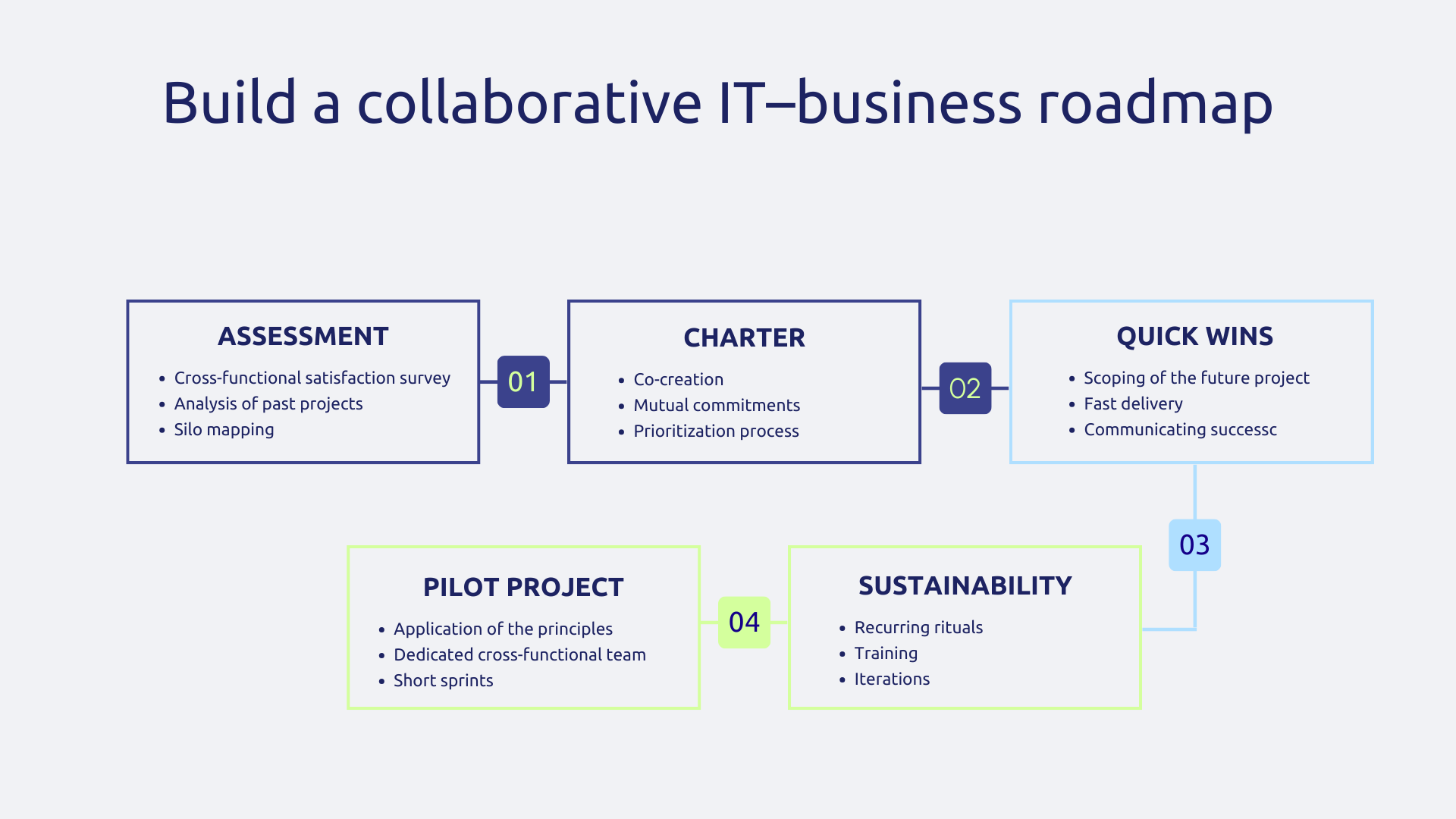
You can't improve what you don't measure. Start with a lucid diagnosis of the current situation of your IT/business relationship.
Lead a cross-satisfaction survey :
Identify the projects that went well or badly, and why then map the silos and friction zones. The ideal is to have this diagnosis carried out by an external third party in order to guarantee objectivity and to free speech.
Based on this diagnosis, co-build a IT/business collaboration charter. This charter formalizes mutual commitments: businesses undertake to mobilize key users and to clearly document their needs. For its part, the IT department is committed to response times, to budgetary transparency and to a presence in strategic business committees.
In addition, the charter defines a shared prioritization process with common evaluation criteria. It establishes the project governance rules : composition of steering committees, pace of reviews, monitoring metrics.
Concrete example: a charter that states that any project greater than 50,000 euros is the subject of a mixed IT/business framework workshop two days before launch.
Is the charter formalized? Perfect. Now it needs to be tested in the field. Pick a strategic but time-bound pilot project : 3 to 6 months maximum, strong business impact, dedicated team.
This pilot project must rigorously apply all defined principles : co-design workshops, mixed IT/business team, business product owner, short sprints, shared governance.
Celebrate and communicate on this success then Anchor the collaboration in the long term by institutionalizing it. Create recurring rituals: mixed monthly IT/business digital COMEXs, quarterly reviews of the quality of collaboration.
Finally:
In short, the real question is no longer “how do I digitally transform my business?” but “how to create the conditions for IT and business to transform together, in a dynamic of co-construction rather than opposition?” It is this change in posture that unleashes innovation and accelerates your projects in concrete terms.
Is your CIO/business relationship generating value or friction? Contact Askware and discover how to transform this relationship into a real driver of transformation.
Start small but start fast. Organize a half-day workshop where CIO and business management map a critical process together and identify the three main irritants. Then set one within four weeks. This first tangible success is worth more than six months of theoretical meetings on “improving communication”. Trust is built on concrete evidence, not on PowerPoints. Once this quick win is in your pocket, you can gradually extend the approach to other areas.
The modern CIO is no longer just a guarantor of technical stability, he is an architect of transformation who translates business ambitions into technological reality. His real role? Orchestrate the encounter between business opportunities and technical possibilities, while guaranteeing security, performance and compliance. He must spend as much time in business departments as with his IT teams, speak business language as fluently as technical language, and measure his success in terms of business impact rather than purely IT KPIs.
Don't fight Shadow IT head-on, understand what it reveals: legitimate dissatisfaction with IT processes perceived as too slow or rigid. The real solution? Offer a faster and just as easy alternative to uncontrolled SaaS tools. Power Platform plays exactly this role: your businesses can create their own applications and automations quickly, but within a framework governed by the IT department that guarantees security and compliance. You channel the energy of innovation instead of stifling it.
Our experts share their vision of best practices and technological trends to ensure the success of your digital transformation.