Data Management: The Complete Guide to the Microsoft Ecosystem
Data management: how to structure, govern, and secure your data with Microsoft Purview, Azure, and Dataverse. Expert guide.

Imagine, your CFO spends three full days each month manually consolidating sales, inventory, and purchasing data from five different systems; your sales department never knows what inventory is available in real time; and your customer service department can't see the customer's purchase history because the systems don't communicate with each other.
The result: decisions made on outdated data, operational inefficiencies at all levels, and widespread frustration across teams. In short, a very classic scenario and the opposite of a fluid and interconnected IS.
What if all of these systems finally spoke the same language and shared the same data? This is precisely the promise of ERP. In this article, we will decipher what a modern ERP really is, beyond technical acronyms, and show you concretely how it transforms the operational management of your business.

ERP stands for Enterprise Resource Planning, sometimes translated into French as Integrated Management Software (ERP). It is an integrated information system that centralizes and manages all of your company's processes.
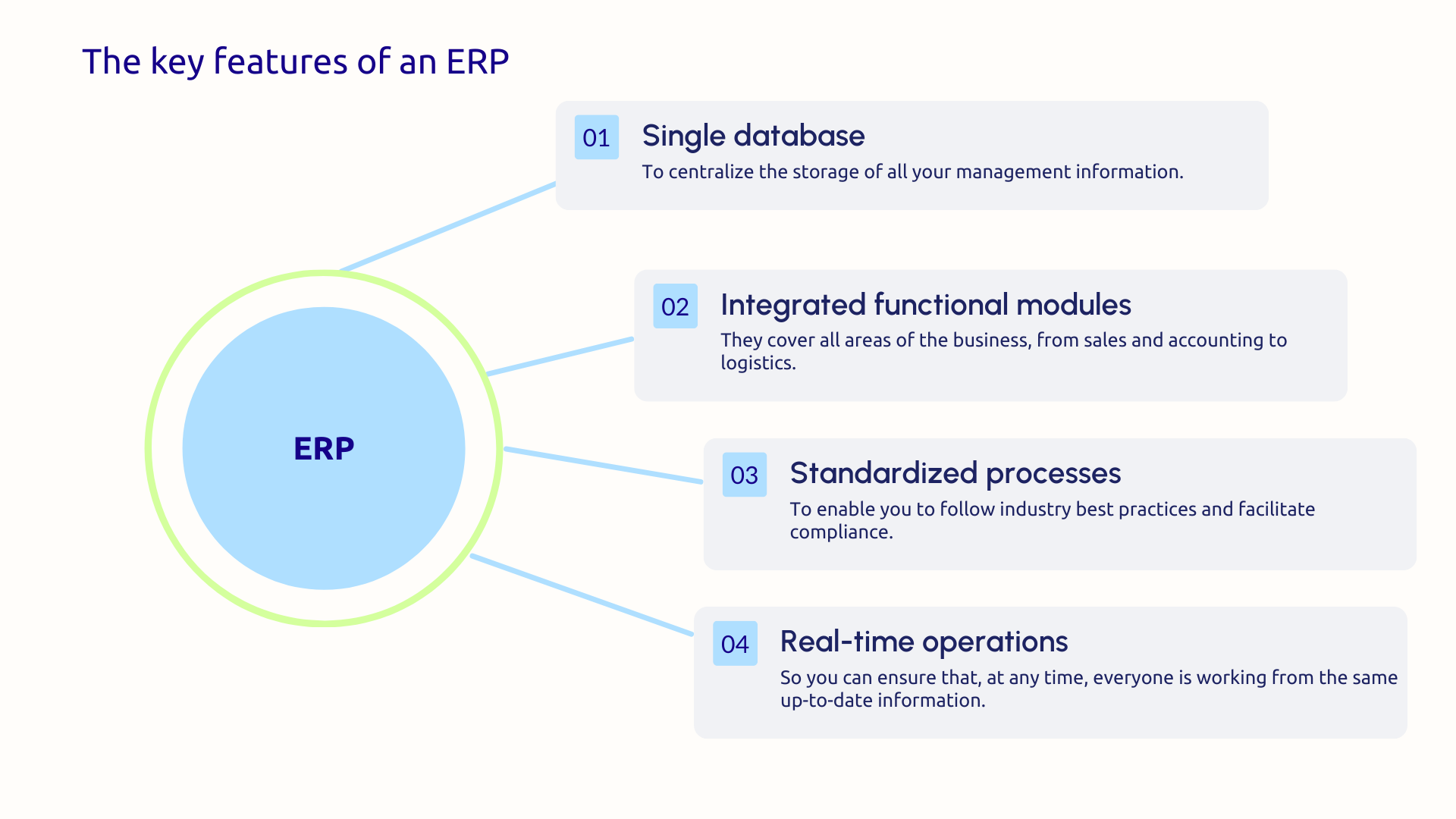
The fundamental difference between an ERP and a simple collection of business software? Data uniqueness and automated flows between all modules. No need for Excel exports, manual re-entries or approximate synchronizations between your tools.
Here is how it happens in practice. When your sales representative registers a customer order in an ERP, several events are automatically triggered:
The central idea to remember: ERP is the integrative base that communicates all the components of your IS and guarantees the consistency of your data.
A modern ERP covers the entire value chain of your company through various interconnected functional modules:
What makes these modules really powerful is that they all share the same database : so, when you validate a customer order, it automatically triggers the reservation of stock, the updating of the cash forecast and the calculation of the sales representative's commission.
Your ERP manages transactions and operational processes (orders, stocks, accounting), while your CRM manages customer relationships (prospects, commercial opportunities, marketing actions). They are not competitors but complementary, especially when using Microsoft Dynamics 365, which unifies them within the same ecosystem to create real synergy.
Second, while Excel is still a great and flexible calculation tool, it does not manage business processes or integration between departments. ERP comes to replace these hundreds of Excel files dispersed throughout the company through structured processes and centralized data.
Thirdly, highly specialized software (WMS — Warehouse Management System for warehouse management, MES — Manufacturing Execution System for production management) can coexist with your ERP via integrations. ERP is the foundation transverse, while the business software provides vertical expertise on very specific processes.
To summarize, think of ERP as the backbone of your organization, CRM as the relational system, and Excel as a notepad for one-off calculations.
Today, the data fragmentation is the number one problem for organizations. Each service has its own tool and its own data.
The ERP addresses this problem at its root thanks to its unique database. There is only one left The only version of the truth, shared by all services and all users. This makes your data much more reliable, your reporting more consistent, not to mention that you will have more confidence in your decisions.
But ERP also has the advantages of automating your processes and eliminating the repetitive manual tasks that hamper your productivity. In fact, the automated workflows take care of entire end-to-end processes: from approval to payment, without manual intervention.
By doing so, you eliminate one of the main sources of errors and time wasting. Each Information is only entered once before driving. Documents are generated automatically while alerts warn you of situations that require your attention, such as low stock or pending validation.
Let's take the example of a goods receiving process. Without ERP, you can count on 20 to 30 minutes per invoice between manual entry, reconciliations and accounting. With an ERP, all steps included, it takes more than two minutes per invoice. Out of a hundred invoices per month, this represents between 30 and 47 hours of work saved.
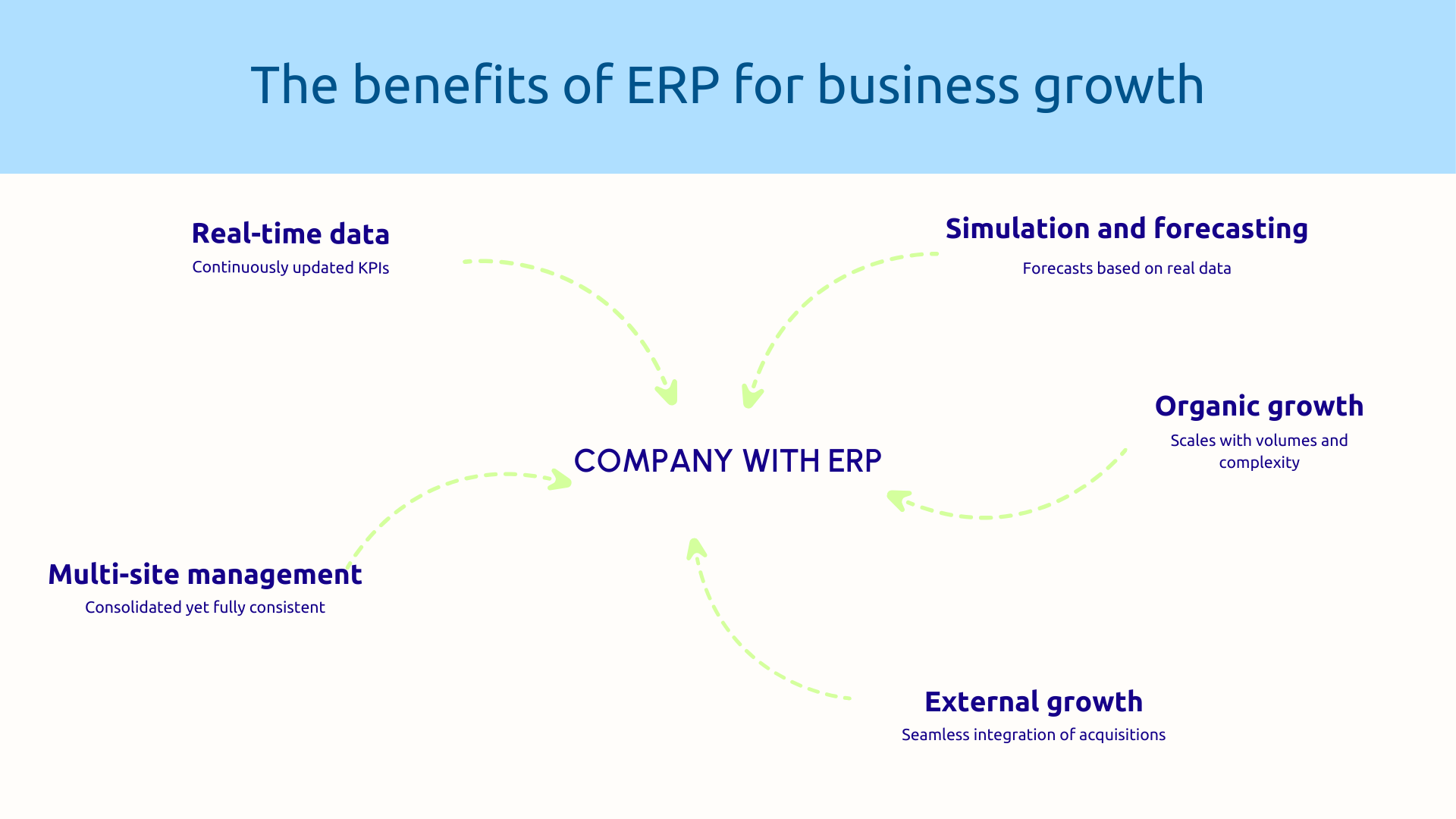
Thanks to ERP, we go from reactive management to proactive management. Indeed, its real-time dashboards give you instant access to all your critical KPIs: financial, commercial, operational indicators, all updated continuously. No need to wait until the end of the month to find out where you are.
You are done with manual reports that always come too late. With the ERP, you control on data of the day, or even the hour. You also win the ability to simulate and anticipate. Your financial forecasts and production planning are based on real and up-to-date data rather than on rough estimates. When you consider a decision, you immediately see the impact it has on the entire chain.
Beyond management, ERP allows you to grow without losing control. For organic growth, ERP scales naturally with your volumes: more transactions, more users, more complexity. The system is designed to absorb this growth without seizing up.
For external growth, the integration of your acquisitions becomes much more fluid. You deploy your ERP on the new acquired entity, which quickly harmonizes processes and facilitates consolidation. By multi-sites, you manage several establishments consistently while maintaining centralized consolidation. Internationalization becomes manageable because multi-currencies, multi-languages and multi-legislations are managed natively.
ERP is therefore not reserved for large companies. It is precisely the tool that allows SMEs to become ETI.
Any technological choice is first preceded by a formal framing phase.
Start by mapping your current processes and identifying your pain points :
Then, define your functional requirements by distinguishing the must-have from the nice-to-have. Also, don't forget to evaluate your volumes:
Involve all stakeholders from the start because it is above all a business project, not just an IT project. In fact, devoting a significant portion of project time to scoping greatly increases your chances of aligning business needs with implementation and of avoiding costly setbacks.
Once your needs are clarified, you have several options:
The current trend clearly favors general standard + extensions. These are created quickly and tailor-made using low-code tools like Power Platform, all without increasing your technical debt.
You can opt for The big bang approach which consists in migrating everything at once: a clear break, but high risk if something goes wrong.
Conversely, a gradual deployment proceed module by module or site by site: you control risks and learn along the way, but with an uncomfortable period of coexistence between old and new systems. It is a preferred methodology for SMEs and ETIs because it limits risks and allows adjustments to be made along the way.
Otherwise, the agile approach, with sprints and continuous adjustments, is generally more suitable for modern ERP projects than the waterfall approach (sequential method, in successive stages).
In truth, even if the methodology must be chosen carefully, the human factors (change management, training, support) are generally more decisive in the success of an ERP project. Indeed, even the best deployment strategy fails if your teams don't take ownership of the tool.
That's why the Management must carry out the project via 3 types of actions:
Listen to concerns, take them seriously and show concretely how the new ERP will simplify daily life rather than complicate it.
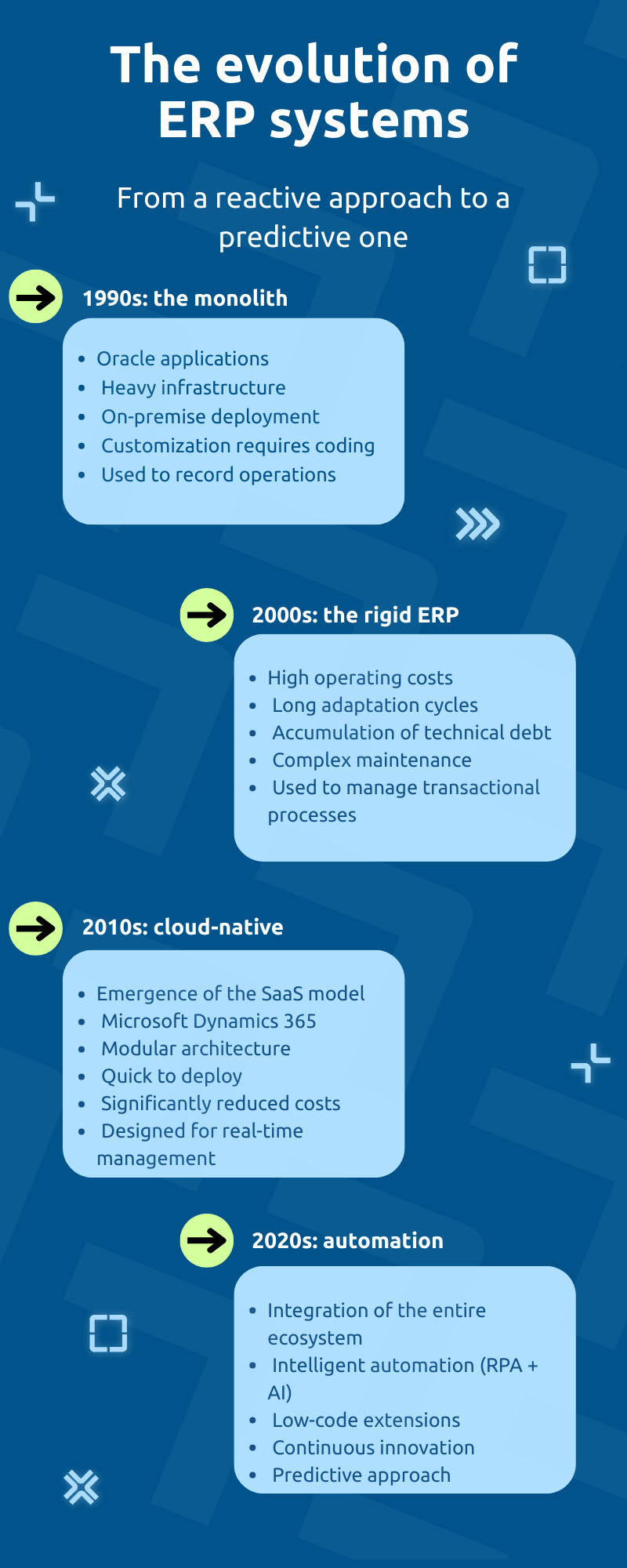
Historical ERPs like SAP or Oracle revolutionized business management during the 1990s with impressive functional comprehensiveness and proven robustness. But their disadvantages are heavy to bear:
Later, the paradigm of cloud ERP (SaaS), which completely changed the situation.
Why? First of all because it is cloud-native, i.e. designed natively to work in the cloud, without dependence on local infrastructure; the infrastructure is managed by the publisher and updated continuously.
Then, it offers a real modular architecture: you activate only the necessary modules and gradually extend (thanks to low-code tools such as Power Platform). Also note that it drastically decreases time-to-value because deployment deadlines are no longer counted in years but in months or even weeks. Plus, you're paying a monthly subscription rather than a huge upfront investment. Finally, you benefit from continuous innovation that is automatically deployed.
In this respect, Microsoft Dynamics 365 perfectly embodies the vision of modern ERP since the Finance module covers your financial management from end to end, Supply Chain Management manages your purchases and logistics, etc.
However, the real strength of Dynamics 365 is its native integration with the entire Microsoft ecosystem: CRM (Sales, Service), Microsoft 365, Teams, Power Platform, Azure. Everything communicates naturally. Power Platform becomes your extension layer to quickly create business applications, automate workflows, and build analytics.
As you will have understood from now on, ERP integrates at the heart of a digital ecosystem which multiplies its value.
For example, we can imagine the following daily scenario: one of your sales representatives works in Teams and consults an opportunity in their CRM. It instantly sees the availability of stock from the ERP, the complete history of customer purchases, and forecasts generated by Power BI. He can then make an informed decision immediately, without changing tools.
Obviously, ERPs are increasingly integrating artificial intelligence and IT automation. Predictive AI helps you with sales forecasts, automatic inventory optimization or predictive maintenance. For its part, intelligent automation combines RPA (Robotic Process Automation) and AI to take on repetitive tasks. Let's not forget the now famous conversational assistants that allow you to query your ERP in natural language or the detection of anomalies for fraud, errors and budget discrepancies.
The first-generation ERP recorded your past transactions. Current ERPs allow you to control in real time. New generation ERPs anticipate and optimize.
The logic has changed: instead of seeing problems after the fact, you see them happen and act before they happen. So much so that ERP becomes a real source of competitiveness: it collects weak signals, identifies emerging patterns, proposes optimizations and learns continuously. Don't get me wrong, it's the orchestration of the digital ecosystem as a whole that really creates value.
Is your organization ready for a modern ERP? Contact Askware for a scoping workshop and build your transformation roadmap.
The cost varies enormously depending on your functional scope and the number of users. In the cloud with Dynamics 365, licenses represent a monthly investment per user, the amount of which varies according to the modules chosen and the roles, plus initial deployment costs. The advantage of the cloud: you spread the investment over time. The real cost also includes support, training and change management.
Start by identifying your real business needs before looking at technology. Map your current processes, identify your main pain points, and define your priorities. Involve your business managers from the start. Then, evaluate the solutions according to the functional coverage of your priority needs, the ease of integration with your existing ecosystem, and scalability. Test solutions on your concrete use cases rather than relying on sales presentations.
Your ERP manages transaction processes: purchases, stocks, production, accounting, everything that makes your operational activity work. Your CRM manages the relationship with your customers and prospects: commercial opportunities, interaction monitoring, marketing campaigns, support tickets. The ERP takes care of what happens once you win the customer and they order, while the CRM takes care of all of the above and accompanies this relationship. Ideally, the two systems communicate perfectly.
Our experts share their vision of best practices and technological trends to ensure the success of your digital transformation.