Digital transformation: how to manage the performance, security and growth of your business?
Learn how to orchestrate your digital transformation with Dynamics 365 and Power Platform. Performance, Security, Growth: A Complete Guide.

According to an analysis by UBS published in January 2023, ChatGPT reached around 100 million monthly active users in almost two months after its launch. Microsoft Copilot is installed in Word, Excel and Outlook. A very large number of companies are experimenting with or have already adopted Generative AI to automate their processes.
However, it is legitimate to ask what, beyond the media buzz, this technology can really bring to your daily life as a marketing, sales or HR director.
This article shows you exactly how marketing, sales, customer service, and HR are already using generative AI in a data-driven model with Microsoft Copilot and Azure OpenAI. You will discover the measurable gains to be expected and how to avoid the pitfalls for a successful adoption.

Generative AI is a technology capable of create new content based on your instructions in natural language. Where other AIs are analytical or predictive, generative AI, as its name suggests, generates: text, images, code, analyses.
It's a bit like an ultra-competent intern who can write, analyze, or summarize, but who needs guidance and whose work needs to be checked. Generative AI does indeed have its limits since it is likely to “hallucinate”, that is to say invent plausible but false information. This is why human validation remains absolutely essential.
Generative AI does not replace the human, it increases it by automating repetitive tasks to free up time on what really matters.
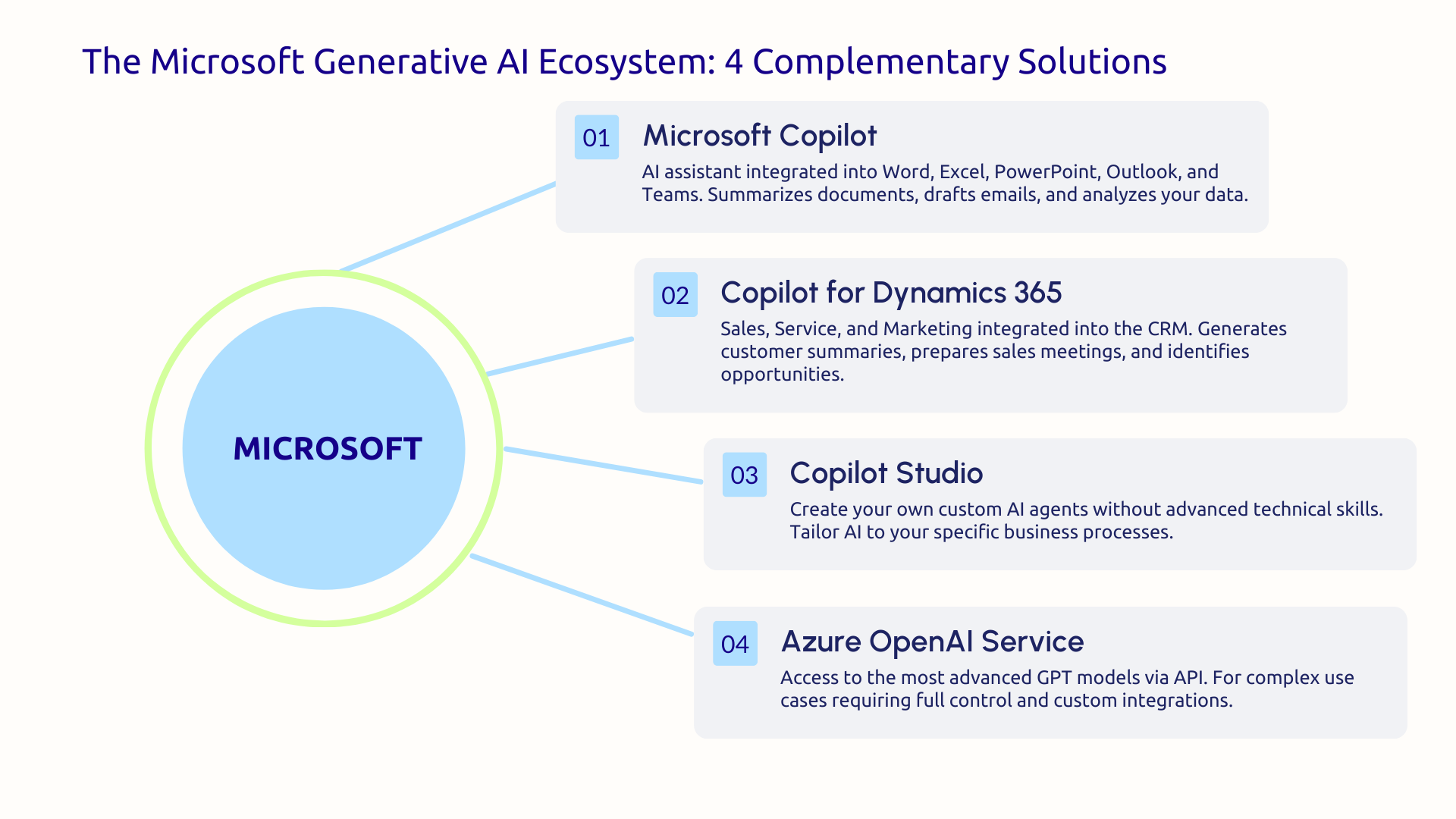
Microsoft has democratized access to generative AI by integrating it directly into the tools your teams already use, as part of its professional offerings:
What sets Microsoft apart is that the security and compliance are native there. In the context of professional offers, your data remains private, is never used to train public models, and respects the GDPR.
According to the study ”The economic potential of generative AI“ published by McKinsey in June 2023, generative AI can improve the productivity of certain cognitive tasks by several dozen percent, depending on the use case. The Microsoft Work Trend Index (2023) indicates that Copilot users report save an average of around 29% of time on certain office tasks.
Technology is now mature and accessible. With Copilot, it integrates naturally into your existing workflows, and the return on investment is measured in weeks, not years. So the question is no longer whether you should start, but where to start.
Your marketing teams spend hours producing content while demand keeps growing. Generative AI is changing this state of affairs.
With Copilot, your marketing manager can generate 10 variants of a LinkedIn post in two minutes instead of one hour. It adapts content for different channels in seconds. For e-commerce, writing product descriptions is becoming trivial.
Generative AI Frees you from blank page syndrome and accelerates production. Attention: it produces quality drafts that must be refined by your experts to ensure the relevance and voice of your brand.
Of course, personalization improves performance, but don't forget that customizing for each segment requires a lot of work. Again, generative AI can be of great help to you because it makes mass customization technically and economically viable.
Imagine an email campaign with 1000 custom variants automatically generated according to the customer profile in Dynamics 365. AI adapts tone, examples, and arguments based on industry, business size, and centralized purchase history in Dataverse.
Integration with Dynamics 365 Customer Insights makes it possible to combine behavioral data and content generation for a unified and efficient customer relationship. The result: every interaction is relevant without multiplying efforts. Personalized campaigns generally show higher open and conversion rates than traditional generic campaigns.
Your customers are constantly talking to you through reviews, surveys and social networks. This wealth of information remains untapped because analyzing it manually would take weeks. Generative AI democratizes access to insights by allowing you to query your data in natural language.
Put in a situation, your marketing director asks Copilot: “Analyze our last 500 customer reviews and propose 3 areas of campaign”. In 30 seconds, she gets a summary identifying emerging trends and positioning opportunities through data visualization.
When it comes to the time your salespeople spend on leads, generative AI is transforming your CRM from an input tool into an intelligent sales assistant.
Copilot for Sales automatically analyzes all interactions: emails, calls, documents consulted, web behavior. It generates instant summaries that give the full context in seconds instead of 30 minutes of research.
Beyond demographic criteria, AI detects Weak buy signals — these subtle signs of buying interest — such as a prospect who mentions a transformation project or frustrations with their current solution. According to Microsoft studies, this approach makes it possible to significantly reallocate salespeople's time to activities with high added value.
Preparation makes the difference between an appointment that converts and one that is stagnant. Generative AI allows each salesperson to be as well prepared as a top performer.
Before an important appointment, Copilot can automatically prepare a brief :
After the appointment, Copilot generates a summary and offers a personalized follow-up email. The salesperson adjusts and sends in two minutes instead of 20. Preparation time can thus be reduced by up to five times in some contexts.
Some salespeople know how to respond brilliantly to objections, others less so. Generative AI helps to use collective experience to make it an advantage in the service of individuals.
In this respect, Copilot analyzes the patterns of won versus lost deals and identify the real objections behind the apparent objections. The tool suggests structured answers with numerical case studies.
In addition, the generation of value proposals adapts to the decision-making profile: ROI for a financial director, productivity gains for an operational director.
When your teams spend too much time looking for information, generative AI can allow them to focus on empathy and complex resolution.
Copilot for Service automatically analyzes the complete context: customer history, products owned, previous incidents. In a few seconds, it offers a personalized response that the operator then only has to validate and adjust.
Intelligent chatbots form the first filter of customer requests that they will process by understanding the context of each situation. For the simplest cases, the resolution is autonomous and instantaneous.
According to the observations of several consulting firms, the average processing time can decrease by 30 to 50% depending on the case, while customer satisfaction improves.
Is your knowledge base incomplete or out of date and no one has time to maintain it? Generative AI uses each solved ticket as a reusable knowledge asset.
For example, the system detects that the same question was asked 10 times this month. After which, it generates a structured article based on the resolutions of your best agents, identifies the appropriate keywords and submits it for validation while guaranteeing documentary traceability. In short, you capitalize on collective expertise in a few clicks.
Finally, when a customer tells you they're leaving, it's often already too late. Generative AI you Alert to the first signs of dissatisfaction.
Automatic detection analyzes the feeling in all interactions. So, A customer who uses increasingly frustrated language triggers an alert, allowing intervention before the situation escalates.
This approach also works at scale: identifying trends makes it possible to act at the systemic level. If 5 customers mention the same bug this week, your dashboard alerts you immediately for a numerical escalation to the product team.
Contextual CV analysis goes beyond keyword detection. AI includes atypical careers and identify transferable skills. A recruiter analyzes 200 resumes in minutes, identifies the 15 most relevant profiles with justification, and focuses on interviews. Screening time can be reduced by up to ten times in some highly automated contexts, while helping to reduce the risk of missing out on the right candidate.
Once recruited, the right people need to be integrated effectively. Virtual assistants respond instantly to the practical questions of new hires in a modern collaborative environment: leave requests, templates, contacts. The newcomer quickly becomes autonomous without overloading the teams.
Beyond recruitment, generative AI improves development support, for which managers often lack time.
In fact, the generation of individual development plans combines current skills, aspirations, team needs and available training. In seconds, the manager gets a structured plan over 6 months. What used to take half a day takes a few minutes.
Likewise, writing constructive feedback is becoming more accessible. AI helps to formulate feedback in an empathetic and actionable way, with concrete recommendations. The objective is not to replace the manager's judgment, but to give him the tools to communicate better, with the final responsibility always remaining human.
Faced with all these opportunities, there is a great temptation to want to do everything at the same time. It is the mistake not to make. The key to success is choose use cases with high value AND a high probability of success.
The selection criteria must cross three dimensions:
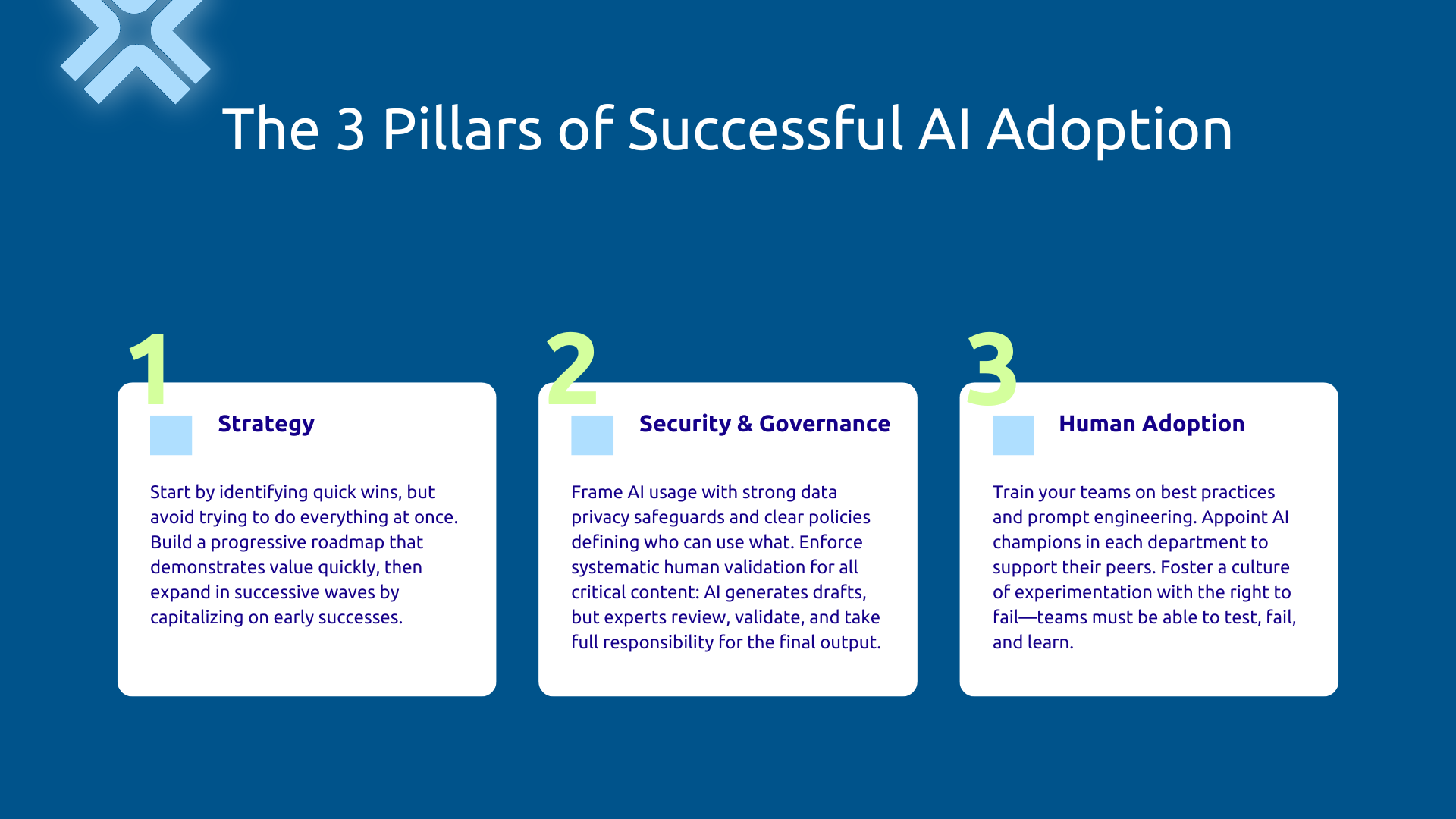
Avoid the”Boil the Ocean“(wanting to change everything right away). Start small, prove the value, learn, then expand. A successful pilot project is better than a failed deployment that burns your trust.
With that in mind, a discovery workshop with your teams and an expert partner like Askware makes it possible to quickly identify your 3 priority use cases and to build a realistic roadmap.
Generative AI raises legitimate questions of safety and ethics, but if it is properly framed, generative AI does not present risks.
With the Microsoft ecosystem, as part of professional offerings, your data stays in your Azure tenant, is never used to train public models, and complies with the GDPR for controlled IT compliance. What's more, Entra ID access controls also apply to interactions with AI.
That said, vigilance is still required. AI's “hallucinations” are a reality: it can invent plausible but false facts. Human validation remains absolutely essential on any critical content. The role of AI is to generate drafts, that of the expert is to validate.
As for governance, it defines who can use what and how. Thus, clear policies avoid excesses while allowing innovation.
At Askware, we believe that generative AI should augment humans, not replace them. It is a tool at the service of business expertise, never a substitute for human judgment.
Technology is an enabler but it is human adoption which is the only factor of success. Indeed, the best tool doesn't create value if no one uses it.
Start by training your teams in the right uses. You need to help them understand what AI does well, what it does less well, and how to formulate effective instructions. The “Prompt Engineering” — the discipline of structuring instructions to maximize the quality of responses — makes all the difference.
The creation of AI ambassadors in each department accelerates dissemination. These champions identify relevant use cases, test functionalities, and support their colleagues. They create a peer-to-peer support network that is more accessible than the IT team.
Finally, establish a culture of experimentation with a right to make mistakes encourages innovation. Teams should feel free to test and learn without fear of sanctions. A 3-month adoption program with training, user challenges, and celebration of gains transforms initial distrust into enthusiasm.
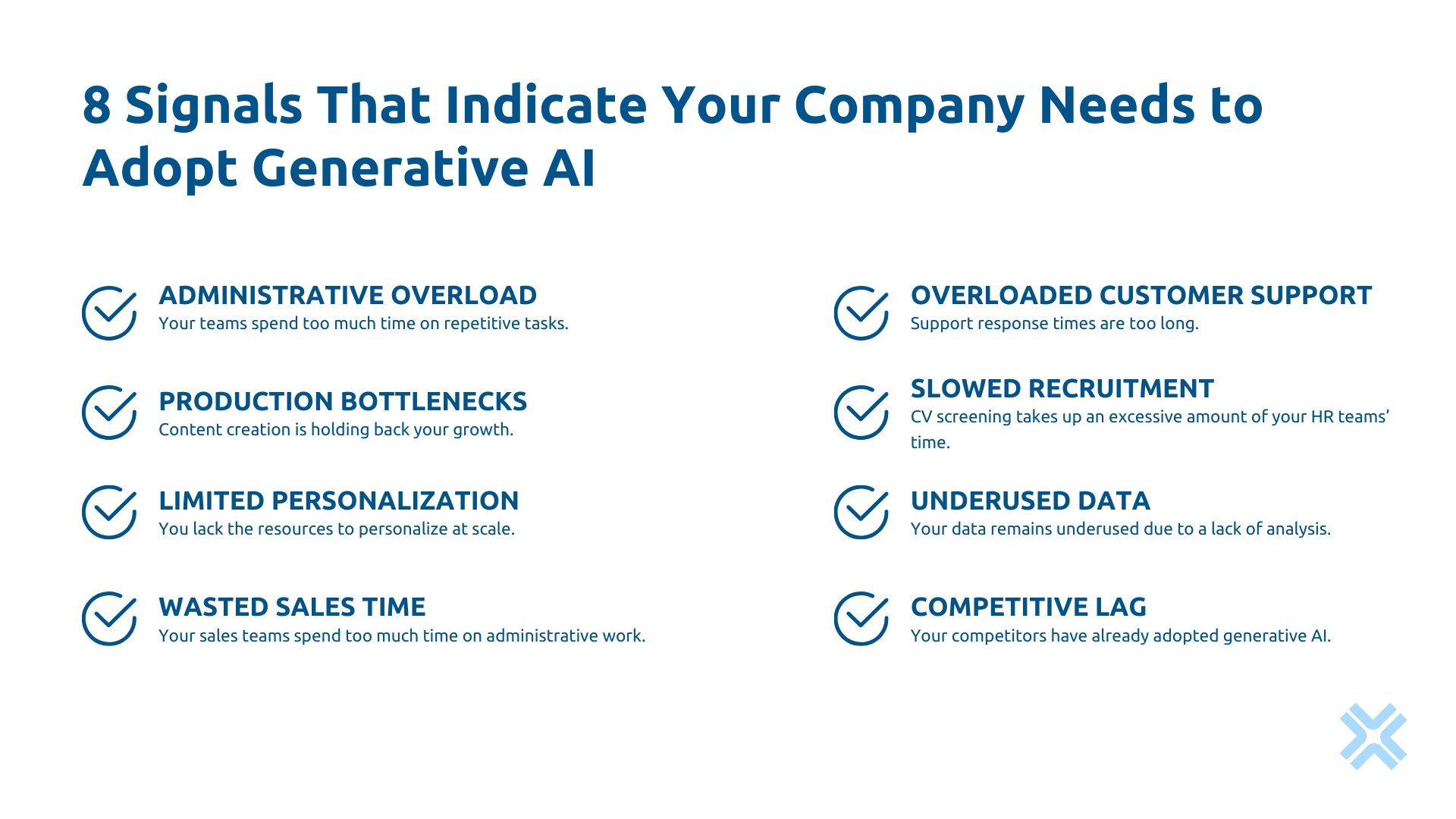
With Microsoft Copilot and Azure OpenAI, generative AI technologies are accessible, secure, and integrable into your existing processes.
Askware helps you identify your quick wins, build your adoption strategy, and deploy generative AI at the service of your businesses with an approach that balances technological ambition and operational pragmatism.
Let's explore your AI opportunities together: Request your discovery workshop.
Generative AI is transforming daily business by automating time-consuming tasks. Copilot automatically summarizes customer history, generates personalized follow-up emails, and prepares appointments by synthesizing relevant information on the prospect. The salesperson arrives better prepared and can focus on the relationship rather than on the administrative side, allowing a significant part of their time to be reallocated to activities with real added value.
Yes, with enterprise solutions like Microsoft Copilot or Azure OpenAI. As part of business offerings, your data remains private in your Azure environment, is never used to train public models, and complies with the GDPR. The usual access controls also apply to interactions with AI. However, it is necessary to set up clear governance and train teams in good practices.
The most effective use cases automate repetitive tasks that require thought: writing marketing content, preparing commercial interactions, responding to customer support, analyzing data transformed into narrative insights, or screening resumes. The AI produces a quality draft in a few seconds, the business expert refines and validates. You save time while maintaining control.
Our experts share their vision of best practices and technological trends to ensure the success of your digital transformation.