Data Management: The Complete Guide to the Microsoft Ecosystem
Data management: how to structure, govern, and secure your data with Microsoft Purview, Azure, and Dataverse. Expert guide.

Businesses are accumulating data at an unprecedented rate: CRM, ERP, marketing platforms, IoT sensors, SaaS applications. Each system generates its own flow of information, creating increasing complexity in the Data management. Without a structured architecture, you're navigating blindly with silos and conflicting information.
In the following, we will discuss the principles of a Data architecture modern, its technical components on the Azure ecosystem and the methodology to design it. You will discover how to transform information chaos into a structured, scalable and secure platform.

Data architecture is the master plan that organizes collection, storage, processing and exploitation of your data. Much more than just a technological stack, it defines how information flows through your business, from its inception to being used to make informed decisions.
A comprehensive architecture includes several key components that work together in an orchestral manner:
Without a coherent data architecture, each new project becomes a fight against the existing rather than a construction on healthy foundations.
Beyond technical aspects, data architecture meets concrete business goals that have a direct impact on your daily performance. It radically improves the quality of your data by eliminating contradictory versions between departments. You finally have a single source of truth that all services align with, putting an end to fruitless debates about “which number is the right one.”
This streamlining dramatically speeds up the time to get insights. Your teams access the information they need in a few clicks, without systematically relying on IT to extract and cross-reference data. This autonomy multiplies your responsiveness to market opportunities and is fully part of a data-driven approach.
Let's take the concrete example of a sales department whose data is scattered between Dynamics 365, Excel exports and an old CRM. It is impossible to have a consolidated vision without spending hours manually reconciling these sources. With a unified architecture, this team has a single dashboard that is automatically fed, freeing up valuable time for action rather than collection.
Architecture thus becomes the foundation that takes you from a data-informed culture to a truly informed culture data-driven.
The consequences of a bad data architecture go far beyond simple irritations to become real strategic obstacles. Silos first create a duplication of efforts where each department maintains its own version of the truth, generating inconsistencies that undermine trust.
Then, regulatory compliance becomes a nightmare without accurate mapping. How to respond to a GDPR request for access if you do not know in which systems this information is stored? The risks of sanctions increase in proportion to the disorder of your architecture.
Moreover, fragility in the face of growth comes abruptly when your volumes explode. A poorly sized architecture can collapse if it's not designed to scale, forcing you to make costly emergency redesigns. Finally, dependence on obsolete technologies hampers every IS modernization project.
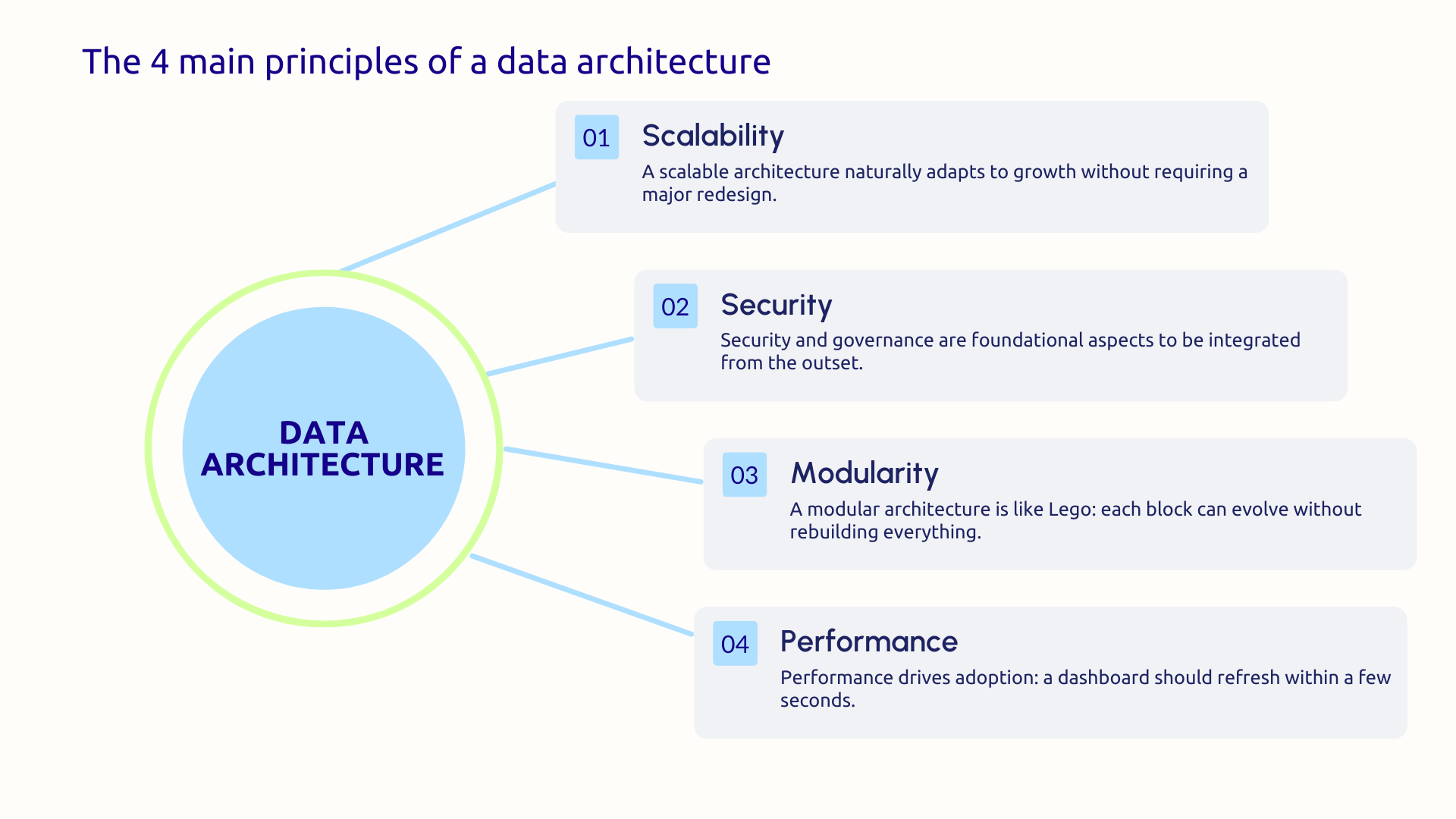
An architecture scalable adapts naturally to the increase in your data volumes and the number of users without requiring a major overhaul. This is the fundamental difference between a system that grows with you and a system that brakes you as soon as you go beyond its initial limits.
It is important to distinguish between Scaling vertical and Scaling horizontally. Vertical scaling is about increasing the power of an existing machine, but this approach quickly reaches its physical limits and is exponentially expensive. In contrast, horizontal scaling adds additional machines to distribute the load, offering an almost unlimited elasticity that is preferred in the cloud.
Take the example of a retail company whose traffic increases from 10,000 to 100,000 transactions per hour during sales. If its architecture is not designed to scale, the site crashes, causing a direct loss of turnover. With a scalable architecture on Azure, resources adjust automatically without degradation.
Security and governance are never optional additions applied on the surface. They are structural dimensions which must be integrated into the very heart of your data architecture from the design stage, in a security by design approach.
In this spirit, we rigorously apply the Principle of least privilege in access management: each user accesses only the data strictly necessary for their function. Then, data is systematically encrypted at rest (stored) and in transit (flowing between systems). This system is complemented by an effort of traceability by documenting who accesses what and when, crucial during security incidents and to demonstrate your IT compliance.
In this set, Microsoft Purview plays a central role. This tool automatically maps your data across all of your Azure services, identifies sensitive data, and documents its complete lineage.
In a powerful data architecture, each brick fulfills a specific function, but The whole forms a coherent system which can evolve without rebuilding everything, according to the principles of a modular architecture.
Thus, independent components communicate via standardized interfaces so that if you change your transformation tool, you do so without impacting your storage or visualization tools.
This approach involves several distinct layers :
This separation makes it possible to optimize and make each layer evolve independently of the others.
Without performance, there is no real adoption. Without adoption, no value created by your investment, no matter how technically sophisticated it is. Ideally, a dashboard viewed during a customer appointment should be refreshed in a few seconds to remain usable in a dynamic conversation.
For storage you will have to choose between OLTP (Online Transaction Processing) and OLAP (Online Analytical Processing). OLTP systems optimize fast writes for your CRM and ERP while OLAP systems instead optimize massive reads for your analytics data warehouse.
Ingestion determines the quality of everything that follows. This is about identifying all your data sources and setting up reliable pipelines to connect them to your centralized platform.
Diversity of sources is often the biggest challenge. You must simultaneously integrate transaction systems (Dynamics 365, SAP), files (CSV, Excel), third-party APIs and real-time flows (IoT, logs). Note that the trade-off between batch (batch processing, suitable for slowly changing data in most organizations) and streaming (continuous flow, essential for real-time responsiveness) depends on your business requirements.
In the Microsoft ecosystem, Azure Data Factory assumes the role of central orchestrator with over 90 native connectors. The architecture is then in a position to instantly detect anomalies preceding a failure and to trigger a maintenance alert, which prevents you from costly shutdowns.
These two approaches respond to complementary rather than competing needs.
On the one hand, the Data Lake stores raw data without transformation. Azure Data Lake Storage Gen2 combines scalability and performance with low costs, great for massive volumes.
On the other side, the Data warehouse Instead, stores structured and modelled data for analysis. Azure Synapse Analytics provides a powerful data warehouse with storage/compute separation.
The architecture Lakehouse, a concept popularized in particular by Databricks, offers the best of both worlds. Your data stays in the lake, but organizational layers (via Delta Lake for example) allow powerful analytical queries directly on the lake, thereby eliminating costly duplication.
Raw data is never directly usable. They need to be systematically cleaned, enriched, and structured before creating real value. This stage can represent up to 70 to 80% of the effort in some data projects.
Azure Synapse Analytics and Azure Databricks excellent in large-scale transformations. The star model then organizes the data around tables of facts surrounded by dimensions, greatly speeding up analytical queries.
Let's take a concrete example. Your customer data arrives with inconsistent date formats, writing variations, duplicates. The transformation process harmonizes these formats, eliminates duplication through reconciliation algorithms, enriches with external geographic data and structures everything in a coherent model.
In the end, architecture is only valuable if it makes it practically easier for your end users to use it. Technology must fading away in favor of business use to maximize adoption and create value in your collaborative environment.
Power BI is the reference platform for Data visualization with native Azure integration. A Power BI dashboard embedded in Dynamics 365 Sales gives each salesperson a 360° view without leaving their interface. The dashboard shows in real time the turnover per customer, current opportunities, and alerts of reduced activity.
This transparent integration multiplies the real use of data because it eliminates frustrating context changes.

Start with Identify comprehensively all the places where your data resides: SaaS applications, on-premise systems, departmental databases, files shared on SharePoint or OneDrive. This comprehensive mapping generally reveals a much larger perimeter than expected, with unsuspected pockets of data.
Then trace how the information actually flows between these systems. What data is synchronized? How often? Through which technical mechanisms? This analysis reveals the bottlenecks that slow down your processes and the risky manual transfers that weaken your IS.
Measure objectively the current quality of your data with concrete metrics: completeness rate, number of duplicates, coherence between systems. These indicators serve as a baseline to monitor your future progress.
In parallel, locate all the personal and sensitive data, a crucial map for GDPR compliance and security. Microsoft Purview accelerates this work considerably with its automated discovery that scans and classifies your data.
Based on the conclusions of the audit, you now define the Vision business that will guide all your technical choices.
Organize co-construction workshops that bring together your business departments to identify priority use cases together. What strategic questions remain unanswered due to the lack of reliable data? What painstaking manual processes could be automated? What customer personalization opportunities are impossible to exploit today? This collaborative approach guarantees alignment between CIOs and business departments from the start, avoiding technical projects that are disconnected from real needs.
Let's take the example of a concrete and measurable vision: “Within 18 months, 100% of salespeople will have a 360° customer view in real time to personalize their actions.” This clear formulation immediately guides all choices: which data to integrate first and foremost, which latency to aim for, which interface to choose. It also makes it possible to objectively measure the success of the project with Activable KPIs.
With a clear vision validated by the professions, you enter into the technical design of your platform.
First, clarify your fundamental strategic trade-offs. Cloud versus on-premise:
Then visually document your future platform through target architecture diagrams. Create flowcharts that show how data flows between systems, a layered view that illustrates the separation of responsibilities, and the precise identification of Azure components that you will deploy. These diagrams become the shared reference between technical and business teams.
Deploy your architecture by successive iterations.
Start with an MVP (Minimum Viable Product) on a limited but functional scope that provides value quickly and validates your approach. For example, a first wave integrates your CRM and ERP into Azure to feed priority commercial and financial dashboards. Once this first scope has been validated and adopted by users, gradually add other data sources.
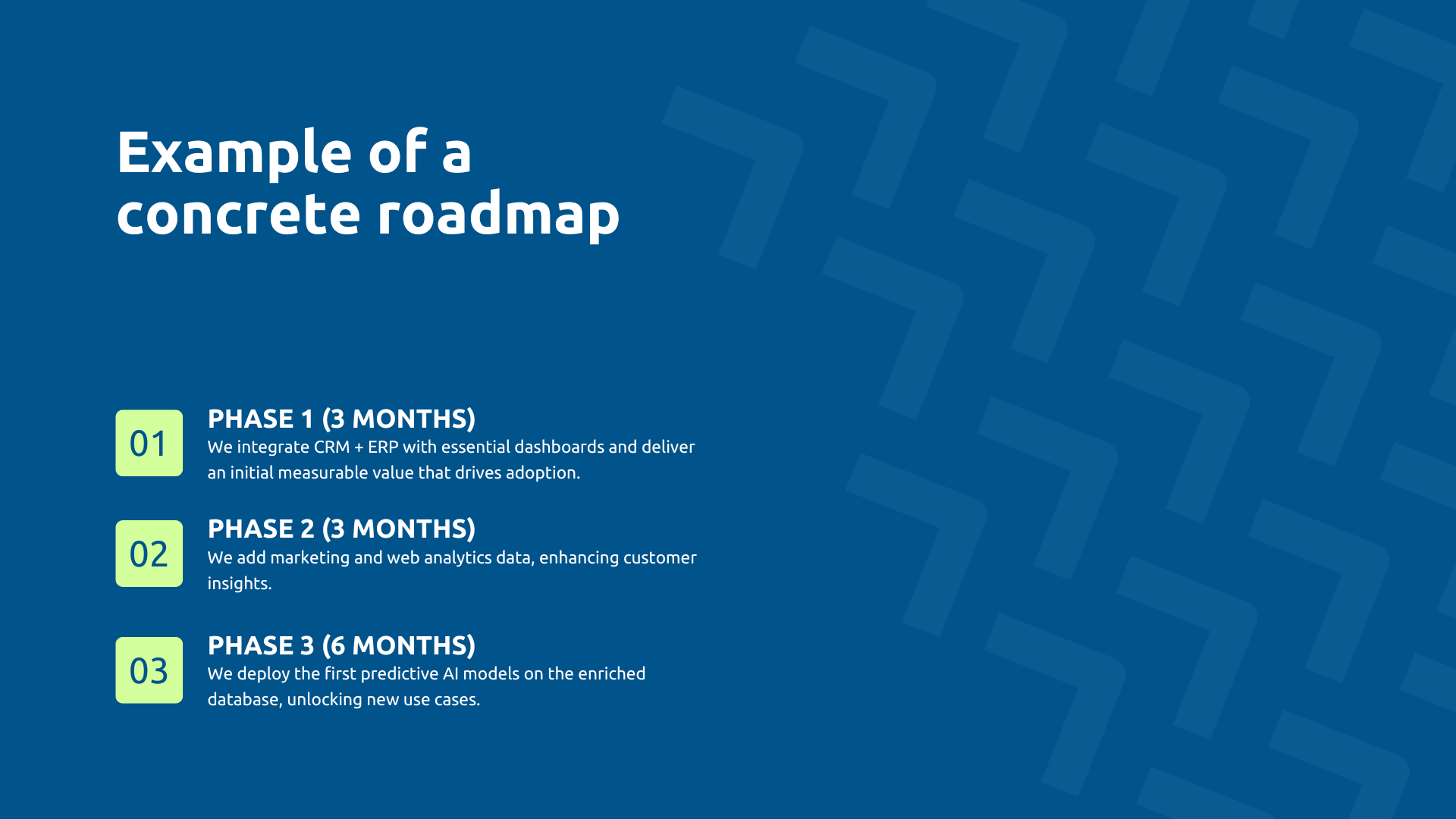
Each phase brings its eigenvalue and fund the next one, while minimizing risks and facilitating gradual adoption.
Keep in mind that a data architecture is never “finished” but evolves continuously with your business needs, the emergence of new technologies and the increase in your data maturity.
Data architecture is the backbone of any successful digital transformation. It aligns IT and businesses around a common vision of valorizing your data.
Askware accompanies you throughout the process: auditing your data assets, defining your target architecture, implementing them on Azure and managing change. Our expertise combines mastery of the Microsoft ecosystem and understanding of business challenges.
Do you want to audit your data architecture or define the foundations of your platform? Contact Askware for a strategic workshop.
The data lake stores your raw data without transformation, like a reservoir where you first pour in and then think about. It's economical and flexible, perfect for massive volumes. On the contrary, the data warehouse organizes structured data for rapid analysis, like an optimized library. In practice, the two complement each other: the lake keeps everything for future flexibility, the warehouse accelerates your daily critical analyses.
Security starts at design time. Consistently encrypt your data at rest and in transit. Apply the principle of least privilege with granular RBAC. Enable multi-factor authentication via Microsoft Entra ID (formerly Azure AD) and Conditional Access policies. Use Purview to map your sensitive data. Track all critical events. Cloud security is based on a shared model: Microsoft protects the infrastructure, you protect your data and configurations.
Without a solid architecture, you build up silos that prevent any consolidated vision. Your teams waste a considerable amount of time looking for information. Your analytics projects fail due to a lack of reliable data. Your compliance becomes impossible to demonstrate. Data architecture transforms this chaos into a controlled system that accelerates your decisions, optimizes your operations and allows the innovation you are aiming for.
Our experts share their vision of best practices and technological trends to ensure the success of your digital transformation.