IT compliance: how to align security, regulation, and performance
Discover how to structure your IT compliance: RGPD, NIS2, ISO 27001. Methodology, Microsoft Purview automation, and governance.

When a customer asks you to justify the conformity When it comes to the security of your cloud infrastructure, what is your first response? For many CIOs, the thought stops at ISO 27001. However, another certification occupies an increasing place in the criteria for selecting suppliers: SOC 2. Less well known in Europe, it is now essential in international commercial relationships and in the most demanding sectors in terms of security.
SOC 2 and ISO 27001 are indeed complementary. Microsoft knows it and has both. This article explains what SOC 2 guarantees in practice, how it differs from ISO 27001, and how to use it intelligently in your Dynamics 365 and Power Platform projects.
SOC 2 signifies Service Organization Control 2. This repository was developed by theAmerican Institute of Certified Public Accountants (AICPA), the professional association of American certified accountants, which defines several audit and certification standards in particular. Its objective is to assess the controls put in place by a service organization to protect its customers' data.
It is useful to specify that SOC 2 is not a certification in the strict sense of the word, unlike ISO 27001. It is a audit report produced by an independent external auditor, who reviews an organization's security controls and attests to their existence and effectiveness. Depending on the scope audited, a SOC 2 Type II report can reach several hundred pages detailing the controls tested, the results and the observations of the auditor.
SOC 2 is based on five trust criteria, the Trust Services Criteria (TSC) :
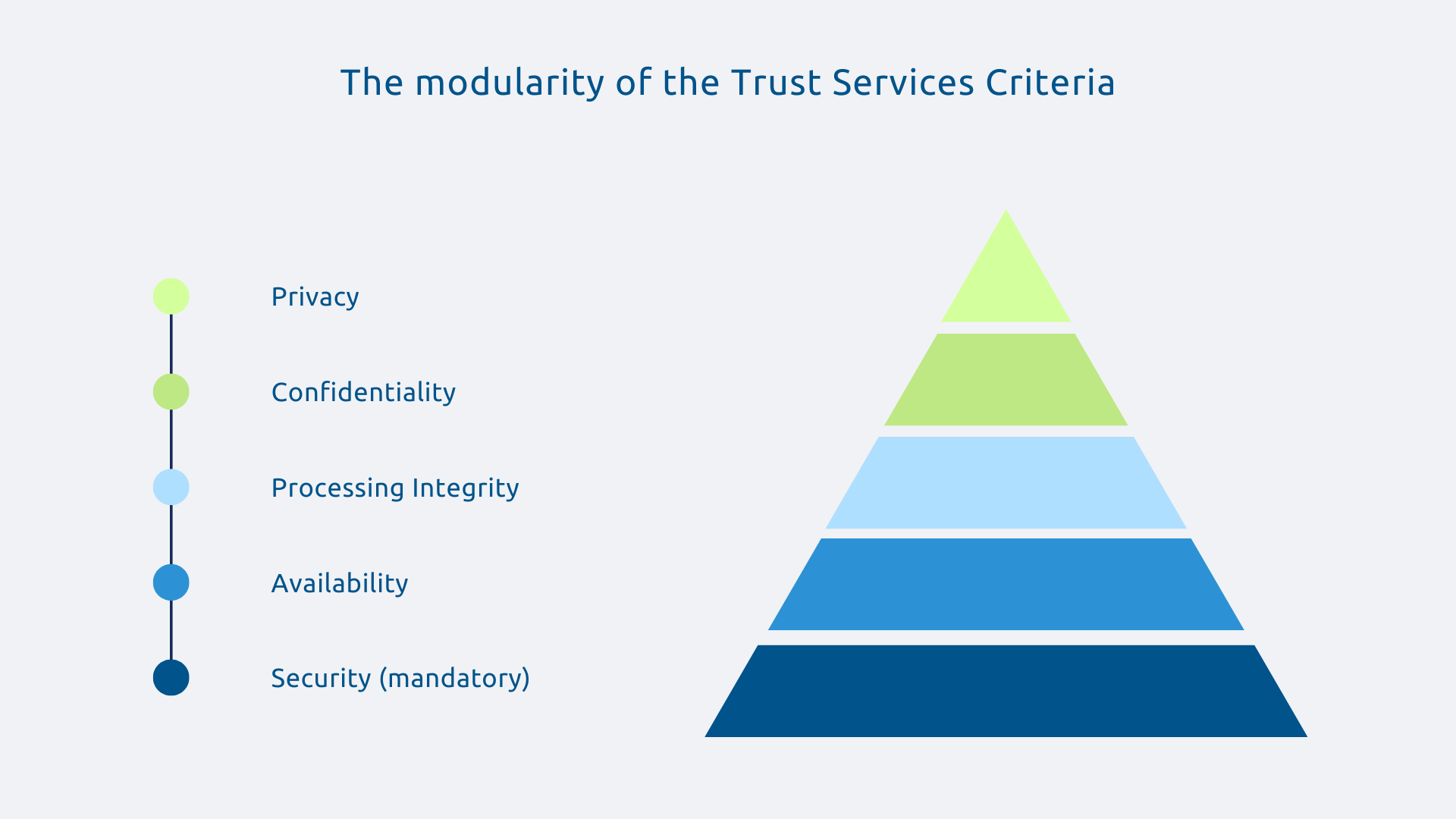
This modularity makes SOC 2 particularly suitable for cloud providers, whose commitments vary according to the services offered.
The distinction, while fundamental, is often misunderstood.
The SOC 2 Type I Evaluate the design controls at an instant T. It answers the question: “Are these controls well designed?” This is useful for an initial assessment or at the beginning of a business relationship.
The SOC 2 Type II goes much further: it assesses the operational effectiveness of controls over an observation period of at least six months, most often around twelve months. It answers the question: “Do these controls really work over time?” It is this report that is expected for serious and long-term commitments.
Microsoft Azure has a SOC 2 Type II report that is renewed regularly, attesting that security controls are not only designed, but also tested over an extended audit period. To seriously evaluate a cloud provider, always require Type II.
ISO 27001 is a international standard developed by the International Organization for Standardization (ISO). SOC 2 is a American standard developed by the AICPA, which is now particularly valued in cloud IT architecture and in commercial relationships with North American companies.
In practice, ISO 27001 is one of the reference standards in Europe for information security management, frequently mentioned as a criterion in public tenders or compliance procedures. SOC 2 dominates in the United States and is highly valued by tech companies and SaaS publishers.
That said, when a French company wants working with an American SaaS publisher, it may require a SOC 2 report to ensure that security controls are not only in place but also effective over time.
To summarize, if you are targeting the American market or Anglo-Saxon partners, SOC 2 becomes almost indispensable. If you operate mainly in Europe, ISO 27001 will be required more often. Global players like Microsoft own both, and that's no coincidence.
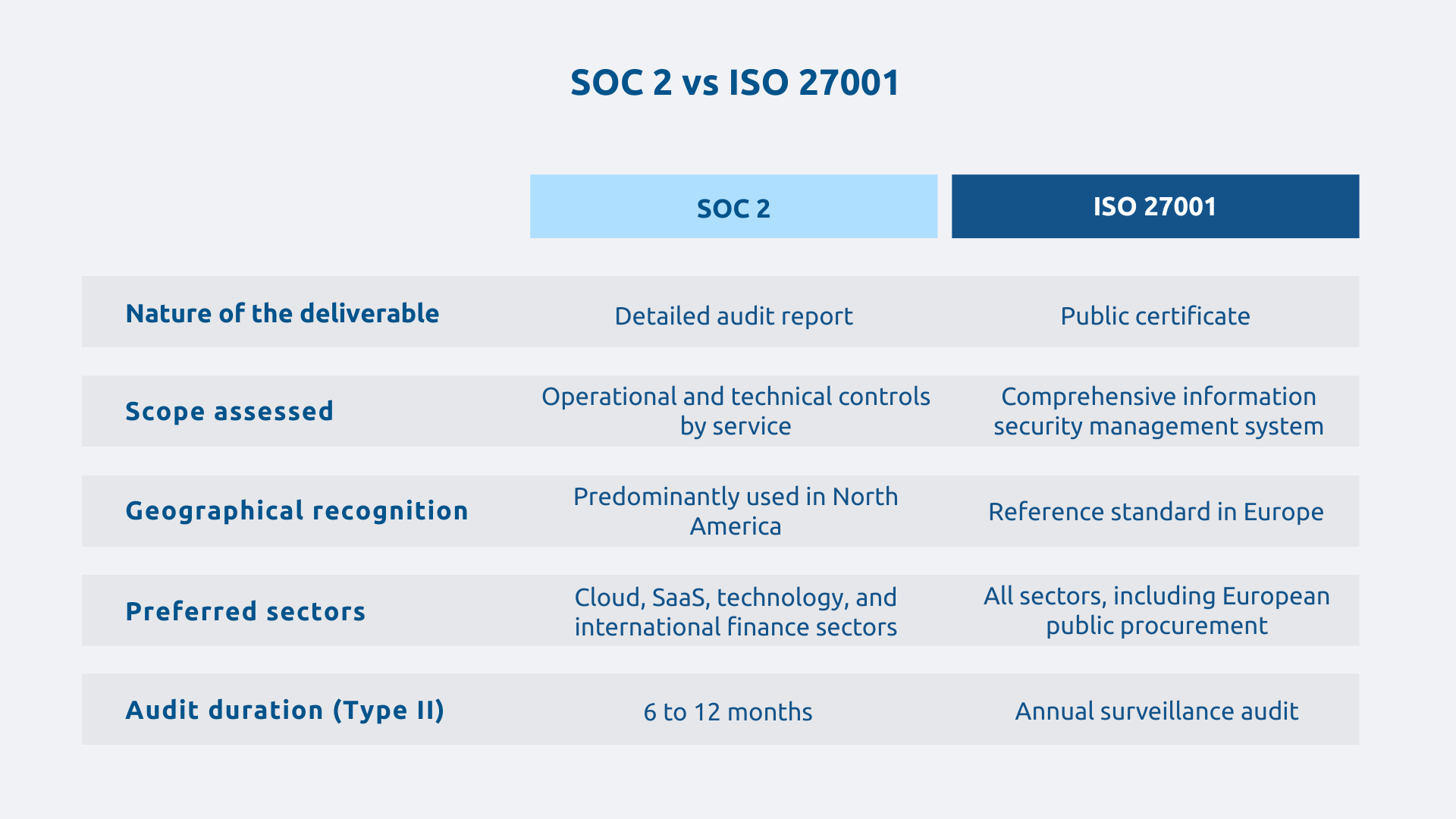
ISO 27001 certifies a Information Security Management System (ISMS). The organization defines its own perimeter, security goals, and risks. The audit verifies that this system is properly implemented and continuously improved (PDCA cycle). The deliverable is a public certificate.
SOC 2, on the other hand, assesses the operational and technical controls of a service provider in relation to the Trust Services Criteria defined by the AICPA. The deliverable is a detailed audit report that describes each control tested and its effectiveness over the observation period.
ISO 27001 certifies that a safety management system is in place and audited, while SOC 2 provides a detailed report describing the controls and their effectiveness over a given period of time. Both approaches are rigorous but they shed light on different perspectives.
Microsoft has numerous international certifications including:
Concerning ISO 27001, the standard provides the strategic and organizational vision: Microsoft has a structured, managed and continuously improved security management system. SOC 2, for its part, goes down to the operational level: for each Azure, Dynamics 365 or Power Platform service, an independent auditor has verified that the technical controls really work over time.
For a DSI which must justify the choice of Azure to its auditors, ISO 27001 provides the overview while the SOC 2 report makes it possible to detail the specific controls put in place on the services actually used. The two certifications reinforce each other.
Microsoft's SOC 2 reports cover major services such as Azure, Microsoft 365, Dynamics 365, and Power Platform, according to the scope defined in each audit report. Each service is subject to a specific evaluation.
These reports are accessible via the Service Trust Portal, after authentication with a professional Microsoft account and acceptance of the access conditions, some resources requiring a confidentiality agreement. If you're deploying Dynamics 365 Sales for your sales force, the report will detail access, encryption, monitoring, and incident response controls specific to this service.
The value of SOC 2 lies in its granularity by service. For a Dynamics 365/Power Platform project, here is what each criterion guarantees in concrete terms:
SOC 2 is not content with theoretical guarantees: it verifies that these controls really work, on the services that your teams use on a daily basis.
Microsoft SOC 2 covers infrastructure and platform part : the physical security of data centers, the availability of the underlying infrastructure, the operational controls of cloud services. It is a solid but insufficient base.
Even with SOC 2, you remain fully responsible for:
Microsoft guarantees via SOC 2 that the Dataverse infrastructure is secure. But if you set up permissions that are too broad in your Dynamics 365 environment, Microsoft SOC 2 won't protect you from this misconfiguration. Supplier certification is an essential foundation, not a blank check.
SOC 2 is required more and more frequently in B2B with American companies or international groups, in regulated sectors (finance, health, tech) as well as in tenders from organizations that are mature in terms of security.
More and more European companies, under the influence of their American parent companies or their international customers, are integrating SOC 2 into their criteria for qualifying cloud providers. Not working with a SOC 2 certified supplier can you disqualify certain business opportunities, even if your own organization is ISO 27001 certified.
Assessing the security of a cloud provider in depth is time consuming, expensive, and technically complex. Fortunately, SOC 2 radically simplifies this process.
Instead of sending a 200-question questionnaire to Microsoft and waiting for self-reporting responses, you can request the SOC 2 Type II report : a document produced by an independent external auditor, updated regularly, which details precisely the controls tested and the results obtained. SOC 2 pools evaluation efforts and provides independent assurance that no internal response can replace.
For IT integrators and service providers, relying on SOC 2 certified suppliers is becoming a commercial argument in its own right. Askware can rely on Microsoft infrastructures with recognized certifications (such as ISO 27001 or SOC 2 Type II) to ensure that the technical platforms used in its projects are based on audited environments.
In sectors where safety is a selection criterion, it is a concrete differentiator.
SOC 2 and ISO 27001 form a complementary duo: one validates the security management system as a whole, the other attests to the operational effectiveness of the controls service by service. Microsoft has both, offering a two-tier level of assurance that few cloud providers can offer. Exploiting these guarantees intelligently in your Microsoft projects requires understanding their scope, limits, and coordination with your own governance.
Beyond SOC 2 and ISO 27001, the Microsoft certification ecosystem is still expanding: ISO 27017 for cloud security, ISO 27018 for the protection of personal data in the cloud, HDS for health, PCI-DSS for payments... These are all standards that, depending on your sector and your customers, can become decisive criteria.
Need help interpreting Microsoft security certifications or structuring your compliance strategy? Contact the Askware experts for an exchange.
SOC 2 is an audit report developed by AICPA that assesses the security controls of a cloud service provider. It is important because it provides independent assurance on how your data is protected based on an audit carried out by a third party. It has become an essential selection criterion, especially for commercial relationships with American partners or in the financial and technological sectors.
Type I photographs the situation at a given moment: it verifies that the security controls are well designed. Type II goes much further by assessing whether these controls actually work over a period of at least six months. It is this duration that makes all the difference: an inspection can be perfectly documented and flawed in practice. To assess a cloud provider you rely on over time, Type II is the only report that really matters.
The question is not really “one or the other” but “which according to your context”. ISO 27001 is frequently mentioned as a criterion in Europe, especially in public tenders. SOC 2 is dominant in relationships with American partners and in the tech sectors. If your organization provides cloud services to global customers or operates in finance or healthcare, you might need both — or at least providers that own them. The main thing is to start from your contractual obligations and your target markets to decide.
Our experts share their vision of best practices and technological trends to ensure the success of your digital transformation.