Creating an effective Design System: a complete method
Discover the Design System: definition, benefits, creation methodology. Expert guide to unify your digital ecosystem.

Several industry studies estimate that the majority of IT budgets are still dedicated to maintaining existing systems, which, of course, limits the capacity for investment in innovation. Faced with this reality, CIOs find themselves caught between two poor choices: continue to pay the increasing cost of maintaining the status quo, or undertake a complete rewrite of the business application with a high risk of failure and an out-of-reach budget. Application refactoring offers a middle path: gradually modernize, preserve existing investments, and manage risks at every stage.
In this article, you will find a clear definition of refactoring, the criteria for deciding when to apply it, the main technical patterns, and a concrete methodology for orchestrating it within the Microsoft ecosystem.

Refactoring means improving the internal structure of an application without changing its external behavior, according to the definition proposed by Martin Fowler, who popularized the concept in Refactoring: Improving the Design of Existing Code (1999, with a second edition published in 2018).
It's important to emphasize that it's not a rewrite that starts from scratch with a new codebase, new functional risks, and a long period without delivery. Refactoring means progressing iteratively on existing code, validating at each step that the business behavior is preserved.
The technical debt refers to shortcuts taken under pressure, architectural compromises never revisited, and documentation never written. Like bank debt, it accumulates silently and accrues interest: each month that passes without addressing it increases the cost required to resolve it.
This technical debt has significant business impacts :
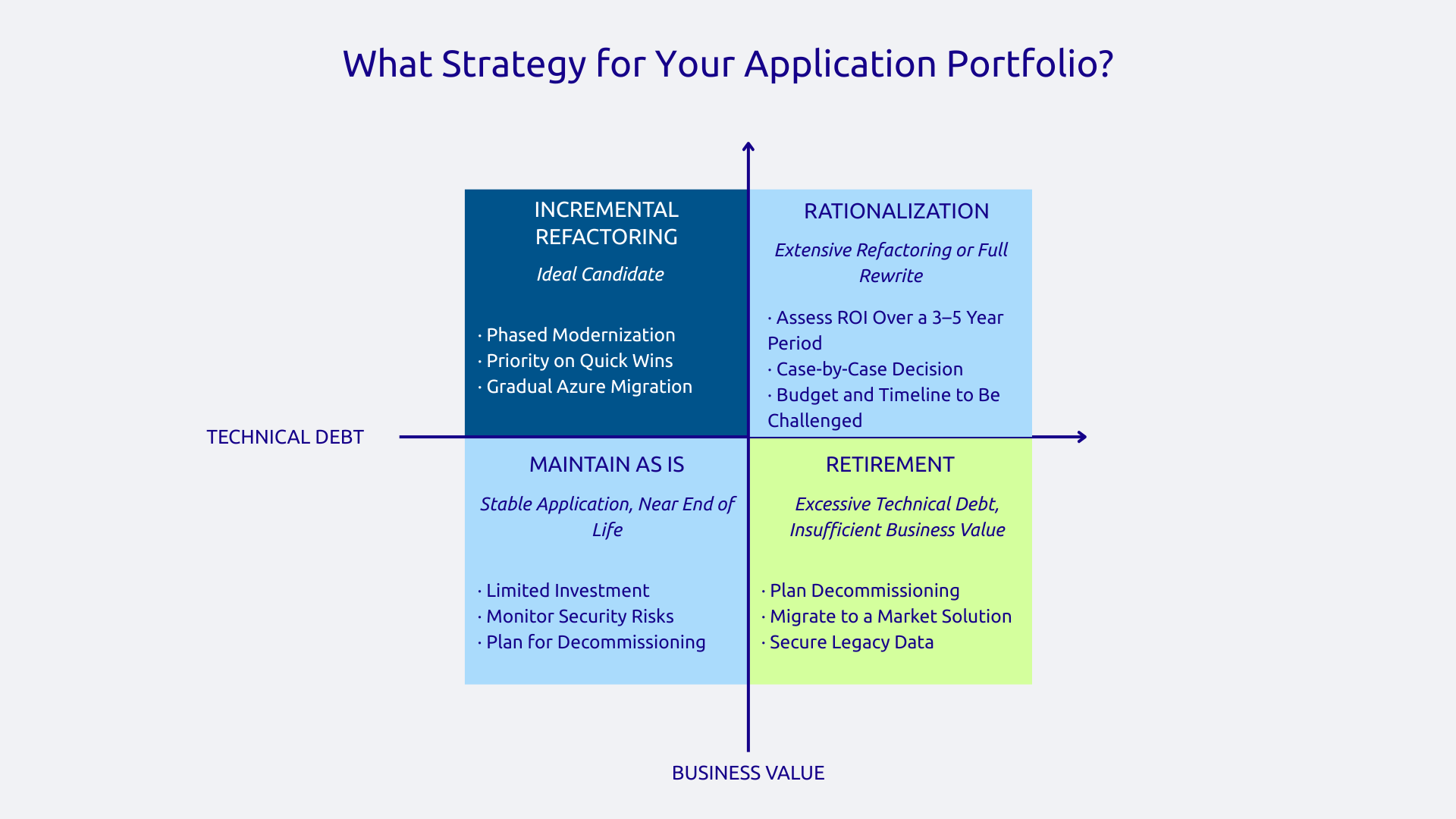
When faced with a legacy application (inherited from an existing system), you have three options.
The first of these is to maintain as is, which makes sense when the application is stable, not critical, and nearing its end of life. The second involves progressive refactoring, which is relevant when the business value is real but the debt is still manageable.
As for a complete rewrite, it should only be considered when the debt is too extensive to be resolved incrementally, or when a radical paradigm shift is required.
To help you decide, use a decision matrix.
Refactored code is more readable, better structured, and less dependent on unique experts. Specifically, onboarding a new developer goes from several weeks to a few days, because the code can be understood without needing to consult the sole expert who knows its secrets.
Bug fixing also changes in nature: instead of triggering a three-hour investigation to trace cascading dependencies, an incident becomes a localized, quickly resolvable problem.
As a result, development cycles shorten, and time spent on maintenance decreases, allowing for greater focus on value creation.
Refactoring is naturally the driver for migration to Azure. The typical path involves three stages:
Each level brings increasing benefits: automatic scalability, reduced infrastructure costs, and high availability without operational overhead.
Legacy applications often harbor the most exploitable vulnerabilities such as outdated authentication protocols, unpatched dependencies, and a lack of in-transit encryption.
Refactoring provides an opportunity to integrate security from the design phase, following the principles of security by design.
Compliance with the GDPR and NIS2 compliance is also facilitated: access traceability, personal data management, modern authentication via OAuth 2.0 and Microsoft Entra ID.
The Strangler Fig pattern is probably the most suitable for constrained production environments. Its name comes from the strangler fig tree, which grows around a host tree, gradually enveloping it and eventually replacing it without any visible disruption from the outside.
Applied to refactoring, this principle involves starting by identifying a first functional domain to extract, developing the new service in parallel, and gradually redirecting traffic to it.
In the Microsoft ecosystem, this typically translates to the gradual extraction of modules from an ASP.NET monolith into .NET microservices deployed on Azure Container Apps, with Azure API Management acting as a unified facade orchestrating the routing.
This way, there's no big bang, no production downtime, and the process is reversible at each step.
Today, monolithic architecture has serious limitations : tight coupling between modules, only global scalability, and risky deployments because everything changes at once.
The microservices address these limitations, but at the cost of significant operational complexity, which notably involves distributed transactions, increased observability and network overhead.
For many mid-market company applications, a modular architecture well-decoupled monolithic is a intermediate solution more advisable than a complete microservices decomposition.
To guide your decision, adopt Domain-Driven Design (DDD). In other words, segment by business domains, not by technical layers.
The database is often the last bastion of legacy. The Anti-Corruption Layer pattern is particularly useful: it creates an abstraction layer between the new code and the old schema, allowing for gradual schema refactoring without breaking everything simultaneously.
Next, the migration to Azure SQL Database, or the introduction of Azure Cosmos DB for non-relational data, these are performed in successive waves, moving from the least critical to the most sensitive tables.
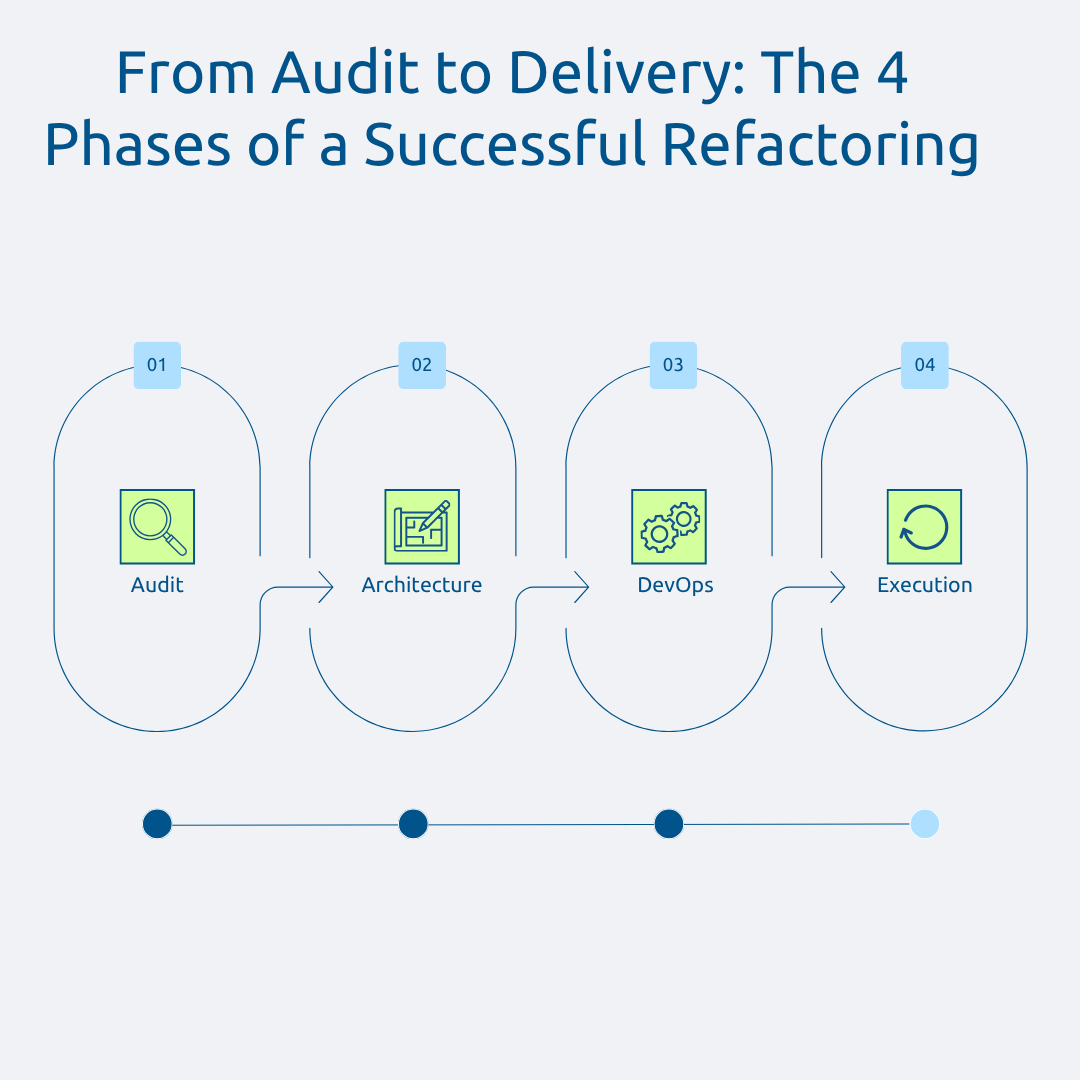
It all starts with a thorough inventory. Each application is evaluated based on its technologies, dependencies, business criticality, and the state of its technical debt.
Tools like SonarQube enable static code analysis and produce objective metrics: cyclomatic complexity (an indicator measuring the number of possible execution paths in the code), duplication rate, test coverage. Azure Migrate provides cloud compatibility assessment.
The outcome of this phase is the prioritization which compares business value, technical status, and estimated refactoring cost. It helps identify quick wins and structural projects to be planned for the long term.
It is at this stage that Askware conducts its application portfolio audits, combining automated technical analysis with interviews with business teams to properly weigh the functional value.
Here, the goal is to define the target architecture for each candidate application. This work is based on the modernization "R" framework, popularized by Gartner and then widely adopted and enhanced by AWS:
The target vision must be ambitious, but the path to achieve it must be pragmatic. More concretely, instead of a global delivery after two years, it's better to aim for a functional MVP each quarter, which allows for validating choices in production and continuous adjustment.
From a technological perspective, these steps rely on the Microsoft ecosystem: .NET 8 for the runtime, Azure App Service for managed hosting, Azure Functions for serverless batch processing, Azure Service Bus for event-driven architectures.
Without automated tests, refactoring is a risky gamble. Before touching a line of legacy code, the first action is to create a suite of regression tests that covers critical behaviors.
In parallel, implementing a CI/CD pipeline allows for rapid, confident iteration. Furthermore,Infrastructure as Code, with Terraform or Bicep on Azure, ensures environment reproducibility. Meanwhile, Azure Monitor and Application Insights provide the necessary observability to detect regressions in production.
Execution is performed module by module : a defined scope is refactored, validated in a staging environment, then progressively deployed to production before moving on to the next. To limit the risk with each delivery, two mechanisms are particularly useful.
Activated or deactivated without redeployment, feature flags allow for immediate rollback if a problem is detected in production.
In the same vein, the Blue-Green strategies on Azure App Service maintain two environments in parallel: traffic gradually shifts, and a rollback can be performed in seconds if needed.
.NET Framework is now in a maintenance and minimal evolution phase. Microsoft is directing new development towards the modern .NET platform, which is cross-platform, open-source, and significantly more performant.
For ASP.NET legacy applications, migrating to .NET 8 provides access to substantially improved performance, deployment on Linux containers, and an actively maintained ecosystem. The .NET Upgrade Assistant tool automates part of the compatibility analysis and speeds up preparatory work.
Azure doesn't just host your refactored applications: it offers managed services that advantageously replace custom code. Batch processing naturally migrates to Azure Functions, with no servers to provision or infrastructure to maintain.
For asynchronous communication between services, Azure Service Bus and Event Grid take over, where custom code previously managed message queuing and distribution.
Finally, Azure API Management acts as a unified facade to orchestrate the coexistence between the old monolith and new services, making it a central component of the Strangler Fig pattern.
The containerization is often the least risky first step towards modernization. Containerizing an existing application without modifying its code allows it to be extracted from its on-premise infrastructure and deployed on Azure Container Apps in a few weeks.
Once containerized, the application can be progressively refactored to .NET 8, then broken down into microservices if the business value justifies it. Azure Container Apps covers most of the needs of mid-sized enterprises without the operational complexity of Azure Kubernetes Service, which remains relevant for large-scale microservices architectures.
Trends are accelerating the need for modernization. GitHub Copilot and new AI-assisted analysis tools can facilitate the identification of certain code quality issues and accelerate refactoring operations, even if the systematic detection of technical debt still largely relies on specialized tools. This evolution makes progressive modernization more accessible than ever, provided it is approached methodically.
Request an audit of your applications from our experts Askware : we combine technical mastery of the Microsoft ecosystem and an understanding of business challenges to establish a modernization roadmap that takes into account your real-world constraints.
Refactoring incrementally improves existing code without altering the user-facing functionality. Rewriting starts from scratch, carrying high functional risk and often involving months without visible deliverables. In most cases, refactoring is less risky and more cost-effective.
The right question isn't technical, but business-focused: does this application still provide value? If the answer is yes, and if the technical debt remains manageable, then progressive refactoring is likely the best approach. A code audit using objective metrics helps in making that diagnosis, rather than relying solely on the team's impressions.
Generally, yes: progressive refactoring spreads out the cost and allows for value delivery at each stage. Industry experience shows that complete rewrite projects often carry higher risks in terms of timelines, costs, and adoption. However, if the technical debt is extremely deep, a rewrite might prove less costly over five years: each situation warrants an honest analysis of both options.
Our experts share their vision of best practices and technological trends to ensure the success of your digital transformation.