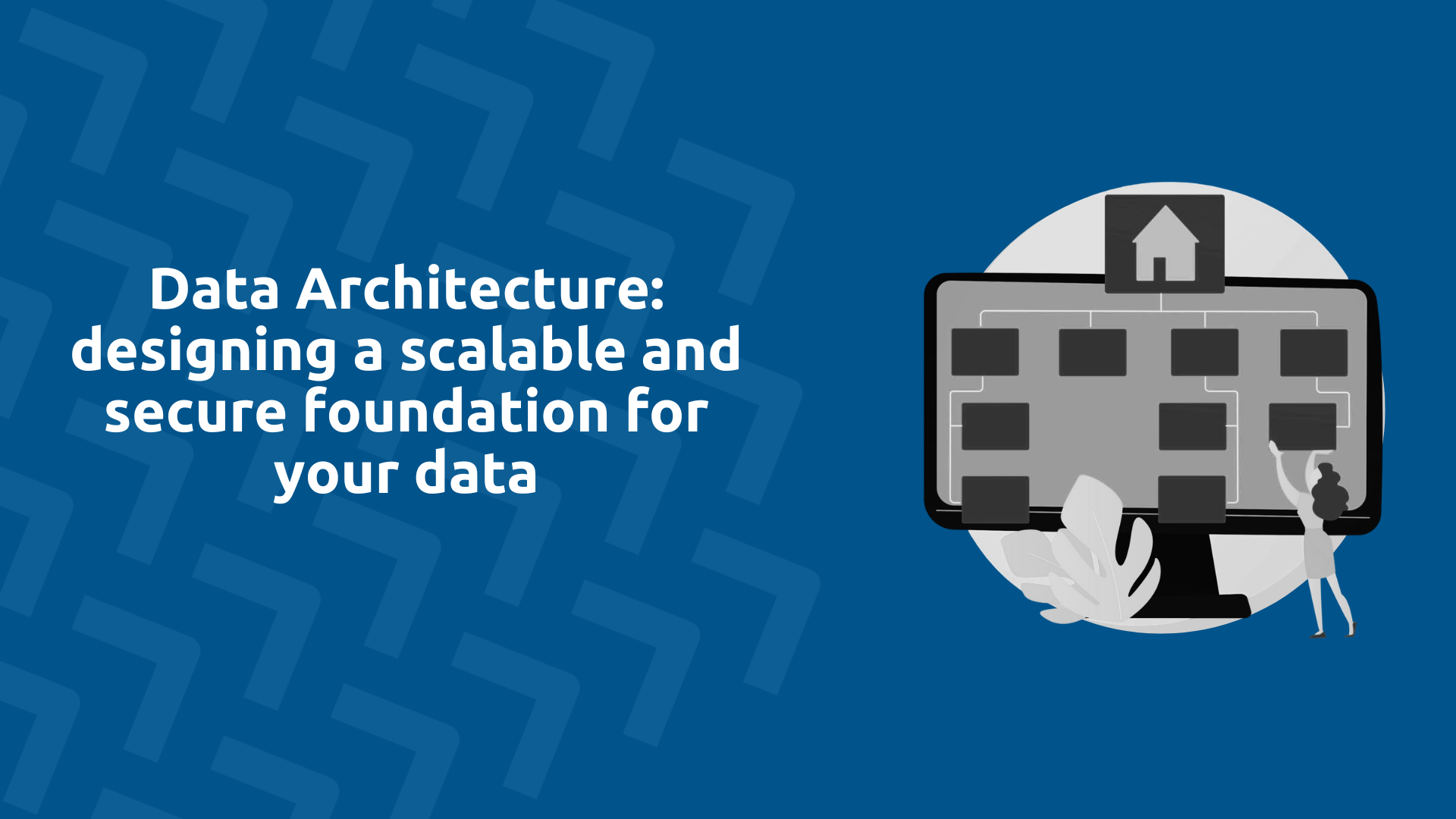
Data architecture: designing a scalable and secure foundation for your data
Discover the principles of a modern and scalable data architecture. Askware guides you on Azure to structure, secure and value your data.

Onpremise license costs are rising, difficulty recruiting on technologies that no one teaches anymore, business departments that are knocking on your door with needs that you cannot meet in a reasonable time. The status quo without digital transformation is not neutral: it has a real, measurable, and increasing cost.
This article is a strategic and pragmatic guide to get out of it. We will see how to diagnose the condition of your IS, what approaches to modernization choose according to your context, why a unified ecosystem like Microsoft's radically simplifies transformation, and how to build a realistic roadmap without crippling your business.

The symptoms of aging IS are organized into 4 main categories.
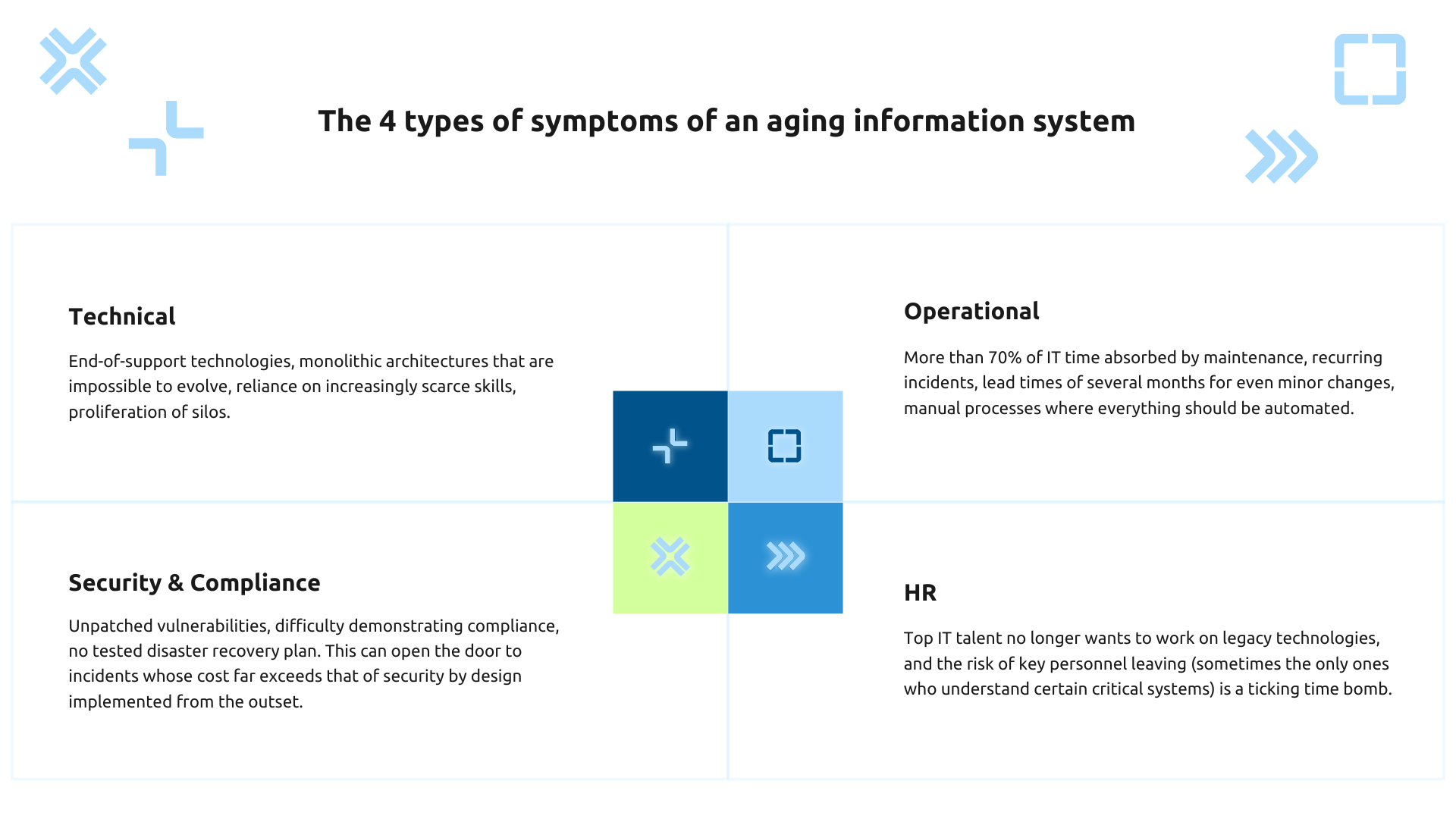
If you check four or more of these symptoms, across all categories combined, modernization is no longer a strategic choice to be arbitrated: each additional month increases technical debt, increases costs, and widens the gap with your most agile competitors.
First of all, the direct costs include:
Then, the opportunity costs include each new service that you cannot launch, each feature that your competitor releases in 6 weeks while you would do it in 6 months.
Risk costs, finally, are the most fearsome. In fact, the average cost of a security incident reached 4.88 million dollars in 2024 according to the IBM Cost of a Data Breach report, not to mention potential GDPR fines and business interruption losses.
A modernized IS therefore less expensive. In fact, businesses that migrate to the cloud can see significant cost savings, sometimes in the order of 30 to 50%, depending on industry benchmarks and the level of optimization.
What's more, access to generative AI, advanced analytics, and automation opens up services that legacy IS simply made impossible.
Not all of your applications have the same profile and that is why each one deserves its own approach. To make your choice, we usually refer to the “5 Rs” framework, popularized by Gartner and now extended to 6. We thus have:
Big Bang approach (the complete changeover in a very short time) is as risky as it is ambitious: if a major problem occurs, then it impacts the entire organization simultaneously. It is only justified for structures of limited size with a simple IS, or in an absolute emergency situation.
Progressive wave approach is the rule in the vast majority of cases. Relatively autonomous functional areas are identified, prioritized based on business value and technical complexity, and deployed in waves over periods of 3 to 6 months. Each wave delivers value, allows you to learn, adapt and reduces risk at a localized perimeter. Agile methods provide an excellent framework for piloting these waves.
A strategy Cloud-first means that by default, all new developments and migrations take place in the public cloud — to avoid creating new technical debts. But “cloud-first” doesn't mean “cloud-only.”
Some workloads have good reasons to remain on-premise: ultra-sensitive data with sovereignty constraints, industrial applications with latency constraints, negative ROI from migration.
Note that Microsoft offers concrete solutions to manage this hybridity:
In fact, most organizations will maintain a hybrid architecture for several years.
The strategy “Best-of-Breed” (selecting the best tool in each category) makes things so complex that the benefits disappear. As a result, we end up with custom integrations that are expensive to maintain, siloed data, a fragmented user experience, and increased governance.
The cost of integrating and maintaining a patchwork of tools can be significantly greater than that of a unified ecosystem, sometimes in the order of 2 to 3 times, depending on the contexts and the complexity of the ecosystem.
Choosing a unified ecosystem is therefore a strategic choice that focuses on consistency, agility and TCO rather than the functional perfection of each brick. Moreover, the unified ecosystem is not monolithic because it can be complemented by third-party tools for very specific needs.
Azure forms the infrastructure foundation: IaaS for rehosting and replatform, PaaS for modernizing applications, specialized services for AI, IoT and machine learning. The Infrastructure as a Service article details the options available.
Microsoft 365 modernizes the workplace and collaboration: Office 365, Teams, SharePoint, and OneDrive. This is often the first pillar deployed because it brings a quick win as well as visible value for all users from the first weeks.
Dynamics 365 replaces legacy CRMs and ERPs with modern cloud applications. These applications rely natively on Dataverse and integrate frictionlessly with the rest of the ecosystem.
Power Platform democratizes development and accelerates innovation: Power Apps to create low-code business applications, Power Automate for workflow automation, Power BI for analytics. This is the layer that allows businesses to gain digital autonomy without systematically depending on the IT department for each evolution.
If the Microsoft ecosystem works so homogeneously, it is in large part thanks to Dataverse. This cloud data platform is the joint foundation of Dynamics 365 and Power Platform and is much more than a relational database.
Dataverse offers a common data model with standard tables shared between all applications, extendable with custom tables. Thanks to this, each entity automatically has a REST API, configurable granular security down to the row and column level, native business logic, and a comprehensive audit.
Regarding modernization, where a traditional IS accumulates custom integrations between incompatible schemes, Dataverse centralizes business data in a shared hub. For example, a salesperson consults their Dynamics 365 accounts in Teams, shares a proposal from SharePoint, triggers a Power Automate workflow, and tracks their goals in Power BI. A single login, a smooth experience, zero re-entries.
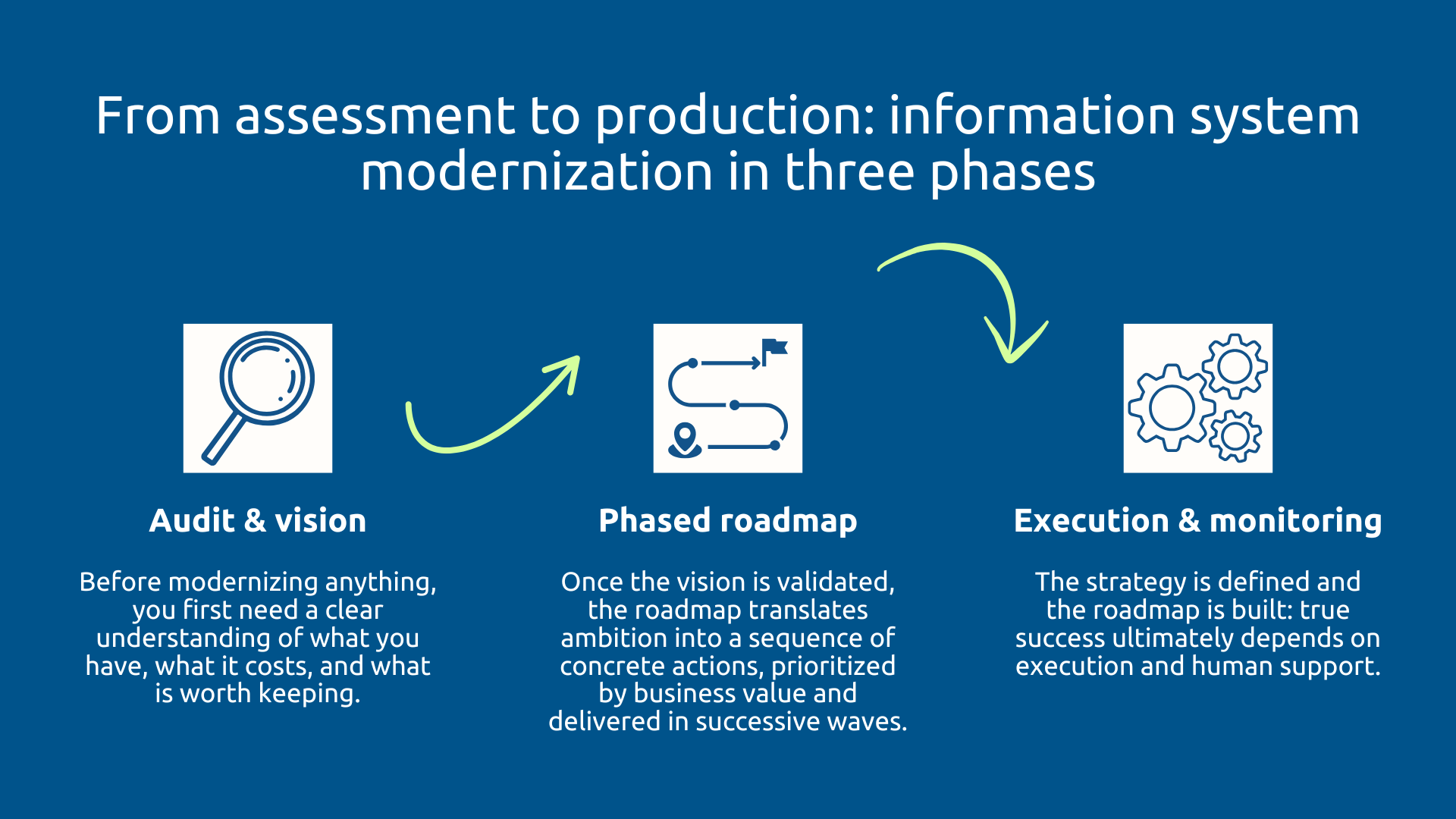
Doing without due diligence means taking the risk of modernizing the wrong things in the wrong order, with guaranteed budget surprises.
A complete audit covers 4 to 6 weeks during which the auditor will look at the following points:
From this base, you define the target vision (architecture, technological choices, strategy by application), then you build the business case: modernization investment vs business as usual costs over five years, expected ROI, analysis of the risks of inaction. Here it is the technical specifications which is an indispensable tool.
The roadmap moves from strategy to a sequenced action plan, structured around a matrix with two axes: horizontal business value, vertical complexity and effort (or vice versa). The quick wins (high value, low complexity) are realized first because they build trust.
Typical structure of the sequenced design is organized as follows:
However, a roadmap is not a fixed plan: quarterly reviews make it possible to integrate learning, adapt to new priorities and measure the value delivered at each stage.
Technical execution is 30% of the effort. Change management is the remaining 70%.
On the one hand, on the technical plan, success is based on agile execution (short sprints, incremental deliverables, environments separated from dev to production) and on careful documentation that guarantees continuity beyond the project.
On the other side, on the Human plane, the quality of the support system is decisive. To successfully adopt change, it will be necessary to establish a clear communication plan from the start, identify sponsors in each direction, adapt training to each role and offer local support at the start.
Finally, the measurement of value must be established as a permanent reflex. Technical indicators such as availability, performance and incidents are complemented by adoption and user satisfaction metrics, and then by concrete business KPIs like:
In our experience, this type of deployment can reach more than 90% adoption by D+30, with measurable productivity gains by D+90, provided we have invested as much in support as in technology.
Modernizing the IS is a necessity to remain competitive, secure and agile. The costs and risks of the status quo now far outweigh the investment in modernization. The unified Microsoft ecosystem offers a coherent foundation that drastically simplifies this transformation. And because modernization has no finish line, this ecosystem is constantly evolving to allow you to gradually adopt the next innovations.
Ready to transform your IS into a performance and agility engine? Contact Askware for a maturity diagnosis and let's build your modernization roadmap together.
The 5 Rs framework makes it possible to adapt the strategy application by application: some can be migrated as is, others are replaced by modern solutions, others are simply extinguished because they are no longer really used. We work in successive waves, starting with areas where the value is quickly visible and the risk is limited.
Not necessarily. Some applications have good reasons to remain on-premise: regulatory constraints, critical latency, disproportionate migration costs. The objective is not the cloud for the cloud, but an architecture adapted to your real constraints. Most organizations achieve an assumed hybrid balance, provided that it is a strategic choice and not the result of a lack of vision.
The real question is not “how much does it cost” but “how much does it cost compared to the status quo”. A prior audit makes it possible to accurately quantify the investment and compare it with the expected savings and the risks avoided. What we regularly observe: the cost of inaction over five years often exceeds that of modernization, without the benefits of agility that permanently change the competitiveness of the organization.
Our experts share their vision of best practices and technological trends to ensure the success of your digital transformation.