ISO 27001: The security guarantee of the Microsoft ecosystem
Learn how Microsoft's ISO 27001 certification ensures the security of your Dynamics 365, Power Platform, and Azure projects. Complete guide.

According to the 17th State of Agile Report (Digital.ai, 2023), 71% of organizations say they use agile practices in their software development cycle. However, the portion of respondents believing that their transformation Agile is fully successful has declined significantly from year to year, which says a lot about the gap between promises and reality on the ground.
But how do you manage a cloud migration of 200 applications in iterative mode when management expects a firm budget and a precise schedule? How do you reconcile agile flexibility with the compliance, security, and documentation requirements of your CIO?
In this article, we detail what are actually agile methods, we analyze in which contexts they bring value and we propose a concrete approach to adopt them gradually without losing control of your projects.

It all started in 2001 with the agile manifesto, a founding text signed by 17 software development practitioners. He suggests giving priority to:
These values have given rise to several operational frameworks that concretely structure the work of teams:
To summarize: the V-cycle is the road map where the entire journey is planned in advance. Agile is GPS that recalculates in real time according to conditions, obstacles and new priorities.
On the other hand, agile Is not lack of planning, or organized chaos, or an excuse not to document. Nor is it a method without governance or a universal solution that solves all the problems of your projects.
The V-cycle follows a sequential logic: we design, we develop, we test, we deliver. The specifications are fixed from the start, validation by the professionals takes place at the end of the project. Therefore, the risk is concentrated on this final phase alone, but it is at this precise moment that surprises cost the most.
The agile methodology works very differently: teams deliver features in increments, specifications are refined with each sprint, and users validate continuously. By doing so, the risk is distributed throughout the duration of the project and detected very early.
As for choosing between the two, It depends. The V-cycle remains suitable for projects with a stable and well-defined scope, especially in highly regulated contexts (aerospace, medical or for certain critical infrastructures). Agile shines as soon as needs change, when the Time-to-Market is a major challenge and that the continued involvement of businesses is possible.
For a major IT transformation project such as a cloud migration or deployment ERP, most organizations retain a hybrid approach : global governance in a V-cycle, execution by modules in agile mode.
According to the 17th State of Agile Report (Digital.ai, 2023), among organizations that have adopted agile practices:
These results are real but If and only if the execution is well done. Misunderstood or poorly implemented agile produces the opposite effect: teams overloaded with ceremonies, sprints that follow one another without delivering tangible value and management that loses all visibility on the real progress of projects.
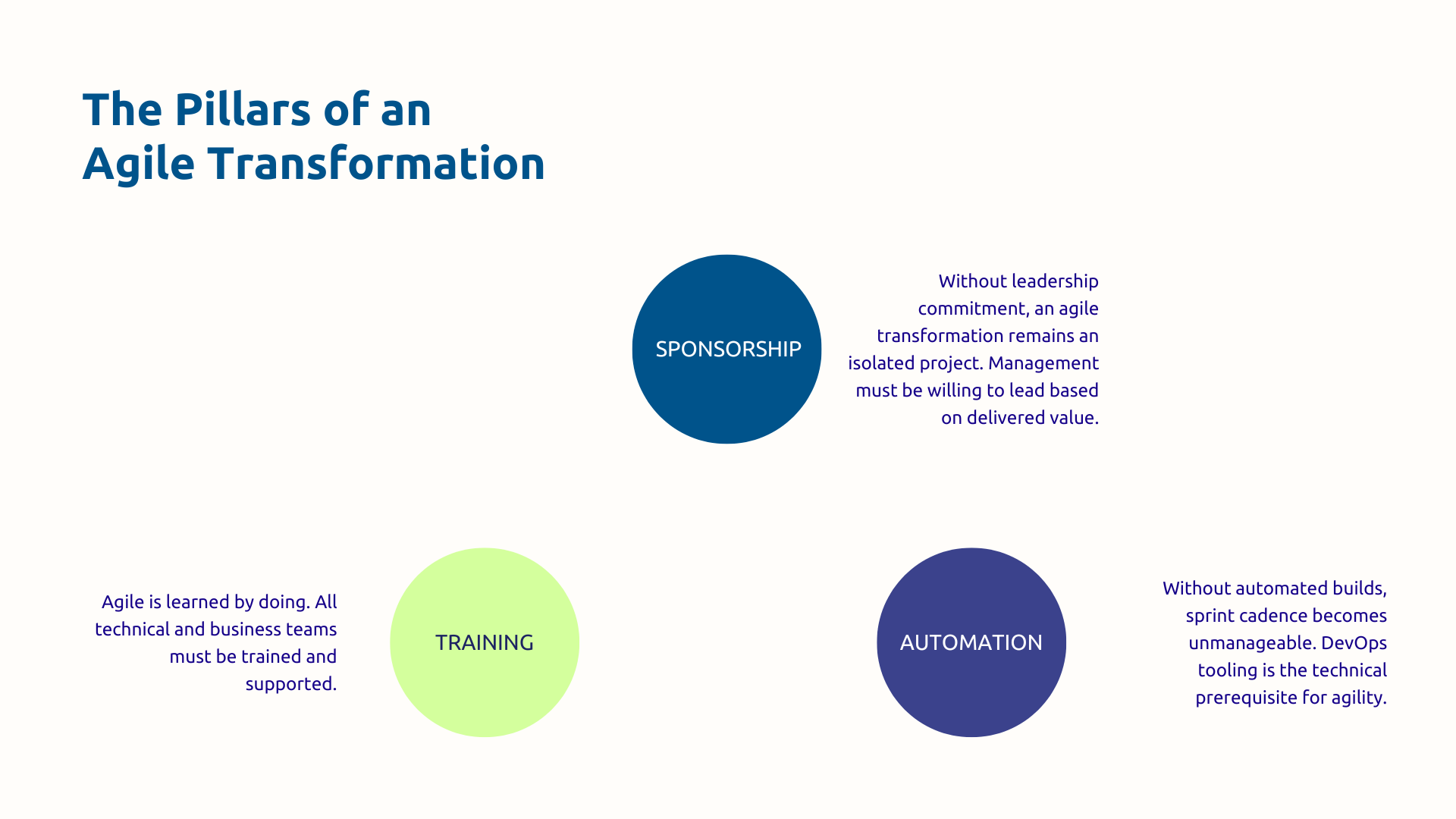
Without porting to the highest level, agile transformation remains an isolated IT project that does not succeed. Also according to the 17th State of Agile Report, only 32% of agile transformations are actively driven by leaders, which is part of the reason why so many initiatives are running out of steam.
Why does management need to make a concrete commitment? Because adopting agile means no longer following an initial plan, but pilot by the value delivered at each increment. Management must accept controlled uncertainty, adapt its reporting (show the value delivered sprint after sprint, not a percentage of theoretical progress) and invest in team training.
Imagine an IS modernization project initially planned over 18 months. In agile mode, management validates 6 successive releases of 3 months, with the possibility of adjusting priorities between each release according to learning. It's more uncomfortable than a frozen Gantt but much more effective at delivering what really matters.
You don't become agile by reading a book or by following two days of training. Agile can be learned By doing, with adapted support.
This means training technical teams in Scrum or Kanban practices, but also, and this is often put aside, train trades for their new role. A Product Owner who does not understand his role (prioritizing the backlog, arbitrating continuously) becomes a bottleneck that paralyzes sprints.
An Agile Coach, internal or external, is valuable for the first 3 to 6 months. An adjustment phase is frequent during the first sprints, while the team stabilizes its rituals and its mode of collaboration. In our experience with large-scale transformations, we generally need several months (often 6 to 12) for a team to reach satisfactory agile maturity, with smooth ceremonies, stable velocity, and an ability to deliver value on a regular basis.
In addition, communities of practice, where teams share their learning across the organization, significantly accelerate this skill growth curve.
Agile without automation is”Agile Theater“: we play the play without reaping the benefits. Delivering every two weeks is only sustainable if builds, tests, and deployments are automated. Otherwise, each sprint generates an accumulation of technical debt and risks that no one can control anymore.
A solid DevOps infrastructure is based on several complementary bricks:
In the Microsoft ecosystem, Azure DevOps centralizes all this natively: boards for agile management, pipelines for continuous delivery, integration with GitHub and Application Insights for observability. With each commit, a well-configured pipeline can automatically launch tests, build the application and deploy it in a test environment, allowing fast and secure iterations, where IT modernization requires it.
The most common danger in large organizations is pretend to be agile without changing anything profoundly. For example, you rename the project manager to “Scrum Master” without changing his role. Then, we organize two-week sprints, but each sprint must go through 5 validation committees before any deployment and we deliver to a recipe environment every two weeks.
Result: we combine the constraints of agile (daily meetings, regular ceremonies, backlog documentation) and the constraints of the V-cycle (cumbersome decision-making, fixed specifications). It is the worst of the two models and teams experience it as a double penalty.
A good indicator of fake agile is to find out when the last production release took place. If the response exceeds two or three sprints, you are not agile.

These two pitfalls seem to be the opposite, but they stem from the same lack of maturity in the adoption of agile.
The dogmatism consists in applying the frameworks to the letter, without taking into account the context: “we MUST do two-week sprints”, “we MUST NOT document”, “we MUST have a 100% Product Owner on each project”. Agility is, in essence, a philosophy of adaptation. Rigid agile is a contradiction in terms. If three weeks is a better fit for your delivery schedule, use three weeks.
In contrast, the loss of governance tends to confuse agility and lack of control. Agile does not eliminate the roadmap, quarterly goals, or reporting to management; on the contrary, it makes them more adaptive. A well-designed agile dashboard for a CIO shows the roadmap in stages, the average speed of the team, the value delivered per sprint, the risks identified, and the planned adjustments. It is a richer governance than a fixed monitoring table, because it reflects reality rather than the initial plan.
This link between agility and IT compliance is also central: well-structured, agile governance facilitates traceability, audits and the response to regulatory requirements, provided it is thought of from the start.
Azure DevOps is designed to cover the entire agile lifecycle. Its modules are structured in a coherent manner:
A typical organization in Azure DevOps structures its backlog in Epics → Features → User Stories → Tasks. Each sprint is planned from the backlog and the burndown chart gives immediate visibility on the real progress in relation to the team's commitment.
Is Azure DevOps better than GitHub Projects or Jira? It all depends on the context. For organizations already in the Microsoft ecosystem, especially those deploying automated tests or working on IT automation, Azure DevOps offers unparalleled native integration with Azure, Power Platform, and Dynamics 365.
Power Platform is, by nature, an agile tool. The ability to build an MVP (Minimum Viable Product) functional in a few days with Power Apps, iterating it directly with users and automating it with Power Automate corresponds exactly to the philosophy of rapid feedback and continuous adaptation.
For example, a Power Apps project can be structured into six one-week sprints: sprint 1 for basic screens, sprint 2 for business logic, sprint 3 for integrations, sprint 4 for user adjustments, sprint 5 for testing, sprint 6 for deployment and training. In six weeks, a business application is in production — where a traditional project would have required several months of prior specifications.
However, be careful: the speed of Low-code can become a trap if governance is not in place. Without a clear framework of environments, DLP policies (Data Loss Prevention) and deployment pipelines, applications can multiply outside of IT control and open the door to Shadow IT.
A Dynamics 365 deployment project, whether it's an ERP or a CRM, is not a typical software development project. It combines configuration, custom development, data migrations, multiple integrations with existing systems, and a strong involvement of businesses at each stage.
The agile adapts to it but with adjustments. The initial discovery and design phase is generally longer (4 to 8 weeks) to map business processes and define a stable architecture. Then, sprints make it possible to configure and validate module by module, with the users concerned.
The progressive release approach is particularly effective for Dynamics 365 deployments.
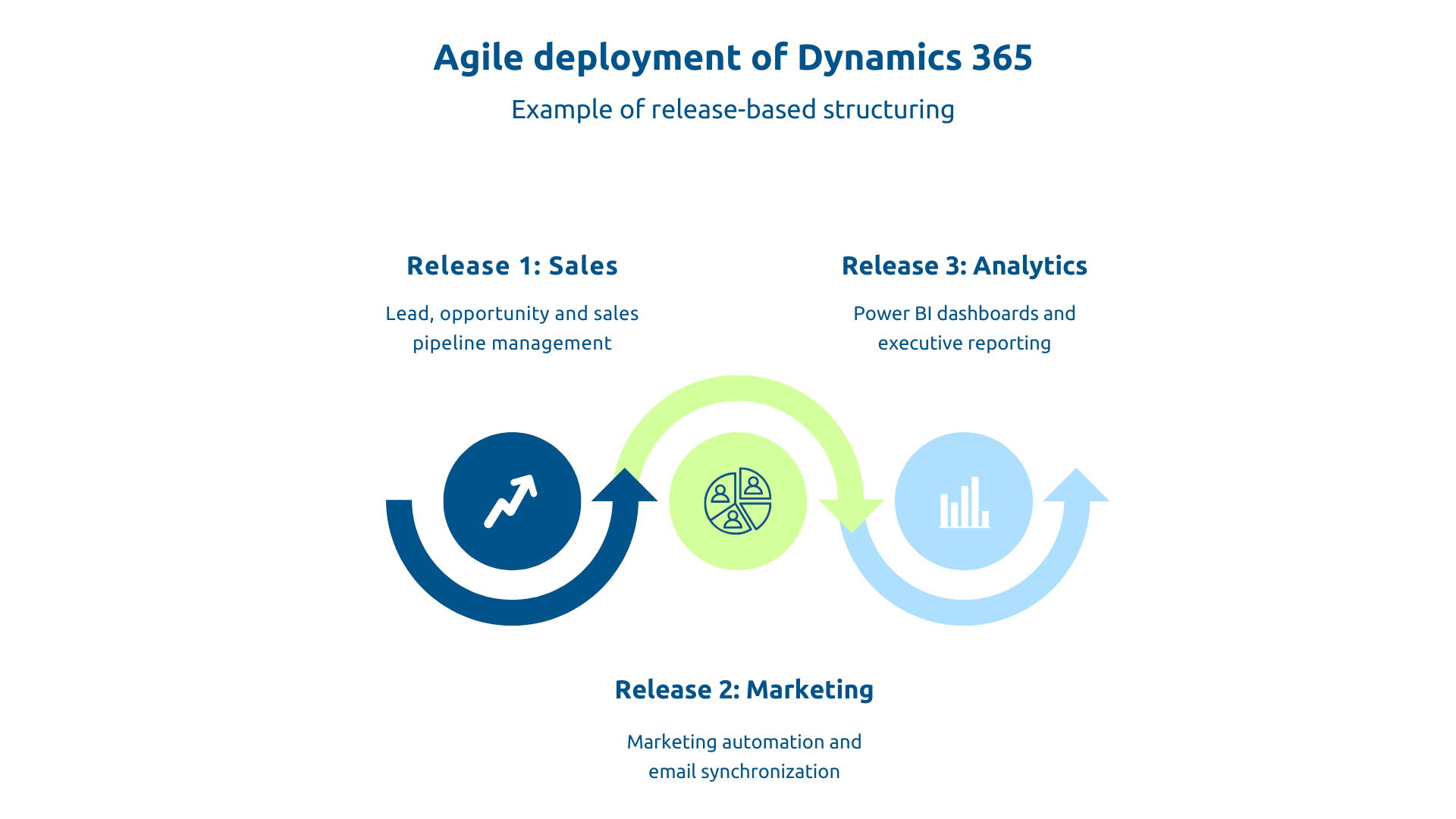
Agile methods are a pragmatic response to the challenges of modern development: evolving business needs, the need to iterate quickly, risk reduction through incremental deliveries. When implemented well, the gains are measurable and significant. When they are focused on an organization without real cultural transformation, they add complexity without providing value.
The key is pragmatism, you have to adapt the method to the context, not the other way around. Some projects are naturally agile, others require adaptations, and a few remain better served by traditional approaches. The Microsoft ecosystem, Azure DevOps, Power Platform, Power Platform, Dynamics 365, greatly facilitates this transition. But the tools don't do the transformation for you.
Do you want to assess the agile maturity of your organization and identify your first pilot projects? Askware offers you a scoping workshop to analyze your context, map your projects and build a roadmap for gradual adoption. Contact our experts to start without dogmatism or improvisation.
It is a set of project management approaches born in the world of software development, which prioritize frequent deliveries, regular user feedback, and the ability to adapt to changes rather than following a fixed plan. Scrum, Kanban, SAFe are the best known variations, each with its own rituals and tools.
Scrum organizes work into short, rhythmic cycles (sprints), with well-defined roles and structured meetings. Kanban, on the other hand, works in a continuous flow: tasks progress over time, without formal iterations, by simply limiting the number of subjects treated in parallel. Scrum is well suited for projects with planned deliveries; Kanban is more suited to teams that manage continuous demand flows, such as support or maintenance.
Yes but not without adaptation. Major IT transformation projects, cloud migrations or ERP deployments have constraints (multiple dependencies, budgetary governance, compliance) that cannot be accommodated with “pure” agile. What we are seeing in the field is rather a hybrid approach: structured global governance, with agile execution by modules or by business perimeters. The risk of the big bang is thus reduced, and teams deliver real value at each stage.
Our experts share their vision of best practices and technological trends to ensure the success of your digital transformation.