How to build a “Customer Data Platform” (CDP) strategy with Microsoft?
Customer Data Platform: Build your CDP strategy with Microsoft Customer Insights. Unification, segmentation, activation. Expert guide.

Each new business request triggers the same scenario: scoping meeting, impact analysis, sometimes up to six months of development, production regression. Meanwhile, some competitors, especially the most mature in DevOps, deliver within a few weeks. The problem is not your team or your budget. It is the architecture of your information system.
Modular architecture proposes a realistic way out: gradually decompose your IS into autonomous bricks, capable of evolving independently without jeopardizing global stability. In this article, we decipher the fundamental principles of this approach, its concrete benefits, and the method to implement it without a “big bang” in a Microsoft ecosystem.

Contrary to what one might think, modularity is more a question of design principle So much technology. The idea is to cut intelligently to evolve effectively.
One monolithic system is a unique application in which all functionalities (order management, billing, authentication, notifications) are closely intertwined. Modifying one of them requires recompiling, retesting and redeploying the whole thing because the slightest regression propagates like a crack in concrete that would have been poured out of a block.
Conversely, modular architecture principle is to break down the IS into autonomous components, with clearly delineated responsibilities, which communicate with each other via standardized interfaces. In such an approach, each module manages its own functional scope and can evolve without the others having to know it.
Interface governance is central because without it, modularity quickly becomes chaotic again. To create it in the best conditions, we rely on three architectural principles:

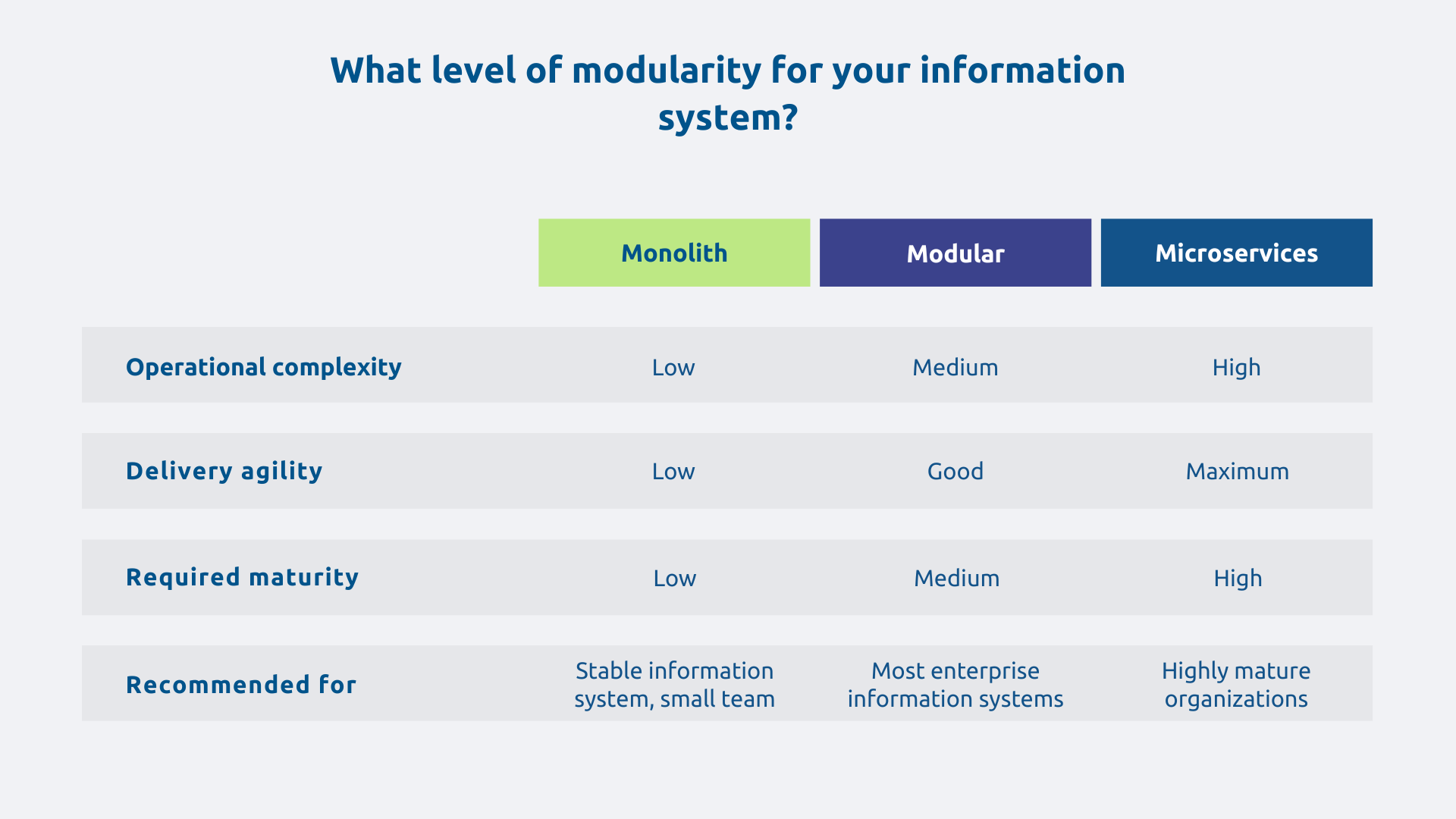
These three terms refer to different maturity levels on the same spectrum.
SOA (Service-Oriented Architecture) is the historical approach, with shared business services, often orchestrated by an ESB. Second, microservices represent the most granular form: each service is highly targeted, deployed independently, with its own resources. As for modular architecture, it is the generic term that encompasses this entire spectrum and not microservices specifically.
As several experts point out, including Martin Fowler, a monolith well divided into coherent modules, communicating via own internal APIs, already provides considerable agility without the operational complexity of an extremely distributed architecture. The right level of modularity depends on your context and your technical maturity.
Concretely, in a modular IS, several teams work in parallel on separate modules without blocking each other. The test scope is mostly reduced to the modified module, even if integration and contract tests are still necessary. Deployment can be done module by module, without risky global production.
The result is a transformation of major risky migrations into controlled incremental evolutions. It is the foundation of true IT agility in the sense of agile methods applied to the architecture itself.
By design, a module has a clear functional perimeter. In other words, teams quickly understand what it does, why it exists, and who is responsible for it. Modularity makes it possible above all to modernise by bricks. For example, a billing module developed 10 years ago can be rewritten in modern technology without impacting neighboring modules that call it via API, provided that the interfaces are clearly defined and respected. This is the essence of application refactoring: modernizing without starting from scratch.
A modular IS therefore ages better, because its components are gradually renewed. Technical debt accumulates less quickly and is repaid more easily.
In a monolithic architecture, a failure in the reporting module can paralyze all operations. In a modular architecture, failures are isolated. Like a partitioned system, a waterway in one compartment does not cause the entire ship to sink.
In addition, each module can incorporate its own resilience strategies such as:
Modularity also allows for targeted horizontal scaling, with direct synergies on a cloud-native architecture.
In a monolith, everything scales in one block. In a modular architecture, you size precisely: you increase resources only on the modules under load, without bloating the entire infrastructure.
It also allows sharing of transversal components (authentication, logging, monitoring) which prevents you from costly duplications. And each module can adopt the technology best suited to its needs, without standardization constraints.
The audit consists in identifying the real components of the IS, mapping their dependencies and measure the coupling level : which components are so interdependent that a modification of one systematically leads to regressions in the others?
To do this, rather than relying on documentation that is often outdated, rely on runtime analysis tools. Azure Application Insights visualizes the real dependencies between modules in production; static code analysis reveals the couplings that are invisible at runtime.
Breakdown by business areas is generally the most natural: sales, invoicing, inventory, logistics, HR. Each domain is a module with its own data model. This is the principle of bounded context from Domain-Driven Design (DDD), i.e. a business perimeter consistent with its own rules and vocabulary.
Dynamics 365 is the perfect example: the Sales, Service, and Finance modules activate functionally independently, even if they rely on a common data layer (Dataverse), which nuances their complete autonomy. One native business modularity that you can be inspired by.
The Strangler Fig pattern corresponds to the most pragmatic strategy: to make the old system and the new modules coexist, then gradually replace the functionalities of the monolith without interruption of service.
In a Microsoft environment, the existing monolith continues to rotate while new modules are exposed via Azure App Services or Azure Functions. Azure API Management acts as a facade and routes calls to the old or new system according to the progress of the migration. It is this approach that we recommend in our IT modernization projects.
A value/complexity matrix forms a starting point. The axis business value evaluates the frequency of evolution of the module and its business impact while the axis technical complexity assesses its dependencies and its level of coupling to the existing one.
Quick Wins are located at the top left: high value, low complexity. A notification module can be quickly extracted in the form of Azure Functions, with an immediate impact on delivery agility. These quick victories create momentum and secure the transformation over time.
Each exchange between modules must be based on a explicit contract : REST or GraphQL API, asynchronous message via Service Bus, event on Event Grid. These contracts must be versioned and documented with the same rigor as a public API.
In the Azure ecosystem, Azure API Management allows you to publish a v2 API while maintaining v1 for consumers who have not yet migrated without interruption of service, without forced coordination between teams. This governance is naturally part of an approach of Safety by design from the design of the IS.
The classical model of the database shared between all the components is incompatible with true autonomy of the modules. The recommended approach is Database per service : each module maintains its own data model, optimized for its needs.
When multiple modules need to share information, synchronization involves asynchronous events. In the Microsoft ecosystem, a CRM module on Dynamics 365 maintains its customer base while a billing module maintains its own copy, synchronized via Azure Service Bus or Azure Event Grid. Coherence becomes possible and distributed, which is called eventual consistency.
Modularity mechanically increases the complexity of supervision. In fact, a business transaction can go through several distinct modules before producing its result. Without transversal observability, locating the source of degradation easily becomes an exhausting treasure hunt.
To answer this question, three layers are essential:
Azure Monitor and Application Insights offer these capabilities, with native support for distributed tracing, subject to appropriate instrumentation (SDK or OpenTelemetry). This is the foundation of IT observability in the hybrid cloud era because a modular IS without observability quickly becomes unmanageable.
A sustainable modular architecture requires an organization that corresponds to it. Teams need to be structured by business area, with complete ownership of their module from end to end — and not by technical layer, which would reproduce at the human level the coupling we are trying to eliminate.
On this point, the Power Platform plays a facilitating role: its low-code tools allow business teams to create complementary modules without systematically depending on IT teams, provided they correctly frame the limits of low-code. For its part, a transversal architecture guild guarantees the coherence of structuring decisions across all modules.
Modular architecture is not a technical fad reserved for hyperscale startups. It is a structural response to the concrete problem of many CIOs: how to make a historical IS evolve without breaking it, without paralyzing innovation? You don't modernize a monolithic IS into a project — in practice, this type of transformation can take place over several years on a complex IS. The important thing is to keep moving.
Let's evaluate the modularization potential of your IS together. Contact the Askware experts for an architectural audit and a framing workshop adapted to your context.
Microservices are a form of modularity taken to the extreme: each service is ultra-granular, deployed independently with its own resources. Modular architecture is a broader concept that covers a whole spectrum. Targeting microservices without the operational maturity that comes with it often means creating more problems than solving. The right level depends on your context.
The key is not to do everything at once. We start with the least coupled components, we validate on each iteration, and we move forward in waves. In practice, this type of transformation can take place over several years on a complex IS.
The classic trap is to cut by technical layer. The right approach is to break down by business area: sales, invoicing, logistics, notifications. If two modules need to talk to each other all the time and share the same data, they probably form a single domain and would benefit from being merged.
Our experts share their vision of best practices and technological trends to ensure the success of your digital transformation.