Microsoft blueprints: how do you structure compliance and security by design?
Learn how Microsoft blueprints automate Azure compliance and security by design. Expert guide for DSI.

Fixing a security vulnerability discovered in production can cost 30 to 100 times more depending on the detection phase. And yet, the majority of organizations continue to treat security as a layer applied at the end of the chain.
Between the increasing sophistication of threats, regulatory tightening and permanent pressure on the time-to-market, the retrospective security approach is now unsustainable. The Security by Design is the opposite approach; it consists in integrating data protection from the design phase of architecture.
In this article, we decipher the fundamental principles of Security by Design, we show how to concretely integrate it into each phase of your projects, and we explain how the Microsoft ecosystem facilitates this approach with native security capabilities.

The Security by Design refers to an approach in which security is not added to an existing system, but integrated from the very first architectural decisions. This means that safety requirements are treated in the same way as functional requirements: from the framework workshop, from the first architecture diagram, from the choice of technical components.
It is different from the traditional approach in which you develop first, you test then you test and you try to add security at the end, often too late to correct structural problems. Between increasing regulatory pressure and the sophistication of threats, secure design has become a non-negotiable prerequisite.
The concept of Privacy by Design, formalized by Ann Cavoukian, is now a regulatory requirement enshrined in the RGPD (article 25), based on an obligation to implement. Its 7 founding principles apply directly to Security by Design:
The problem with the reactive approach is also economic. This ratio can reach 1 to 100 between a correction in the design phase and a correction in production. The numbers of NIST And ofIBM converging on this point.
The costs add up on several levels. First there are the direct correction costs :
Next come the accumulated technical debt, that is, stacked security patches that weaken the system as they multiply. There are also the costs of real incidents: data breaches, ransomware, GDPR fines of up to 4% of total global annual revenue for the most serious breaches.
Take the case of a business application developed without Security by Design and which must be completely redone after a security audit prior to production. The result: several months of delay, significant additional costs (for example +40% in some cases), and a team exhausted by a construction site that could have been avoided.
Security by Design is often presented as a constraint. In reality, when properly implemented, it is more of a competitive advantage.
Reduction in correction costs is the most immediate benefit. Fewer late breaches automatically mean fewer remediation cycles, less technical debt, fewer incidents to manage urgently. But the impact goes further: without a security remediation cycle at the end of the project, delivery deadlines are met and teams remain focused on value, not on recoveries.
This operational gain is combined with a regulatory advantage. Indeed, an architecture designed with GDPR, NIS2 and industry standards requirements integrated from the start does not need retroactive compliance. And that's precisely what your customers and partners want to see: the ability to demonstrate a solid security posture right from the tender phases, a particularly decisive differentiator in finance, health or public services.
Finally, an architecture designed for security is structurally less complex to operate : fewer compensatory layers to maintain means fewer ad hoc configurations to document and therefore less attack surfaces to monitor.
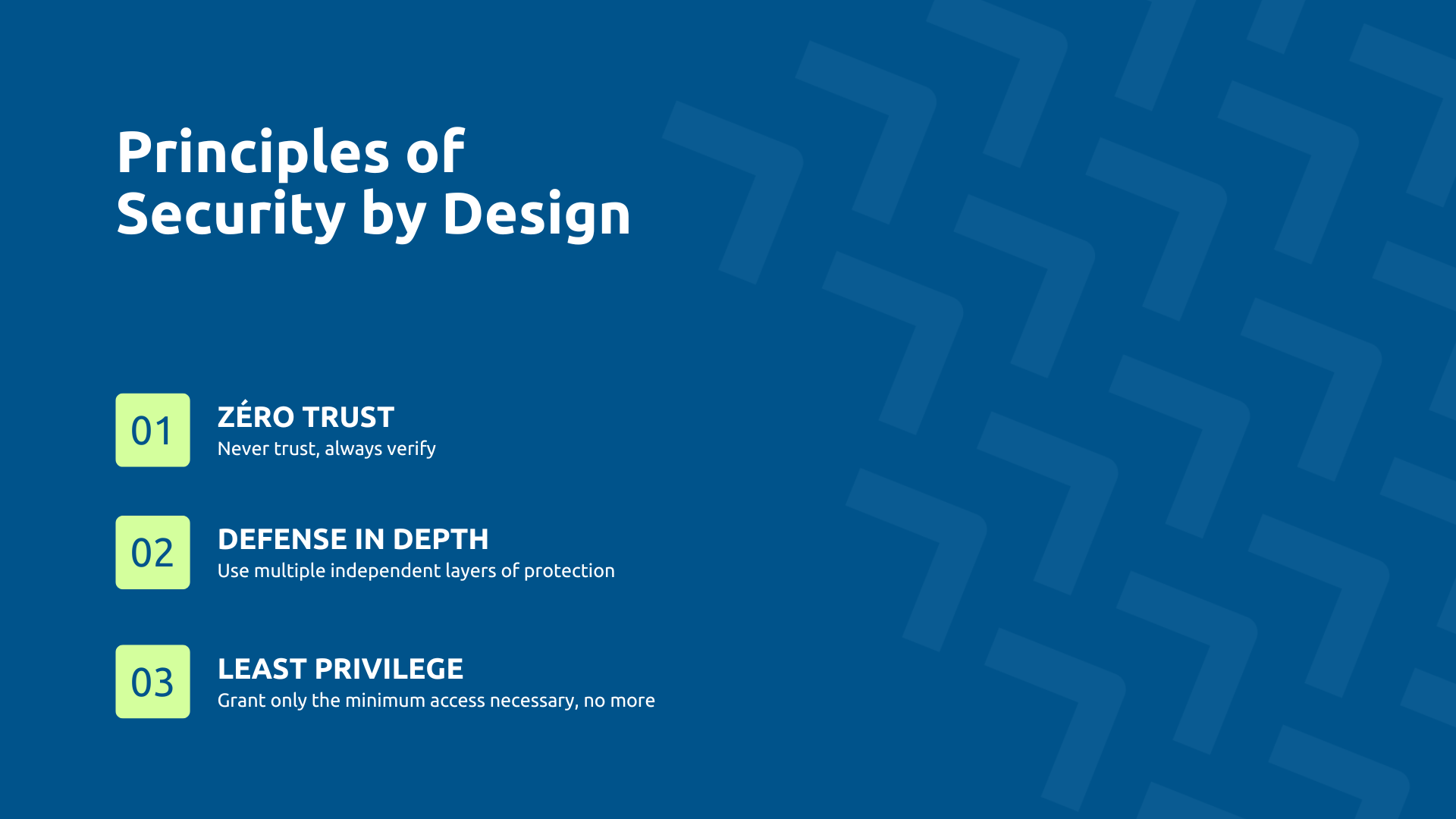
The model Zero Trust is the foundation of Security by Design in modern architectures. Its principle is as follows: no trust granted in principle to any user, device, or application, inside or outside the corporate network. Thus, each access is verified explicitly, based on identity, context, device and risk level.
This is the opposite of the classic perimeter model (the “castle”) in which everything inside is considered safe by default. This model is now obsolete in a world of work where employees work from anywhere, where applications are hosted in the cloud, and where attacks massively exploit compromised legitimate access.
In the Microsoft ecosystem, Microsoft Entra ID And the Conditional Access, before granting access to a resource, the system verifies the identity of the user, the compliance status of his device, his location and his risk level calculated in real time.
Defense in Depth (defense in depth), by definition, never relies on a single line of defense. If one layer is bypassed, the next ones take over. The aim is to make the compromise gradual and detectable, rather than directly exposing critical assets.
The different layers cover the entire spectrum:
In a well-designed Azure architecture, this means, for example, Azure Front Door with WAF as input, Network Security Groups to segment the network, Azure Firewall for traffic control, Microsoft Entra ID for the identity layer, systematic encryption of data at rest and in transit, and Microsoft Sentinel for real-time threat detection.
Defense in Depth means architecture complementary and coherent layers, where each level has a specific and non-redundant role. It is this coherence, built from the design stage, that makes the difference between a true security posture and an accumulation of disparate solutions.
The principle of Least Privilege (least privilege) states that each user, each application, each service must have only the permissions that are strictly necessary for the exercise of its function and nothing more.
This is one of the most effective ways to limit the impact of a compromise. The Verizon Data Breach Investigations Report confirms that a significant portion of breaches involve compromised credentials or poorly managed privileges. For example, it may be an external consultant who maintains administrative access 6 months after the end of his mission.
In the Microsoft ecosystem, the RBAC Azure (Role-Based Access Control) allows granular roles to be assigned instead of global rights. As for PIM (Privileged Identity Management), it allows privileges to be temporarily elevated with justification, approval and complete traceability. Managed Identities eliminate the need to store credentials hard in code.
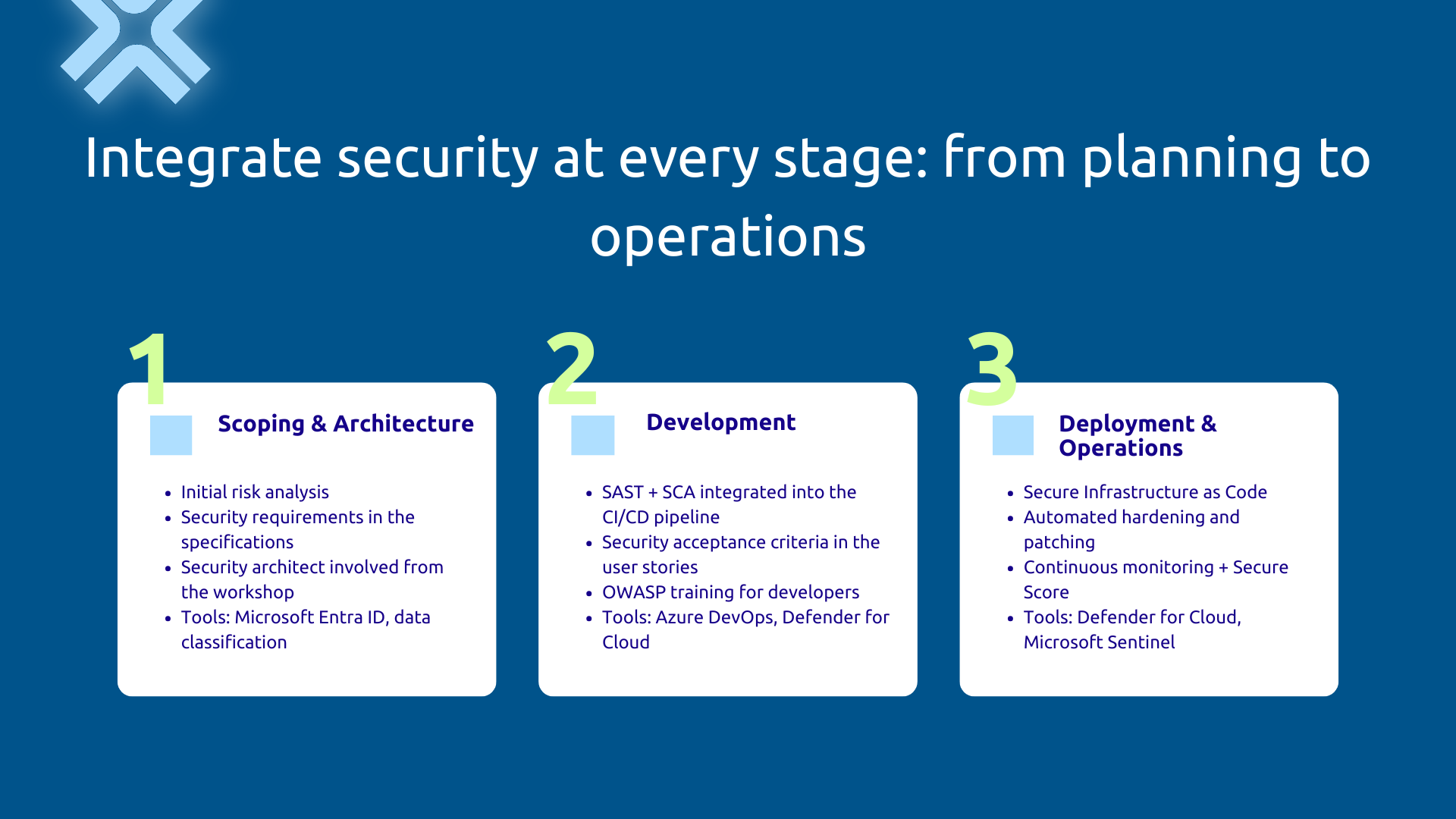
Safety must be taken into account from the first framing workshop. Not at the end, not during the recipe: as soon as the first architectural decisions are made.
Concretely, this means identifying, as soon as the needs are analyzed, what sensitive data the system will handle, what regulatory requirements apply (RGPD, NIS2, sector standards), and what are the critical assets to be protected as a priority. These elements feed a initial risk analysis that guides architectural choices, long before the first line of code.
As part of a technical specifications, security constraints should be included as non-negotiable requirements in the same way as functional requirements. A security architect must be involved in design workshops from this phase. The choices made (authentication mechanisms, data classification, data classification, network topology, encryption strategy) are documented and justified in the architecture document.
If safety is not discussed during the framing, it will be systematically postponed.
The Shift Left Security is to move security tests and checks as early in the development cycle as possible. The aim is to detect vulnerabilities where they cost the least to fix, that is, during development.
This approach is embodied in the DevSecOps : security is becoming a shared, automated responsibility in CI/CD pipelines, and no longer the exclusive business of a dedicated team working at the end of the chain. In Azure DevOps, a well-configured pipeline integrates automatic security scans via Microsoft Defender for Cloud, static code analysis (SAST), and third-party dependency checking (SCA). If a critical vulnerability is detected, the build fails and the issue is addressed immediately.
To complete the device, you must train developers in the practices of Secure coding OWASP Top 10, secure secret management, entry validation. As part of agile methods, integrate Security Acceptance Criteria in each user story is a practice that can be directly applied, without increasing the pace of sprints.
Security by Design does not end with production. It is extended by a adapting to new threats and to changes in the system.
Infrastructure deployment must be based on Infrastructure as Code templates that integrate security configurations from the start. The Hardening Of the systems (deactivating unnecessary services, automated patching, tightening configurations) is a systematic step, not optional.
Microsoft Defender for Cloud provides a Secure Score of your Azure infrastructure, with actionable recommendations ranked by criticality. This score is not a photo: it is a living indicator that evolves as the infrastructure changes. Microsoft Defender and Sentinel ensure the detection of threats in real time and the correlation of security events across the environment.
Regular penetration testing (in compliance with Microsoft policies), structured management of discovered vulnerabilities, and continuous posture improvement complete this cycle. La IT compliance is not a state that you reach once: it is a permanent mode of exploitation.
The Microsoft ecosystem was designed with native security capabilities, but that power doesn't require an intentional architecture. You need to know how to activate, configure, and orchestrate these capabilities to create consistent protection that's tailored to your specific challenges, not just the default settings.
Do you want to move from a reactive approach to a secure design by design? Contact Askware for a framing workshop and turn security into an accelerator for your projects.
Both share the same philosophy but differ in scope. Privacy by Design focuses on the protection of personal data. Security by Design is broader: availability, integrity, confidentiality, traceability. In practice, the two approaches are complementary and must be carried out jointly as soon as a project is framed.
Security should not happen at the end of a sprint like an external audit, but should be embedded in the team's rhythm: Security Acceptance Criteria in user stories, automated scans in the CI/CD pipeline, continuous developer awareness. Security by Design avoids catch-up sprints at the end of the project, which are the real obstacle to time-to-market.
In design, a flaw is corrected by a different choice of architecture. In production, the same flaw involves a partial redesign, complete non-regression tests, coordinated production, sometimes crisis communication. Each step taken between design and production multiplies the complexity (and therefore the cost) of the correction.
Our experts share their vision of best practices and technological trends to ensure the success of your digital transformation.