ISO 27001: The security guarantee of the Microsoft ecosystem
Learn how Microsoft's ISO 27001 certification ensures the security of your Dynamics 365, Power Platform, and Azure projects. Complete guide.

The Private Equity and Family Offices orchestrate relationship networks of a density few organizations experience: institutional Limited Partners, HNWI (High Net Worth Individuals), co-investors, advisors, whose interactions span cycles of ten years or more. Managing this complexity with Excel, individual inboxes, and disparate tools creates operational blind spots that even the most rigorous structures cannot afford.
In this article, we examine why CRM generalists fail in PE and Family Offices, the truly essential features, and how Dynamics 365 can become the central nervous system of your fund or wealth management structure.

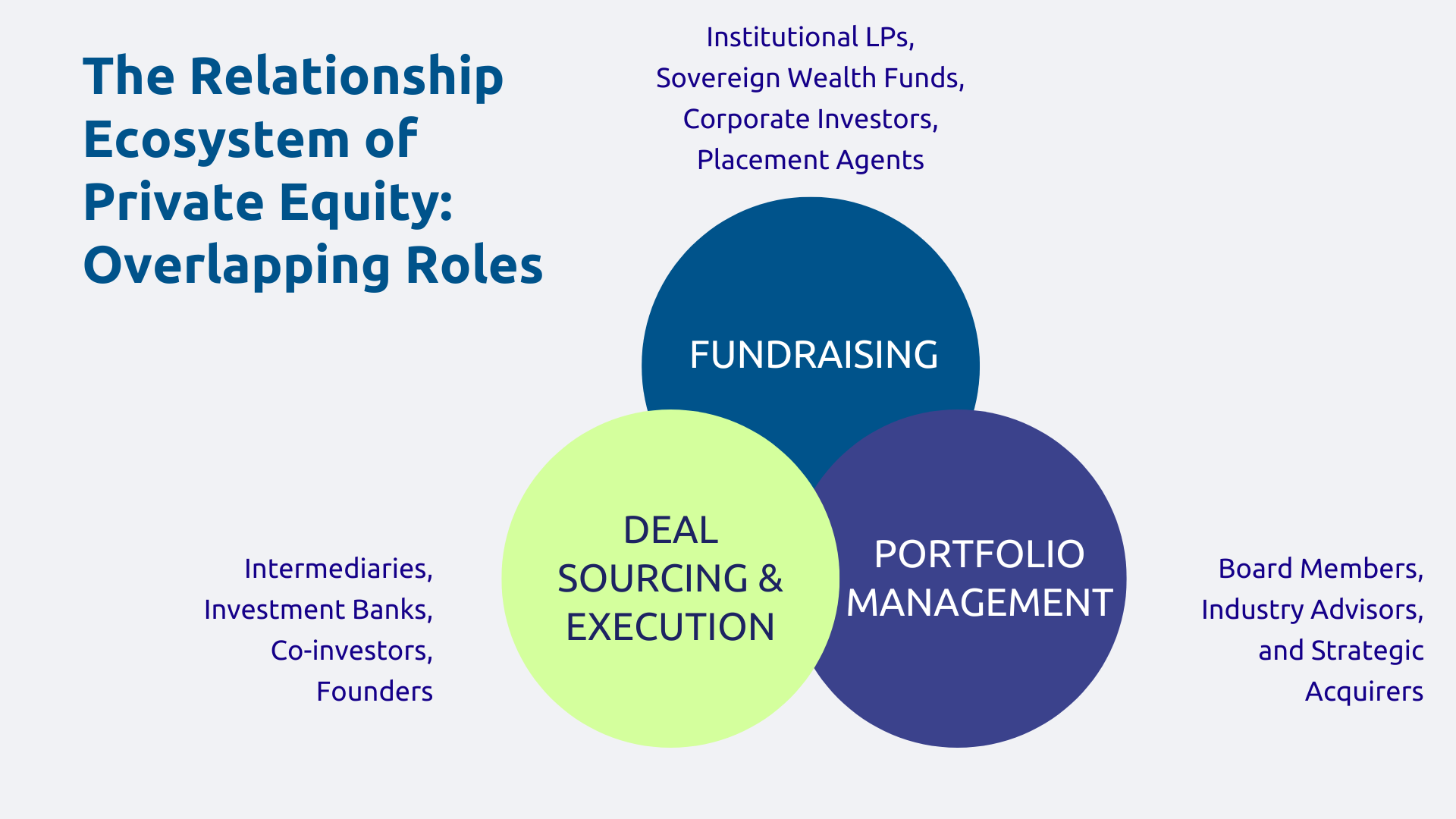
An active mid-market PE fund can simultaneously manage several hundred active contacts, spread across overlapping and intertwining layers:
What further complicates management is the fact that a single contact often wears multiple hats. For example, a family office might be an LP in your fund, a co-investor on a specific deal, and a source of deal flow in a sector where it has expertise. All your relationship intelligence must reflect all these dimensions simultaneously.
Confidentiality adds an additional constraint. Indeed, the identities of LPs, the details of ongoing transactions, and portfolio valuations are all information whose uncontrolled exposure can have serious regulatory and reputational consequences.
Relationship management in Private Equity revolves around structuring business processes that must be tracked and managed end-to-end.
The deal flow management covers sourcing, initial screening, scoring based on investment criteria, Investment Committee approval, due diligence coordination, and closing.
As for fundraising (fundraising), it involves tracking roadshows, managing soft commitments, and adhering to closing dates.
Another essential step is syndication, which involves quickly identifying relevant co-investors based on a deal's profile, managing data rooms, and coordinating follow-on rights.
Next comes portfolio monitoring : tracking operational and financial KPIs of portfolio companies, preparing board meetings, managing value creation plans, and exit planning.
Finally, regulatory reporting mandates producing quarterly and annual reports for LPs, with metrics such as IRR (Internal Rate of Return), TVPI (Total Value to Paid-In Capital), or DPI (Distributed to Paid-In Capital) compliant with the requirements of the AIFMD (Alternative Investment Fund Managers Directive).
These processes are completely interdependent; meaning that when a new deal arises, the Managing Partner needs to know instantly who in their network knows this sector, which LPs have expressed interest in this type of asset, and which co-investors have the appetite and capacity to participate.
Clearly, all of this is only possible if all data resides in a single system.
Salesforce, HubSpot, and their equivalents were designed for relatively standardized B2B or B2C sales cycles: lead, opportunity, closed deal. Suffice it to say, this model is fundamentally unsuited for PE.
The data structures don't match. A traditional CRM cannot natively model a Limited Partnership, a distribution waterfall, preferred rights, or carried interest. One must either settle for approximations or undertake costly developments that compromise maintainability.
The reporting is insufficient. Generating the regulatory metrics expected by LPs from a CRM designed to track sales pipelines is a makeshift solution.
The Excel alternative is well-known in funds because it offers significant flexibility for financial models. However, it doesn't scale because it allows neither interaction traceability nor real-time collaboration on a deal shared among multiple deal team members. Not to mention that manual reporting is tedious and error-prone, and this solution provides no consolidated view across deal flow, LPs, and the portfolio.
Hence the need for a middle-ground solution between the rigidity of a generalist CRM and the informality of Excel. A question also raised by the choice between ERP and CRM depending on the business needs of the structure
A PE CRM must offer a fully customizable pipeline whose stages reflect the actual investment cycle, namely:
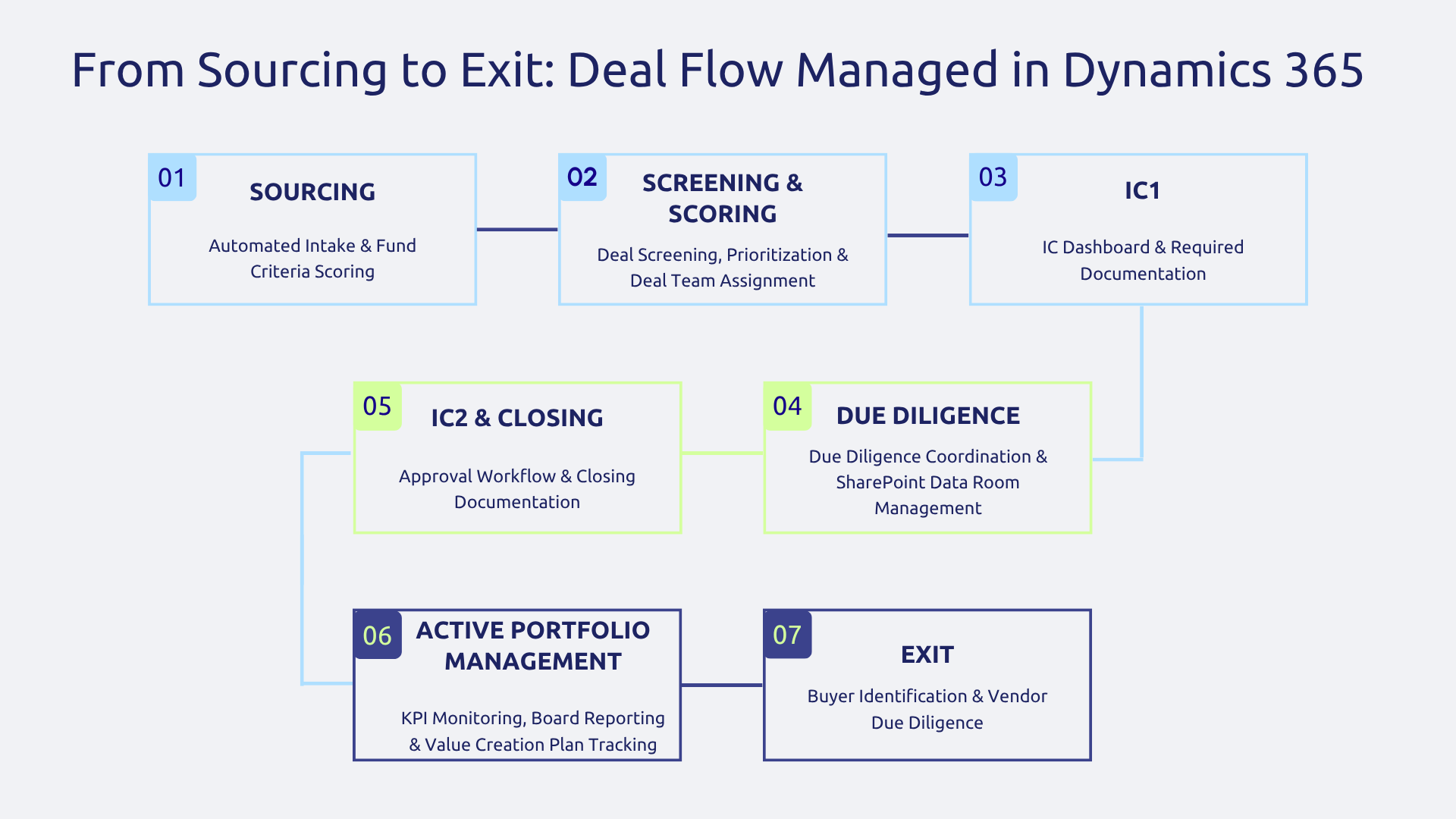
Each stage has its own passing criteria, required documents, and responsible parties.
The automated scoring enables rapid sorting of a significant inbound pipeline based on the fund's investment criteria: sector, geography, ticket size, EBITDA multiple, and strategic fit. For example, an active fund can receive several hundred deals per year through sourcing; without structured filtering, the best opportunities risk getting lost in the noise.
Complete traceability is essential. All interactions (emails, calls, meetings) related to a deal must be accessible in a centralized log, viewable by the entire deal team, with granular access rights.
We round out the system with smart alerts that notify, for instance, that a deal has stalled, that a follow-up is due, or that a new deal shows similarities with a deal already in the portfolio.
In a competitive market where multiple investors can simultaneously analyze the same opportunity, the speed of analysis and decision-making is often a significant competitive advantage. This is why a system that structures and accelerates this process creates immediate operational value.
The LP database must go far beyond contact details to establish targeted communication and a long-term relationship. It is therefore essential to record the following data for each investor:
Another particularly differentiating use is the syndication workflow. When a deal progresses to due diligence, the CRM should allow for filtering active co-investors in that sector within seconds, displaying their estimated capital availability, generating personalized teasers, and tracking expressions of interest. For the most competitive opportunities, the ability to quickly mobilize syndication partners can be a decisive competitive advantage.
Beyond syndication, automated reporting (capital call notices, distribution notices, quarterly reports) significantly reduces the administrative burden and limits the risk of errors in documents with high contractual and regulatory value.
Each active investment should have a consolidated record:
It is worth noting that the operational monitoring integrates business KPIs (revenue, EBITDA, cash) and operational KPIs (headcount, clients, growth), regularly updated by the portfolio company's teams or imported from their reporting systems.
It is therefore clear that the link with relational intelligence is crucial here. For a portfolio company facing operational difficulties, the CRM must indeed allow for identifying relevant sector advisors within the network, LPs with useful expertise, or potential strategic buyers in case of an early exit.
This intersection of portfolio management and networking is something specialized tools typically can't manage.
Dynamics 365's main advantage in this context is its architecture. Dataverse, the underlying data layer, allows for the creation of fully customized business entities: Deals, Funds, Limited Partners, Portfolio Companies, Co-Investors, complete with relationships and fields specific to each structure.
Power Apps enables the design of tailored interfaces for each process: deal screening forms, IC dashboards, and portfolio tracking interfaces.
Next, Power Automate automates recurring workflows: pre-IC alerts, automatic LP report distribution, and due diligence task reminders.
Finally, Power BI generates the analytical dashboards essential for strategic management: fund performance, pipeline analytics, and portfolio overview.
In our experience, Dynamics 365 offers a level of flexibility that allows for addressing these specific needs with a limited amount of custom development.. In many projects we support, this type of adaptation primarily involves configuration rather than custom development.
It's a tool that supports organizations managing tens of millions of euros in assets, as well as much larger multi-fund organizations.
PE and Family Office data are among the most sensitive in the corporate world. Therefore, the platform's security posture is non-negotiable.
Microsoft Azure, which Dynamics 365 relies on, holds certifications ISO 27001 and SOC 2, with support for common financial sector compliance requirements (GDPR, DORA, AIFMD, depending on use cases and chosen configurations).
Data is encrypted in transit (TLS 1.2 or higher depending on services) and at rest (AES-256). Access management is based on a granular RBAC via Microsoft Entra ID, with multi-factor authentication and Conditional Access. Furthermore, all access and modifications are logged by the audit trail.
Specific business functionalities complete the system: fields marked "confidential" accessible only to senior partners, deals in stealth mode invisible outside the deal team, strict segmentation between different funds within the same structure. Data geolocation in Europe contributes to GDPR compliance and facilitates the management of applicable regulatory requirements.
A fund doesn't abandon its existing tools overnight. The value of Dynamics 365 lies partly in its ability to become the hub that orchestrates what already exists.
Thus, emails and meetings processed in Outlook and Teams are automatically captured and linked to the corresponding deals and contacts. Data rooms, for their part, are structured in SharePoint by deal, with versioning and granular permissions.
Excel, which remains the tool of choice for LBO models and valuation analyses, natively interfaces with Dynamics 365 data to enrich or feed the CRM. Finally, Power BI completes the picture by generating IC dashboards and LP reports directly from the CRM.
For the specialized business tools (valuation platforms, due diligence tools, fund accounting), integration is achieved through APIs or Power Platform connectors. Dynamics 365 does not replace these tools; it creates the unified view that reconciles them.
Generic CRMs were not designed for these processes. Excel doesn't hold up at scale. Dynamics 365, configured by teams who truly understand the business challenges of Private Equity and Family Offices, offers a third way: a custom, enterprise-grade system that adapts to your processes rather than the other way around.
Askware supports Private Equity funds and Family Offices in the design and deployment of their Dynamics 365 CRM, from needs assessment to go-live. If you wish to transform the management of your relationships and operations, contact our experts.
There's no such thing as a "universal" PE CRM that's ready to use out-of-the-box. What sets a good solution apart is its ability to be configured according to the fund's actual processes: its investment cycle, its LP reporting structure, and its syndication practices. Dynamics 365 stands out in this context because it is flexible enough to adapt to these specific needs without requiring extensive development.
Effective deal flow management relies on three key elements: a structured pipeline with stages that correspond to the fund's actual investment cycle, rapid scoring to prioritize incoming deals, and complete traceability of interactions to never lose track of an opportunity. Without a centralized system, these three elements inevitably end up in disparate Excel files and individual inboxes.
A traditional CRM is optimized for short sales cycles and relatively linear relationships. In Private Equity (PE), cycles last for years, contacts hold multiple roles simultaneously, and the data to manage (valuations, capital structures, regulatory reporting) has nothing to do with a sales pipeline. The difference isn't just a matter of features: it's a fundamentally different data model and business logic.
Our experts share their vision of best practices and technological trends to ensure the success of your digital transformation.