Modular architecture: the lever of an agile and sustainable IS
Discover modular architecture: principles, benefits and methods for transforming your IS into an agile and sustainable system. Expert guide.

The transition to the cloud is now active in the vast majority of organizations. But between migrating to Azure and actually architecting its transformation for the cloud, there is a difference that many CIOs discover at their expense, often after the first major incident or the first uncontrolled bill.
The real question is no longer “should we go to the cloud?” but “how do you do it intelligently?” One cloud architecture poorly designed isn't just expensive: it limits agility, exposes the business to security risks, and ends up generating technical debt as heavy as that of the systems it was supposed to replace.
This article gives you the keys to designing a cloud architecture that combines performance, cost control, security, and scalability — based on best practices from the Azure ecosystem.

Cloud architecture refers to the set of components, services, and organizational principles that structure your IT resources in the cloud. It is a system of decisions that determines how your applications work, how your data flows, and how your infrastructure evolves over time.
It is organized around three main layers.
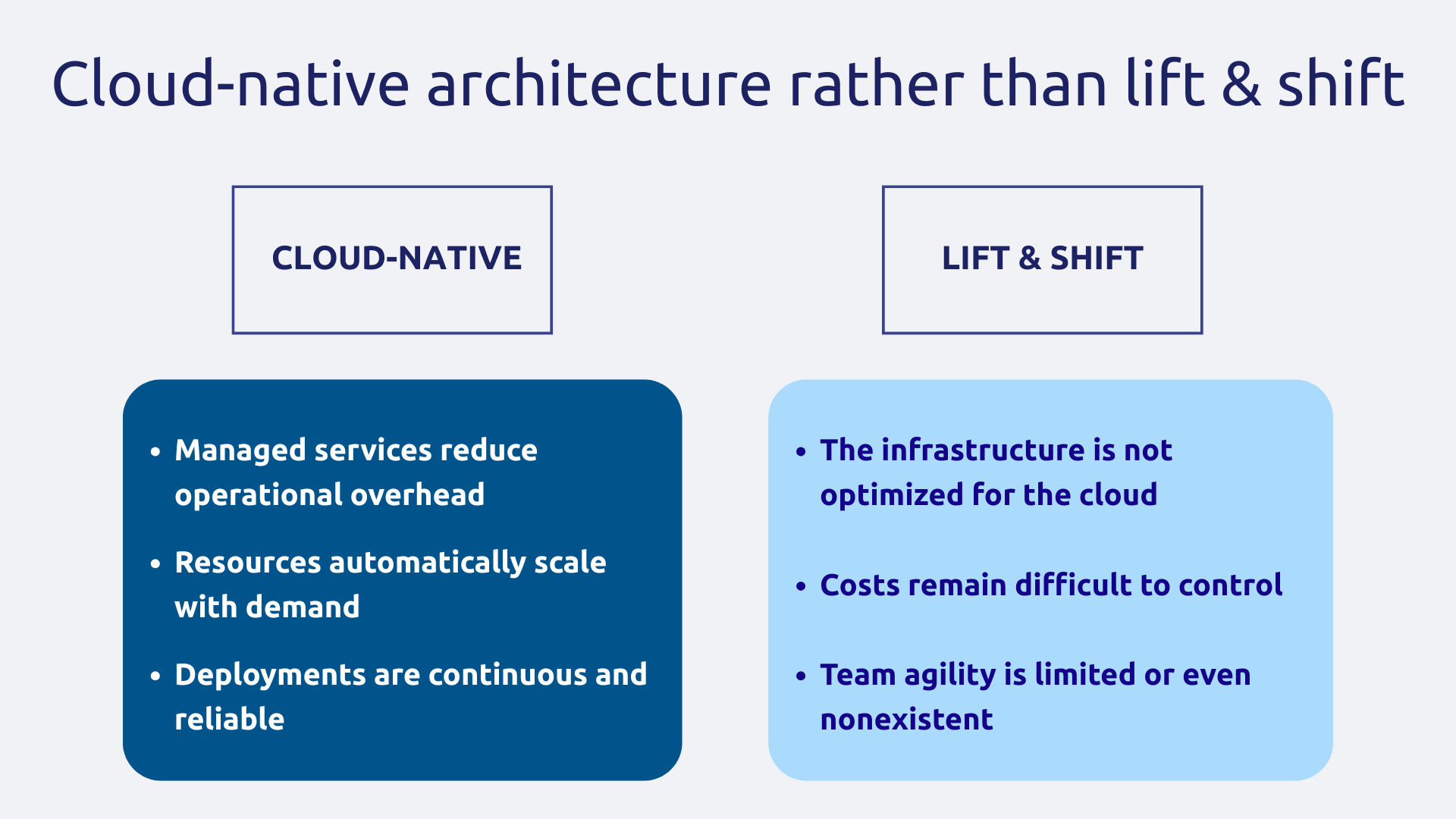
Attention, migrating an application to Azure without rethinking it means doing Lift & Shift That is to say, we move without transforming. Conversely, architecting for the cloud is leverage managed services, native elasticity, and modern patterns to create a system that is truly designed for this environment.
A well-designed cloud architecture directly conditions your Time-to-Market. When your components are decoupled and your deployment pipelines automated, it can drastically reduce production cycles, sometimes from several weeks to a few hours.
It also determines your long-term IT costs. In fact, an architecture that is over-provisioned from the start creates a vicious circle where resources are expensive, teams are hesitant to optimize them for fear of breaking something, and the Azure bill is swelling quarter after quarter. Conversely, an architecture designed for elasticity only pays for what it actually consumes.
Finally, the cloud architecture also conditions your ability to be compliant. Data governance, access traceability, isolation of sensitive environments: these requirements — whether they come from RGPD, of DORA Or of the ISO 27001 standard should be integrated at the design stage, not added after the fact.
Designing a cloud architecture means managing permanent tensions. So, the security must coexist with agility, in other words, it is necessary to open access to business teams without creating breaches, which requires thoughtful architecture choices.
Likewise, the performance must be balanced with costs, because sizing accurately but without under-provisioning remains one of the most delicate exercises in the business.
Finally, standardization should not stifle flexibility : imposing safeguards without hampering innovation is perhaps the most structuring challenge for an IT department.
For example, the most common trade-off today concerns the degree of publisher commitment: a 100% Azure managed architecture simplifies operation but creates dependency. A multi-cloud approach promises independence but multiplies operational complexity and the necessary skills.
Be that as it may, there is no one-size-fits-all solution. Cloud architecture is the art of finding informed compromises, adapted to your business, regulatory and organizational context.
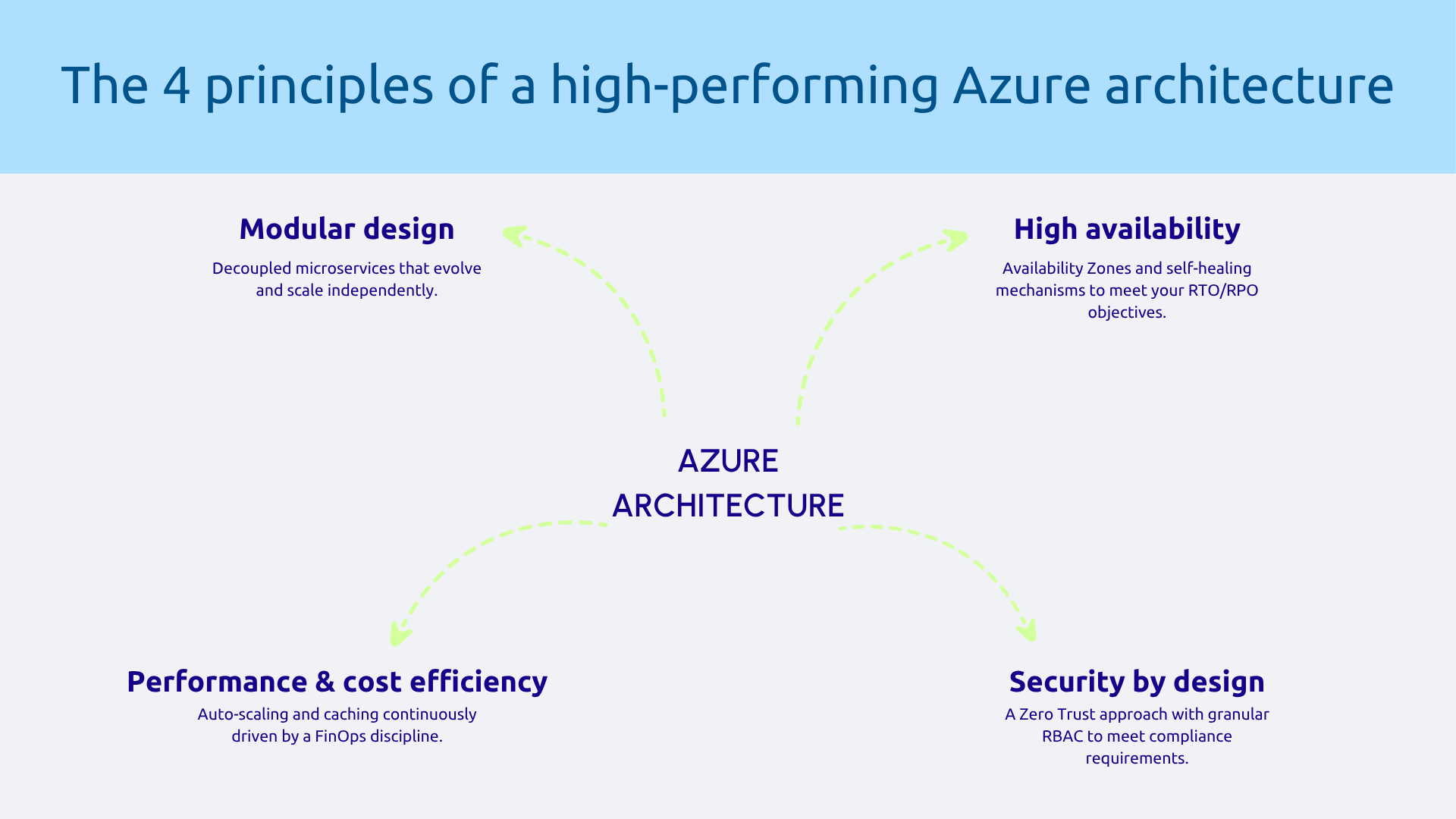
To set up a robust cloud architecture, you should especially not build anything monolith because you would lose the main advantage of modular architecture: a decomposition of your system into independent components that can evolve, scale, and fail without causing the whole thing in their failure.
Inevitably, the more modular your architecture is, the more agile you gain in order to make each component evolve without affecting the rest of the system.
In the Azure ecosystem, this is concretely reflected in the combined use of:
Each brick can evolve independently and that's exactly what the Modernization of the IS towards a unified Microsoft ecosystem aims to achieve.
A common mistake is to design the architecture for the nominal scenario and manage the outage when it occurs. However, as a reminder, resilience is designed from the start, not a posteriori.
Azure offers Availability Zones, that is, physically separated data centers within certain Azure regions, generally three in number depending on the region. These allow you to replicate your resources and automatically switch over in case of failure. In addition, services such as Azure Front Door or Traffic Manager manage the intelligent routing of traffic to the available area, with no visible interruption to the user.
This approach is closely aligned with your cloud backup and resilience strategy: defining recovery goals (RTO/RPO) and ensuring that the architecture actually meets them, with tests to support them.
Performance does not always mean over-provisioning. Indeed, an intelligent architecture uses auto-scaling to adapt its resources to the real load: it increases in power during peaks and automatically falls back down when not active.
The Caching also provides a first-class function: Azure Redis Cache makes it possible to avoid repetitive database calls, Azure CDN brings static content closer to end users. These optimizations have a direct impact on response times and therefore on the bill.
On the operational level, the discipline FinOps (continuous management of cloud costs via Azure Cost Management) is absolutely essential because the observability of expenses, combined with a right to alert on budget overruns, avoids unpleasant surprises at the end of the month.
Integrating security after the fact means agreeing to pay for it twice: once to implement it urgently, and a second time when an incident occurs. To do the opposite by thinking it from the beginning is Safety by design, which makes protection an architectural property rather than an overlay.
In Azure, this results in an approach Zero Trust : no access is granted by default, each request is authenticated and authorized according to the principle of least privilege.
With this in mind, Private Endpoints isolate PaaS services from the public network; Azure Key Vault centralizes secrets and certificates; for its part, Microsoft Entra ID manages identities with granular RBAC and Conditional Access policies.
The selection criteria are as follows: nature and sensitivity of the data, sectoral regulatory obligations, existence of an application legacy that is difficult to migrate and the organization's appetite for risk.
Managing an on-premise fleet and an Azure infrastructure separately creates a considerable operational burden: 2 security policies, 2 update processes, 2 monitoring repositories. That's why Azure Arc unifies this management by extending the Azure control plane to your on-premise resources and other clouds.
From the Azure Portal, You Can Apply Policias de compliance to servers located in your data center, deploy managed Azure services outside of Azure (Azure SQL Managed Instance, App Services) and consolidate monitoring in Azure Monitor.
In theory, the multi-cloud strategy is attractive: we avoid publisher dependency, we optimize workload costs by workload, we take advantage of the best of each platform. However, in practice, it generates operational complexity that often experiences the expected benefits: skills are fragmented, security processes heterogeneous, and integration costs are high.
Multi-cloud can be suitable for large businesses, or when there are specific regulatory constraints and technical needs. However, in many cases, multi-cloud is more the result of historical pile-up than of a real strategic decision.
In a controlled ecosystem such as Azure, focusing on operational excellence generally brings more value than dispersing across several platforms managed unequally.
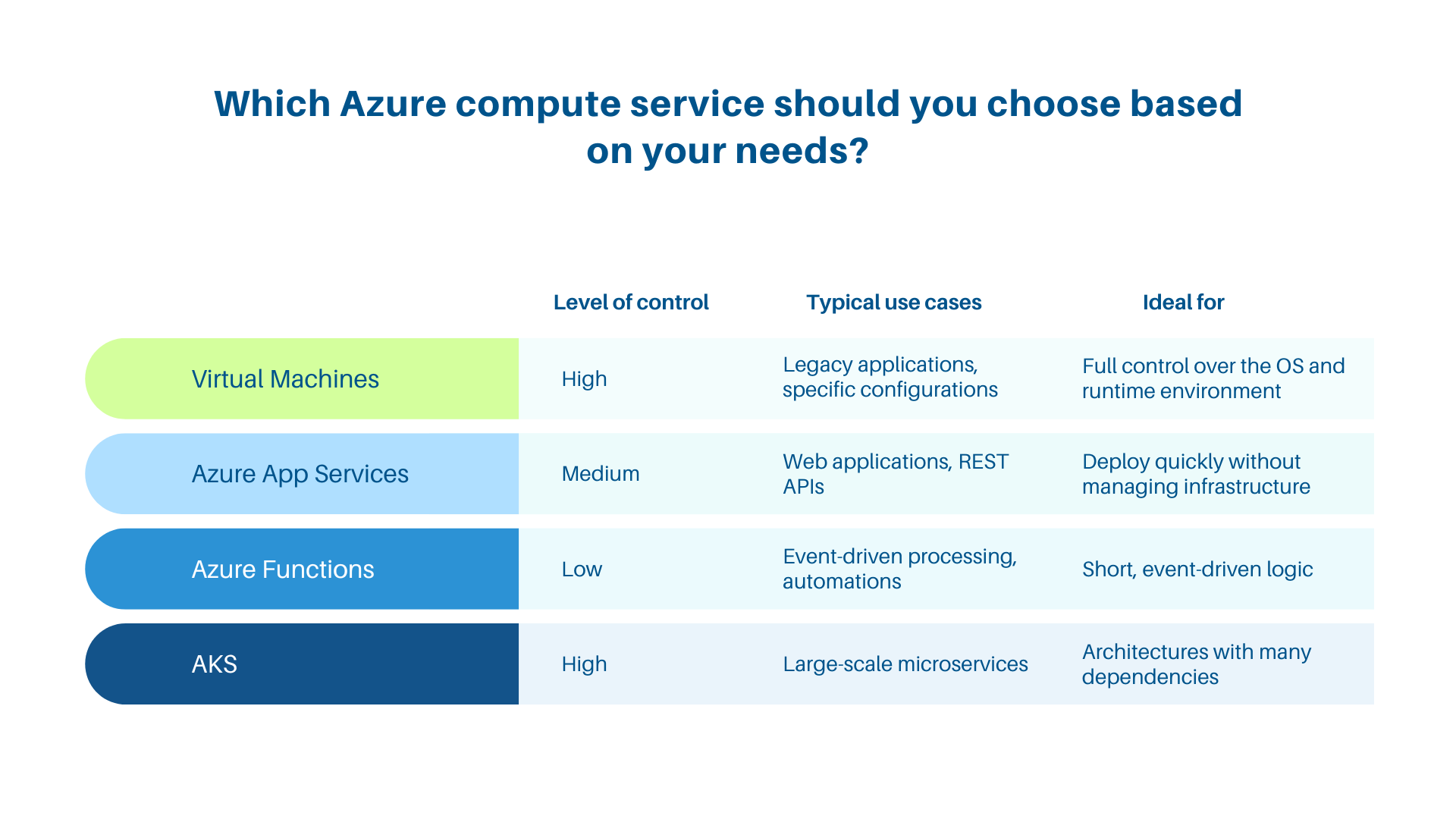
Azure offers a broad spectrum of computing services, each positioned on a different control/simplicity axis. First of all, the Virtual Machines offer maximum flexibility but require comprehensive management.
In contrast, Azure App Services manages the infrastructure For you, making it the natural choice for web applications without the need for fine configuration. For event logic, Azure Functions takes a serverless approach with run-time billing in the Consumption plan or models adapted according to the chosen plan.
Finally, when your microservices architectures reach a certain scale, Azure Kubernetes Service (AKS) takes over to orchestrate your containers with the required granularity.
As you can see, the right compute service depends on your desired level of control and your operational capacity to manage complexity. Serverless architecture, for example, if properly sized from the start, can transform your scalability and cost model.
The data layer is the core of your architecture: it's where your analytics capabilities, compliance, and ability to harness AI depend on it.
Azure SQL Database covers the vast majority of transactional cases and is often the natural starting point for structured business applications. When your needs involve more flexible schemas or global distribution, Cosmos DB takes over as a multi-model NoSQL database designed precisely for these constraints. For the massive volumes generated by your analytics and data science workloads, Azure Data Lake Storage Gen2 offers the cost-effective and scalable storage that complements this data architecture.
Note that The integration with Dynamics 365 and Power Platform is native : your CRM and ERP data can directly feed into a Data Lake, then be exposed via Power BI for decision management. This data architecture combining Dataverse, Azure Synapse and Power BI constitutes a scalable and secure foundation for valuing all of your information assets.
Finally, data governance is based on Microsoft Purview, which automatically discovers, classifies, and catalogs your data assets across the entire ecosystem.
Virtual Networks (VNets) constitutes the first layer of isolation of your environments, by segmenting traffic between your various application perimeters.
For connections with your on-premise infrastructure, ExpressRoute establishes a private and dedicated connection, independent of the public Internet, via a partner connectivity provider — an often unavoidable obstacle for sensitive data.
As for Private Endpoints, they ensure that your PaaS services remain inaccessible from the public network, regardless of their default configuration.
For multi-environment architectures (production, preproduction, development), the model Hub-and-Spoke Is a solution of choice: a central VNet carries shared services (security, DNS, monitoring), satellite VNets hosts each environment in an isolated and interconnected manner in a controlled manner.
Governance allows you to innovate with confidence, without the risk of drifting into shadow IT or losing control of your cloud assets.
Azure Policy automates compliance by precisely defining what can and cannot be deployed: authorized region, mandatory tags, prohibited public exposure. Depending on the desired level of control, two modes are available — Audit to detect and report violations without blocking, Deny To prevent them directly at the time of deployment.
Management Groups structures the whole by organizing your subscriptions in a hierarchical manner, with automatic inheritance of policies at each level.
Operational security, for its part, is based on two complementary bricks:
Azure Cost Management Close the loop by managing expenses with budget alerts and continuous optimization recommendations, an essential FinOps practice for controlling your infrastructure over time.
Building a successful and sustainable cloud architecture requires much more than choosing the right Azure services. This requires a strategic vision capable of aligning technical constraints and business objectives, expertise in design principles that avoid traditional pitfalls, and an ability to maintain governance over time. Azure offers a remarkably complete platform, as long as you know how to orchestrate it methodically.
Askware Helps you design and deploy Microsoft cloud architectures that create sustainable value: from initial diagnosis to production, through governance and continuous optimization. Let's discuss your cloud architecture project.
These are three levels of delegation to the cloud publisher. With IaaS, you manage virtual machines and everything that runs on them. PaaS relieves you of infrastructure management so you can focus on your applications. SaaS, like Dynamics 365, gives you access to a turnkey application. The higher up the stack, the less you manage, and the more you can focus on business value rather than technical considerations.
It all depends on your applications and your level of technical debt. The Lift & Shift (moving servers as they are) is often the least risky starting point in the short term, but it doesn't take advantage of the cloud. A secure migration starts with an audit of your application assets, a prioritization of the workloads to be migrated, and a strategy in successive waves with validation at each stage. Wanting to migrate everything at once is rarely the right approach.
Yes, but it doesn't happen by itself. Cloud costs derive when no one is actively managing them. In this respect, the FinOps practice is a complete game changer. Indeed, mechanisms such as auto-scaling, Reserved Instances or the policy of Rightsizing can generate significant savings, with some options allowing significant reductions depending on usage and the level of commitment. The main thing is not to wait for the first unpleasant surprise to worry about it.
Our experts share their vision of best practices and technological trends to ensure the success of your digital transformation.