Data architecture: designing a scalable and secure foundation for your data
Discover the principles of a modern and scalable data architecture. Askware guides you on Azure to structure, secure and value your data.

Migrating to the cloud without transforming your applications is moving the problem, not solving it. Delivery times remain long, scaler is still just as expensive and a failure continues to impact the entire IS at once.
This is where the architecture Cloud-native come into play. In this article, we will demystify what it really is, what it actually changes for your agility and costs, what Azure technologies make it possible and how to approach the transition pragmatically.

The term “cloud-native” is defined by the Cloud Native Computing Foundation (CNCF) like a approach that allows organizations to build and run applications designed to take full advantage of the cloud, based on containerized, orchestrated and decoupled architectures. What radically sets it apart from a traditional migration is that a cloud-native application isn't just moved to the cloud: it's designed for it.
The difference between cloud-enabled and cloud-native is often summed up by the expression Lift & Shift vs Rearchitect. Migrating a monolith to Azure without transforming it is like bringing an old diesel-powered car into a garage equipped for electric vehicles: the environment has changed, but the constraints remain the same.
A cloud-native application is built like a resilient distributed system, composed of small independent services that communicate with each other, adapt automatically to the load and pick up on their own after a failure.
These five pillars are interdependent. To remove them one from the other is to weaken the whole.
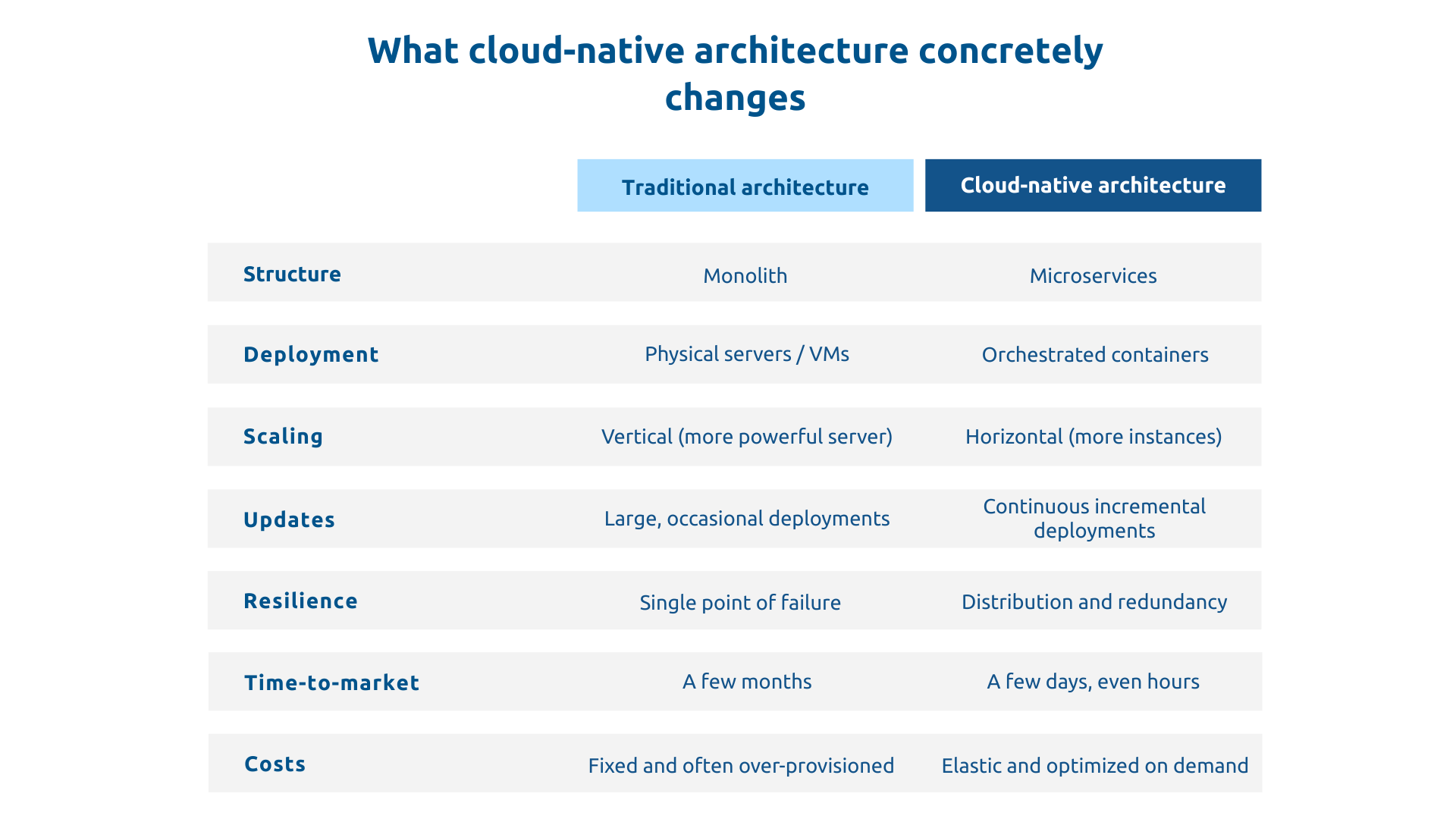
Cloud-native reverses the usual compromises: where traditional architecture forces you to choose between agility and stability, between performance and controlled cost, cloud-native seeks to obtain both simultaneously.
In a monolithic architecture, deploying a new feature involves redeploying the entire application, with the cycles of testing, validation, and coordination that go with it. In cloud-native architecture, each microservice deploys independently. The team in charge of the order module can deliver without waiting for the catalog team to finish its developments.
Coupled with an automated CI/CD pipeline, this model can significantly reduce release cycles, with some organizations going from several weeks to a few hours. IT then ceases to be a brake on innovation to become a real accelerator, in direct connection with agile methods that structure IT transformation.
Take an e-commerce site that is sized to absorb peak sales. In traditional architecture, you provision the infrastructure at the peak level and pay for this oversizing all year round, even during off-peak periods. Cloud-native technology reverses this logic: horizontal auto-scaling automatically adapts the number of instances according to the actual load, to the granularity of the microservice.
In concrete terms, this means that you only scale the payment service during a period of high traffic, without touching the rest of the application. Infrastructure costs tend towards a more variable model that is aligned with use, subject to appropriate FinOps management.
Imagine a cloud-native application for a delivery service: the package tracking module breaks down. In cloud-native architecture, the rest of the application (catalog consultation, order placement, account management) continues to function normally. In a monolith, the failure of one component can paralyze the whole.
That's what we call the fault isolation. Kubernetes adds an extra layer of protection by automatically restarting failed containers without human intervention. Deployments can also be done in Zero-Downtime thanks to blue/green or canary strategies, which make it possible to gradually switch traffic to the new version.
This architectural resilience has a direct impact on your SLAs and on the trust of your users.
One of the least visible, but most strategic, benefits of cloud-native is that it reduces the cost of failure. When testing a new feature does not require deploying the entire application, when a rollback is done in a few seconds and when a Feature Flag allows the novelty to be exposed to only a fraction of users (for example 5%), the teams dare to experiment more.
This culture of Test & learn also facilitates the integration of new technologies such as Generative AI, IoT or real-time processing, which can be connected as additional microservices, without calling into question the entire IS.
Kubernetes has become the De facto standard for container orchestration. Its only drawback: its operational complexity, which can be a real obstacle for teams that do not want to devote dedicated expertise to it full-time.
Azure Kubernetes Service (AKS) solves this problem by offering Kubernetes in a managed version: Microsoft takes care of the control plane, its high availability and some of the security updates, while the management of nodes and workloads remains the responsibility of the customer.
AKS natively integrates auto-scaling, self-healing and load balancing and connects directly with the rest of the Azure ecosystem: Microsoft Entra ID for identity and access management, Azure Monitor for observability, Azure Container Registry for storing Docker images. It is the reference platform for complex microservices architectures on Azure.
Not every application needs the power or complexity of AKS. For APIs, web applications or event-based processes, Azure App Services, and Azure Functions offer a cloud-native alternative without container orchestration.
Azure App Services is a PaaS that supports automatic scaling and high availability without you having to manage the underlying infrastructure. Azure Functions takes logic even further Serverless: you benefit from run-time billing in the Consumption plan, or from a different model depending on the plan chosen, which is particularly suitable for one-off or event-triggered treatments.
Azure Container Apps fills the gap between App Services and AKS: it offers the flexibility of Kubernetes without its configuration complexity, ideal for mid-size microservices architectures. Rather, Azure Service Fabric is aimed at the most complex stateful microservices applications, requiring fine management of distributed state.
Around these execution platforms, Azure offers a set of essential complementary services: Azure API Management to expose and govern your APIs, Azure Service Bus and Event Grid for asynchronous communication between microservices, Azure Cosmos DB for large-scale distributed database needs requiring high scalability. Together, these bricks form a coherent ecosystem, provided they are well orchestrated, which is precisely the object of a Data architecture sturdy.
Cloud-native is only viable if the deployment chain is fully automated. Azure DevOps covers the entire pipeline: planning, source code management, continuous integration, automated testing, deployment. GitHub Actions, now strongly integrated into the Microsoft ecosystem, is a modern and widely used alternative for teams already on GitHub.
Infrastructure as Code (IaC), via Terraform or Bicep (language recommended by Microsoft), as well as the ARM templates traditionally used, ensures that your infrastructure is versioned, reproducible and audited like any application code. Progressive deployment strategies (blue/green, canary, rolling updates) make it possible to update without interruption of service and to automatically go back in the event of an anomaly detected by Azure Monitor or Application Insights.
Perhaps this is the most important point in this article: cloud-native transformation does not affect your entire application portfolio. Some stable legacy applications, with a low frequency of change and whose end of life is planned, have no interest in being redesigned into microservices.
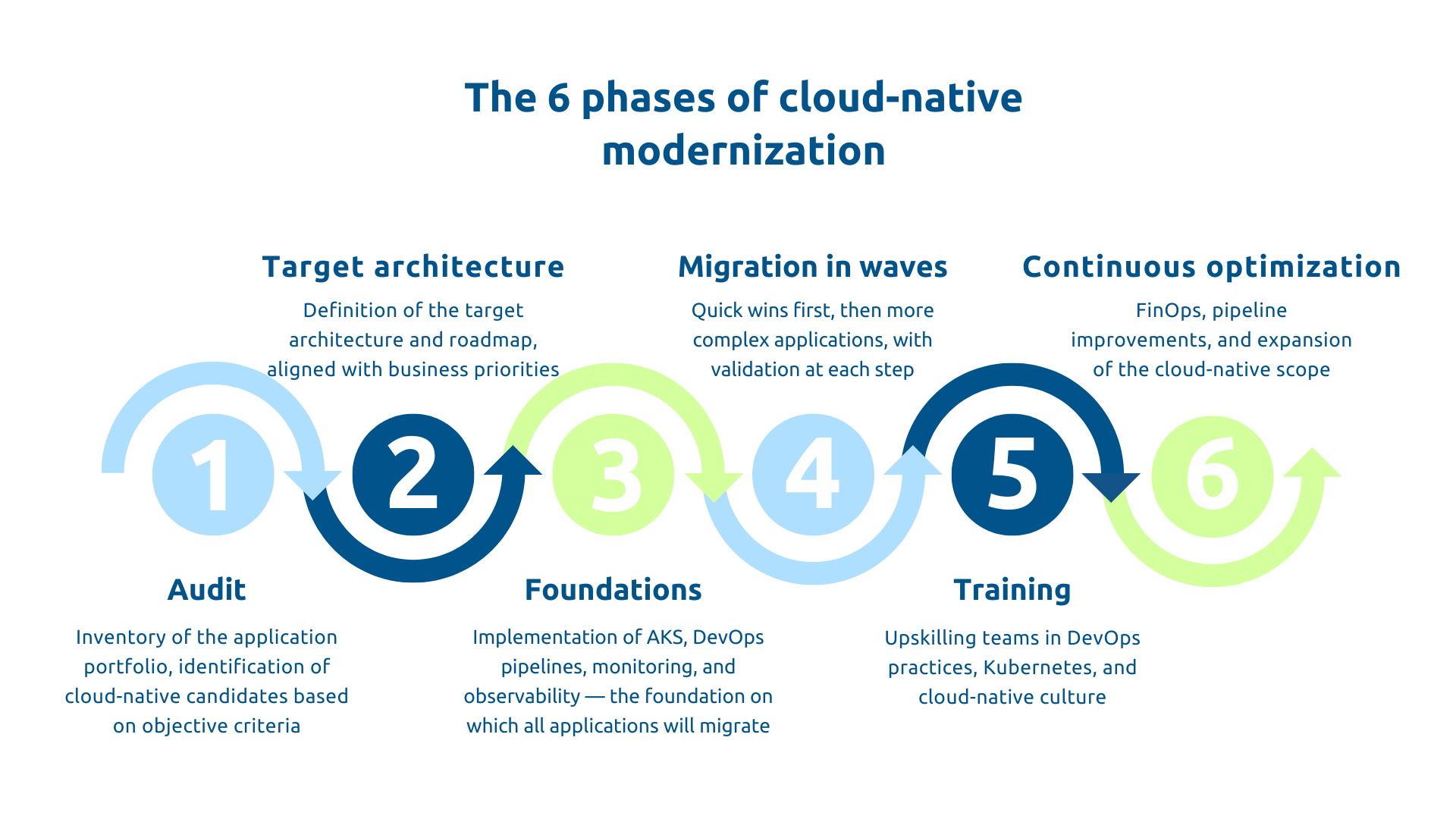
Good candidates share common characteristics: strong expected business development, variable load peaks, new applications without technical debt. The wisdom is to prioritize according to a business value/technical complexity matrix, and not to redo everything on principle.
Several transition strategies coexist, and the choice depends on your context:
The recommended approach is always gradual and iterative, with quick wins identified from the start to demonstrate value and maintain team buy-in.
Cloud-native architecture is not just another buzzword in IT vocabulary. It is an architectural response to the modern imperatives of agility, scalability and resilience if approached pragmatically.
With AKS, App Services, Azure Functions, and Azure DevOps, Microsoft offers a comprehensive range of services to build and operate powerful cloud-native applications. But technology alone is not enough: you need a clear strategy, a gradual approach and an increase in team skills. Not all applications need to be transformed; value is created by choosing the right candidates and moving forward through controlled iterations.
Ready to modernize your applications? Request your audit from our Askware experts to identify your cloud-native candidates and build your roadmap.
A cloud-native application is designed from the start to exploit cloud mechanisms (elasticity, distribution, automated deployment) and not simply hosted on cloud servers. In practice, this is what allows an application to be updated in a few minutes without interruption of service, or to absorb a peak in load by automatically adding instances.
Being “in the cloud” means that your servers are at a remote host but your application remains structured as before. Being cloud-native means having redesigned its architecture to really take advantage of it: independence of components, fine scaling, continuous deployments. The difference is measured in concrete terms of time-to-market and resilience, where a traditional migration does not change them.
Through an audit of the application portfolio to identify which applications really have an interest in evolving: those that change often, that experience peak loads or that are strategic for the business. The technical foundations are then built before migrating in waves, starting with the least risky ones. It's a gradual process, not a big leap.
Our experts share their vision of best practices and technological trends to ensure the success of your digital transformation.